1st Source (SRCE) — Supplier footprint, operational posture, and investment implications
1st Source Corporation operates as the holding company for 1st Source Bank, generating revenue from traditional regional-bank channels: net interest income on loans and securities, fee income from trust and wealth advisory services, and insurance and service fees for retail and commercial clients. With roughly $421 million in trailing revenue and a market capitalization near $1.66 billion, the company’s economics lean on high-margin relationship banking and wealth services, supplemented by SBA-supported commercial lending activity. For investors and operators evaluating SRCE as a supplier partner, the relevant question is not whether the bank sells typical banking products, but how it outsources key valuation and processing functions, relies on programmatic SBA channels for commercial lending, and how those relationships concentrate operational risk. For a fast supplier-risk scan, start at the firm homepage: https://nullexposure.com/.
What 1st Source sells and how it gets paid
1st Source is a regional bank and trust services provider headquartered in South Bend, Indiana. Its monetization rests on three complementary streams: loan interest margins, fee income from trust and wealth advisory services, and ancillary insurance/service fees. The company reports a trailing profit margin of 37.6% and return on equity of 12.7%, signaling efficient core banking operations relative to its regional peers. Market multiples (trailing P/E ~10.6; price-to-book ~1.30) position SRCE as a value-oriented regional financial stock with steady cash returns (dividend yield ~2.3%). For sourcing deeper supplier intelligence about SRCE, see https://nullexposure.com/.
Supplier relationships that matter (what’s on the record)
Below is every supplier or external partner relationship identified in the supplied results, summarized plainly with sourcing.
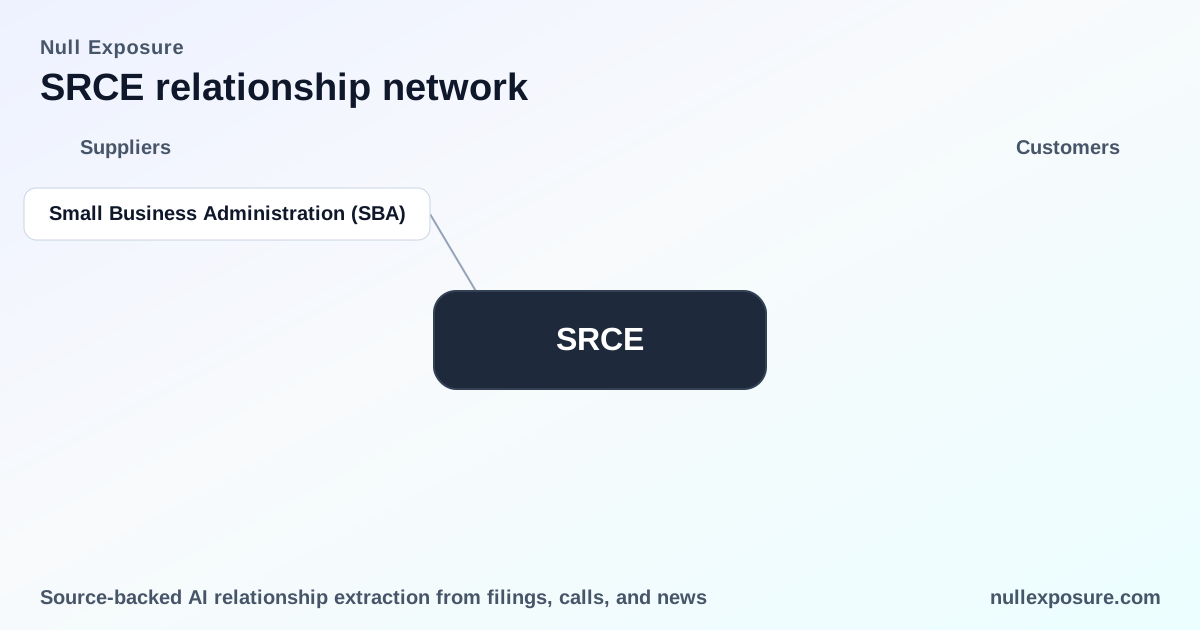
- Small Business Administration (SBA) — 1st Source leverages SBA loan products as a distribution channel for its commercial lending book and has been recognized by the SBA at a high service level for consecutive years, underscoring an active small-business lending program that relies on federal guaranty mechanisms to expand credit access. According to a March 2026 news article on GreatNews.life, 1st Source Bank achieved SBA Gold level recognition for the tenth consecutive year and highlights internal experience in SBA loan products within its business-banking credit team (FY2023 context referenced). Source: https://greatnews.life/article/with-help-from-knowledgeable-bankers-like-lisa-misch-1st-source-bank-achieves-sba-gold-level-recognition-for-the-10th-year-in-a-row/
What the disclosed constraints reveal about SRCE’s operating model
Company disclosures and the supplier evidence combine to paint a clear operational posture for SRCE. The most important constraints for supplier evaluators are:
- Outsourced valuation and processing: 1st Source states that “investment securities available-for-sale are valued primarily by a third‑party pricing agent,” and that it “depends on the services of a variety of third‑party vendors to meet data processing and communication needs” while contracting to run third‑party proprietary software. This indicates an outsourcing-first approach for non-core back-office functions and asset valuation, where external vendors provide critical inputs to financial reporting and trading/treasury support (company disclosure language).
- Service-provider role is material and explicit: The relationship role dimension is classified as service_provider, with multiple supporting excerpts, implying vendor services are embedded into daily operations rather than occasional consultancies.
- Operational criticality and vendor concentration considerations: Because price discovery for investment securities and core data processing are externally sourced, these vendors are operationally critical. The disclosures do not name a sole vendor, so investors should treat vendor concentration risk as an open variable and probe whether single‑vendor dependencies exist in treasury/pricing systems.
- Mature regional-bank operating model: Outsourcing valuation and data processing is consistent with a mature regional bank model that preserves capital and concentrates internal teams on client-facing lending, wealth management, and relationship services.
Together these constraints signal that supplier diligence should prioritize continuity of valuation services, vendor SLAs for data processing, and the bank’s contingency plans for vendor failure or repricing.
How these supplier dynamics translate into investment and counterparty risk
For business users evaluating SRCE as either a supplier or a counterparty, the implications are straightforward:
- Operational risk concentrated in third‑party pricing and data vendors. If a pricing agent or core data vendor experiences disruption, SRCE’s valuation of available-for-sale securities and related regulatory reporting could be affected, creating short-term volatility in reported capital metrics.
- SBA channel increases credit distribution but shifts some credit policy constraints. Active use of SBA loan guarantees expands 1st Source’s commercial reach while transferring partial credit risk to SBA programs, but it also ties parts of origination and servicing to program rules and timelines.
- Supplier diligence should include vendor SLAs, change-control history, and contingency arrangements. Validate contract terms for proprietary software runs, pricing agent fallback procedures, and the bank’s ability to replace or dual-source critical services.
Practical checklist for investors and procurement teams
- Confirm whether SRCE uses a single primary pricing agent or multiple vendors for investment valuations and request details on failover procedures.
- Ask for recent vendor performance metrics on data processing and settlement (uptime, incident history, recovery time objectives).
- Review the bank’s SBA origination volumes and servicing metrics to understand how dependent originations are on program flow and agency timelines.
For a structured supplier-risk evaluation template tailored to regional banks like SRCE, visit https://nullexposure.com/ to get started.
Bottom line and actionable signals
1st Source is a relationship-centric regional bank that expands lending reach through SBA programs and leverages third-party vendors for critical valuation and data services. The business model produces strong margins and respectable returns on equity, but the core counterparty risk for partners and investors lies in outsourced pricing and processing. Prioritize vendor‑level diligence, SLA verification, and SBA program exposure when sizing operational or credit risk.
For a deeper vendor map and tailored due-diligence guidance for SRCE and comparable regional banks, consult the resources at https://nullexposure.com/.