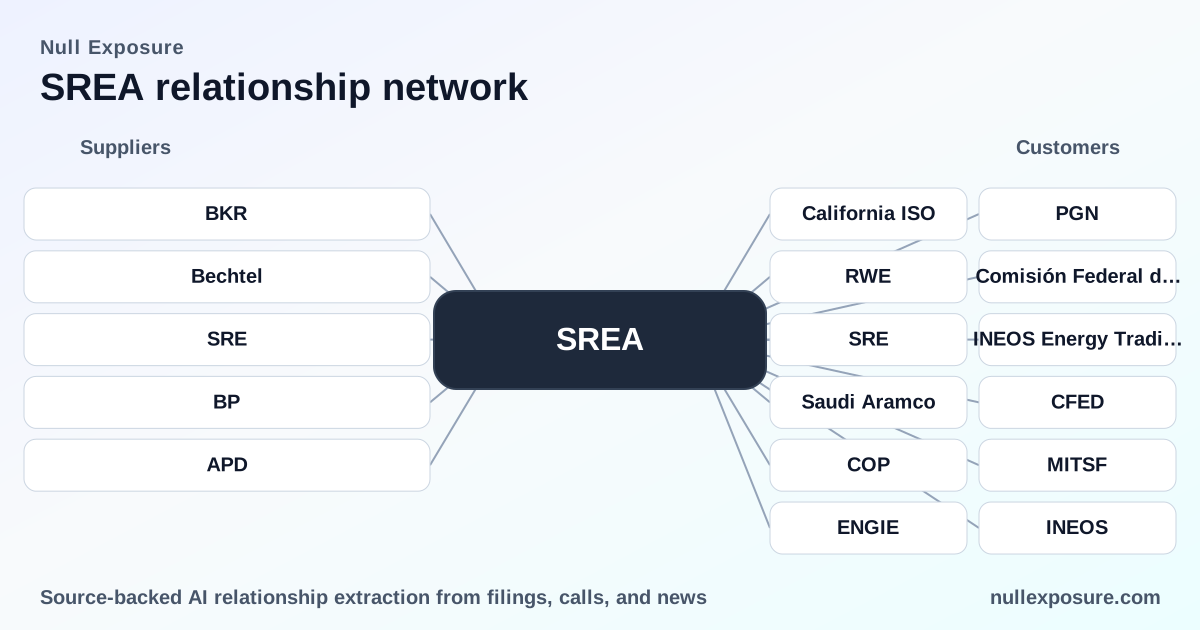
SREA (Sempra 5.750% Junior Subordinated Notes due 2079) — supplier footprint, capital implications, and what investors should watch
SREA represents a fixed-income claim on Sempra Energy’s consolidated cash flows, paying a 5.75% coupon and sitting junior in the capital structure; proceeds and ongoing cash generation from Sempra’s utility and infrastructure platforms — notably LNG projects and regulated utilities — underwrite interest and principal capacity over the long run. Investors in SREA are buying a high-coupon, subordinated exposure to a company whose operating model is driven by long-dated contracts, project-level non-recourse financing, and large, concentrated supplier commitments that directly affect project completion and cash flow timing. For further supplier and counterparty analytics, visit https://nullexposure.com/.
How Sempra monetizes projects and why suppliers matter
Sempra monetizes through two linked channels: regulated utility cash flow and project-level infrastructure returns. Regulated operations generate predictable revenue streams under tariffs and PPAs, while infrastructure projects (LNG terminals, pipelines) generate contract-backed, dollar-denominated revenues or capacity fees once operational. That hybrid model makes supplier execution and large-capital counterparties a first-order driver of credit delivery on subordinated notes like SREA. Project delays or cost escalation handled by major EPCs and equipment vendors translate directly into cashflow timing risk for Sempra’s junior creditors.
Company-level signals from available constraints reinforce this narrative: Sempra’s contracting posture is heavily weighted toward long-term agreements, but it also has identifiable short-term and spot exposures that introduce near-term price and volume variability. Payments under some contracts are usage-based, increasing counterparty spend volatility, and cumulative supplier and lease commitments register in the $100M+ spend band, indicating material vendor concentration for individual projects. Geographically, Sempra sources fuel and services across North America. There is a company-level note that certain labor issues are judged immaterial to service, and several relationships are in renewing or prospective stages (company-level signals only). These characteristics define the operating constraints that underpin SREA’s risk-return profile.
The supplier relationships you need on your radar now
Below I cover every supplier relationship surfaced in the available results, with one-line takeaways and source references.
-
Baker Hughes — Baker Hughes has been awarded main equipment and MRC supply roles for Sempra Infrastructure’s Port Arthur LNG project, including orders placed via Bechtel for Main Refrigerant Compressors on Phase 1 and supply scope on Phase 2 expansion work; these vendor awards reflect critical equipment suppliers integrated into the project’s delivery chain (see Offshore-Energy report on MRCs, FY2023; LNG Prime on expansion gig, FY2021).
Source: Offshore-Energy reported Baker Hughes’ MRC award for Port Arthur LNG Phase 1 (reporting FY2023), and LNG Prime covered a Baker Hughes role tied to Port Arthur expansion (FY2021). -
Bechtel — Bechtel holds the Engineering, Procurement and Construction (EPC) contract for Port Arthur LNG Phase 1 and has been issued final notices to proceed after project financing closed, placing Bechtel at the center of construction delivery and schedule risk for key LNG capacity (see EnergyConnects on the EPC contract, FY2022; Offshore-Energy on closing of financing and EPC notice, FY2023).
Source: EnergyConnects described Bechtel’s EPC scope for Phase 1 (FY2022); Offshore-Energy noted the project financing close and EPC notice to proceed (FY2023). -
bp — bp delivered the first carbon-offset LNG cargo into Sempra’s Energía Costa Azúl receiving terminal in Mexico under a carbon-offset offering, signaling commercial offtake activity and buyer engagement in Sempra’s LNG trading and import flows (reported by VesselFinder, FY2021).
Source: VesselFinder covered bp’s first carbon-offset LNG cargo to Sempra’s terminal (FY2021). -
Air Products — Air Products was selected to provide technology for Sempra’s Energía Costa Azúl LNG project, representing a process-technology supplier relationship whose performance influences plant efficiency and operating cost once in service (reported by Offshore-Energy, FY2021).
Source: Offshore-Energy reported Air Products’ technology selection for Sempra’s ECA LNG project (FY2021).
What these relationships imply for credit and execution risk
- Criticality and concentration: Primary EPCs and large equipment vendors (Bechtel, Baker Hughes, Air Products) carry outsized influence over project schedules and capital spend. Given the disclosed $100M+ spend band signal, a single supplier disruption has the potential to meaningfully shift cash flow timing for projects that support SREA servicing capacity.
- Contracting posture: Company-level evidence shows a preference for long-term, dollar-based contracts, which supports revenue stability once assets are operational; however, short-term, spot, and usage-based elements exist that can introduce near-term variability into operating cash flows.
- Maturity and financing structure: Several project milestones (notably financing close and notice-to-proceed for Port Arthur) have already executed, reducing some development risk, but junior creditors still absorb residual project and execution risk until full commercial operations commence. Offshore-Energy’s coverage of the financing close for Port Arthur is a material milestone to track.
- Operational risk vectors: Technology suppliers (Air Products) and specialized equipment providers (Baker Hughes’ MRCs) create single-source technical dependencies that translate into performance and warranty risk over an asset’s life.
Practical due-diligence checklist for investors and operators
- Track EPC progress and P&L treatment: monitor Bechtel milestones, change orders, and completion timelines against public financing covenants (Offshore-Energy coverage is useful to timestamp financing and NTP).
- Validate supplier delivery timelines for critical equipment (compressors, process trains) and test commissioning schedules; Baker Hughes’ MRC orders are a bellwether for mechanical completion sequencing.
- Assess counterparty credit and substitution options for large, concentrated suppliers; quantify spend exposure across time buckets given the $100M+ company-level signal.
- Stress cash-flow modeling for usage-based and spot exposures to determine how near-term variance affects interest coverage in a downside operating scenario.
If you want an operationalized supplier map and continuous monitoring for these counterparties, see the coverage available at https://nullexposure.com/ — it’s designed for exactly this use case.
Bottom line and investor action points
SREA is a yield-led instrument backed by a portfolio that blends regulated utility cash flows and project-level infrastructure economics. The investment thesis hinges on the timely execution of large LNG projects where a small set of suppliers and EPC contractors govern schedule and cost outcomes. Bechtel and Baker Hughes represent more than vendors — they are execution partners whose delivery cadence directly affects subordinated bond serviceability, while bp and Air Products signal commercial offtake and technology stacks that affect long-term operating economics.
For a deeper read and monitoring setup tied to these counterparties, go to https://nullexposure.com/. For portfolio-level stress testing and supplier concentration analytics that map directly to debt servicing scenarios, start with the home page at https://nullexposure.com/ and request the SREA supplier brief.