Seritage Growth Properties (SRG): Capital partners, advisors, and the commercial playbook investors must price
Seritage Growth Properties is a self‑managed, publicly traded REIT that monetizes legacy Sears real estate through leasing, redevelopment, and strategic dispositions, while using structured financing to extend runway for asset conversion. The company’s value proposition is execution on property-level redevelopment, asset sales to crystallize gains, and rental income from re-tenanted parcels; returns hinge on capital recycling and debt management rather than operating-margin expansion. For a fast look at supplier and capital relationships that shape that strategy, visit NullExposure homepage.
Business model essentials and what relationships drive value Seritage runs a hybrid operating model: it is operationally self‑managed but selectively hires external advisors and service providers for transactions and technical functions. The firm holds 166 wholly owned properties and 29 unconsolidated properties and funds redevelopment with a combination of asset sales and secured financing. Financial disclosures show negative EBITDA and EPS, a small market capitalization (~$159 million), and relatively high leverage multiples (EV/Revenue and EV/EBITDA), which makes lender relationships and transaction execution partners critical to sustaining the transformation strategy.
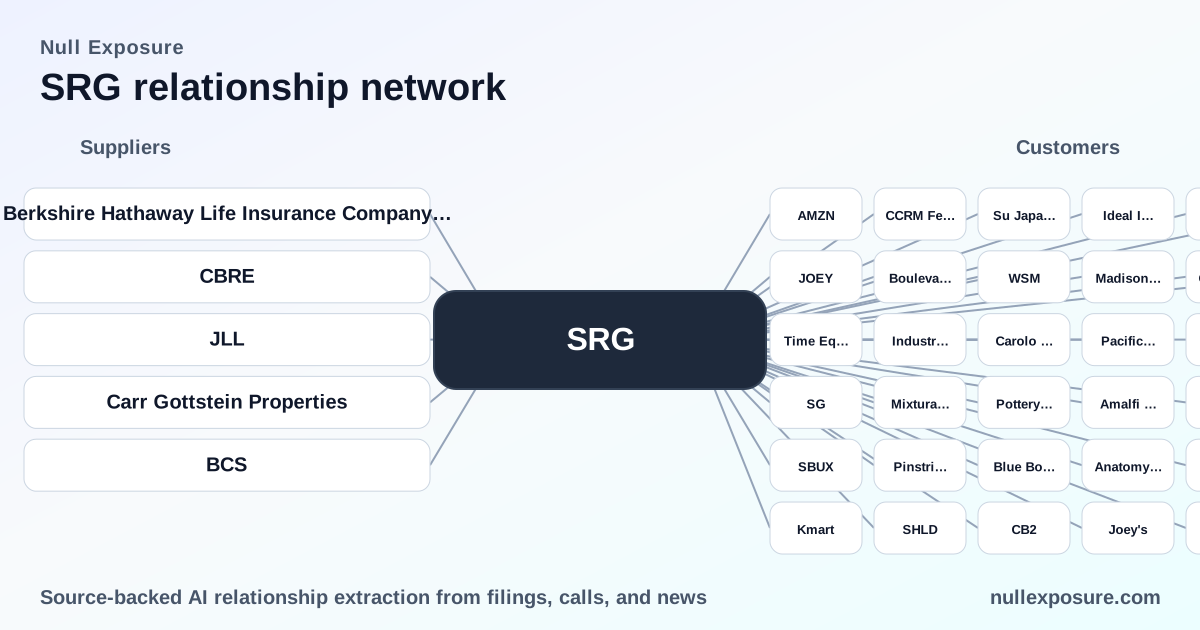
All supplier and capital relationships you should know
- Berkshire Hathaway Life Insurance Company of Nebraska — Seritage has a $2.0 billion term loan facility with Berkshire Hathaway as lender; the facility is a material part of the company’s secured financing package. Source: Seritage FY2024 Form 10‑K (Term Loan Facility disclosure).
- CBRE — CBRE acted as the seller’s representative in the Midtown Mall transaction and provided brokerage services that facilitated the local disposition. Source: Alaska Business magazine coverage of the Midtown Mall sale (FY2022).
- JLL Capital Markets — JLL represented Seritage as seller on the sale of the Esplanade at Aventura mixed‑use retail center, providing capital markets and disposition execution. Source: JLL press release on the Esplanade at Aventura sale (FY2025).
- Carr Gottstein Properties — Carr Gottstein was the original owner of the Midtown Mall complex before selling to Seritage; this reflects Seritage’s strategy of acquiring and repositioning legacy retail assets. Source: Alaska Business magazine (FY2022).
- Barclays — Barclays served as Seritage’s financial advisor in a strategic review process, providing investment banking counsel on alternatives. Source: CNBC reporting on Seritage’s strategic review (March 2022).
What the Berkshire loan means for credit posture and execution The $2.0 billion term loan facility with Berkshire Hathaway Life Insurance Company of Nebraska is the linchpin of Seritage’s secured financing profile (FY2024 10‑K). The facility has been amended over time, including extensions and voluntary prepayments, which reduced unpaid principal to $240 million at December 31, 2024, thereby altering near‑term maturity and liquidity demands. From an investor perspective, a large, concentrated secured loan from a single institutional lender increases both refinancing dependency and execution discipline; successful redevelopment is contingent on managing covenant, maturity, and prepayment dynamics.
Who runs deals and markets assets Seritage relies on top-tier real estate advisors for disposition and leasing execution: JLL and CBRE have acted for the company on notable asset sales and marketing assignments. These relationships signal that Seritage outsources capital markets execution — a sensible approach given the complexity of converting big‑box parcels to mixed‑use outcomes and the need for institutional placement. Source: JLL press release (Esplanade sale FY2025); Alaska Business magazine (Midtown Mall FY2022).
Legacy ownership and strategic advisory signals References to Carr Gottstein Properties identify prior ownership history on specific assets Seritage acquired, illustrating the company’s strategy of buying existing retail portfolios for redevelopment. Barclays’ role as financial advisor during a strategic review (reported in 2022) indicates Seritage periodically engages global investment banks when evaluating alternatives, which is consistent with an asset‑recycling strategy that requires sophisticated capital markets advice. Source: Alaska Business magazine (Carr Gottstein, FY2022); CNBC (Barclays advisory, March 2022).
Constraints that shape operational risk and upside Seritage’s disclosures surface two company‑level constraints that are material to operator and investor due diligence:
- Long‑term contracting posture: The company’s reliance on a large term loan facility is evidence of long‑dated secured financing commitments that influence cash flow allocation, refinancing cadence, and strategic flexibility. Evidence in the FY2024 Form 10‑K shows amendments, maturity extensions, and sizable voluntary prepayments that altered the unpaid principal. This is a company‑level signal about maturity profile and refinancing dependency rather than a single relationship attribute.
- Selective outsourcing for critical services: Seritage has elected to engage third‑party managed service providers to maintain its network and to manage cybersecurity monitoring and mitigation, implying a hybrid operating model where core real estate decisions remain internal but operationally critical IT/security functions are outsourced to specialists.
These constraints combine into an operational template: high strategic centrality of financing and transaction partners, moderate operational decentralization through outsourced technical services, and a maturity profile determined by a small number of large credit instruments.
Risk/reward synthesis for investors and operators
- Upside drivers: successful asset sales, re‑tenanting, and disciplined capital recycling will drive value realization; top‑tier brokerage and advisory relationships improve market access and pricing execution.
- Key risks: concentrated secured debt, negative operating profitability, and a small market capitalization increase execution risk; high insider ownership (~33%) and elevated beta (~2.48) amplify governance and volatility considerations. Data: market cap ~$159M, insiders 33.327%, beta 2.481, EBITDA negative (FY‑TTM).
- Operational implication for suppliers and partners: lenders, brokers, and advisors are mission‑critical — their capabilities and alignment materially affect whether Seritage converts real estate options into realized value.
If you are modeling Seritage’s next 12–24 months, explicitly stress test scenarios for: (1) asset sale timing and pricing, (2) refinancing outcomes for the remaining secured debt, and (3) cost and timeline variance on redevelopment projects.
For a consolidated view of Seritage’s counterparties and to prioritize monitoring of the relationships that most affect valuation, see our platform summary at NullExposure homepage.
Conclusion and next steps Seritage is an execution‑centric REIT where capital partners and transaction advisors determine the pace and success of value creation. Monitor lender covenant dynamics, the cadence of dispositions executed by JLL/CBRE, and any further engagement of investment banks for strategic reviews. For tailored counterparty analysis and alerts on changes to these supplier and capital relationships, explore our coverage at NullExposure homepage.