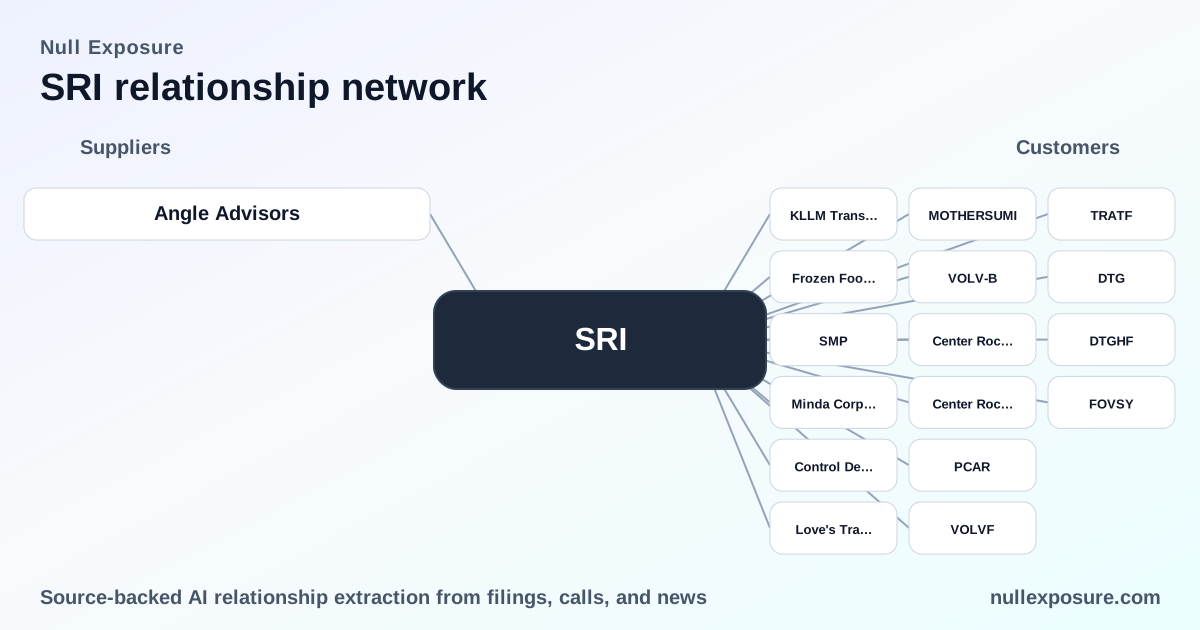
Stoneridge Inc. (SRI): Supplier Relationships, Operating Constraints, and Investment Implications
Stoneridge designs and manufactures electrical and electronic components, modules, and systems for automotive and off-highway vehicles and monetizes through direct OEM supply contracts and aftermarket sales across North and South America, Europe, and other regions. The company generates revenue by winning program awards with vehicle manufacturers and executing production and aftermarket fulfillment; its cash flow profile is driven by program timing, component mix, and recurring parts shipments rather than software or subscription revenue. Investors should evaluate Stoneridge through the lens of a capital‑intensive parts supplier with cyclical OEM demand, program-level revenue visibility, and active portfolio management of product lines. For a focused supplier-risk snapshot and relationship intelligence, visit https://nullexposure.com/.
Where Stoneridge stands financially and why suppliers matter
Stoneridge reported roughly $874m revenue (TTM) with negative net EPS (diluted EPS -3.7) and EBITDA around $26m, producing a compressed profitability profile for an auto supplier. Market capitalization is approximately $161m, with an EV/EBITDA of ~17.6, which reflects either market skepticism about margin recovery or valuation pressure from cyclicality and restructuring. High institutional ownership (~87%) signals professional investor interest, but the company's margins, return on equity, and EPS are under stress relative to peers, making supplier cost and reliability central to any turnaround thesis.
How Stoneridge contracts with suppliers — a concise operating model read
Company disclosures and operating excerpts show a mixed contracting posture: Stoneridge purchases production materials under both annual contracts and spot purchasing methods, and for key materials it establishes collaborative relationships with qualified suppliers to reduce costs and improve quality and service. This provides several salient operating signals:
- Contracting posture: A blend of short-term and spot buys gives Stoneridge buying flexibility to manage price swings, but it also reduces supplier lock‑in and long-term supply commitment.
- Concentration and criticality: For “key production materials” Stoneridge pursues collaborative ties, indicating selective supplier strategic importance rather than blanket dependence on single sources.
- Maturity and bargaining power: The buyer role and use of annual contracts for key items show disciplined procurement governance; concurrent spot purchases imply active cost management in commodity or low‑criticality inputs.
- Operational risk profile: Mixed contracts imply exposure to commodity price volatility and potential supply disruption on spot-dependent inputs, while strategic supplier relationships for critical components provide partial insulation.
These are company-level signals drawn from procurement language, not tied to any single named supplier.
Documented transaction relationship: Angle Advisors and a product-line divestiture
Angle Advisors acted as the exclusive investment banking advisor to Stoneridge in the sale of certain switch-connector product lines, a transaction reported in March 2026. This engagement indicates active portfolio management by management to rationalize product scope and extract value from lower-return or non-core lines. (Source: Angle Advisors announcement, March 10, 2026 — https://www.angleadvisors.com/post/sale-of-stoneridge-s-certain-switch-connector-product-lines)
Why the Angle Advisors engagement matters for supplier risk and capital allocation
The use of an investment bank to sell product lines signals management is executing structural optimization: shedding non-core manufacturing enables reduced operational complexity, potential reallocation of capital into higher-margin programs, and possible simplification of supplier networks. For operators, this is consequential — divesting product lines typically reduces the number of SKUs, changes volume commitments with existing suppliers, and can convert some previously captive supplier relationships into surplus capacity for those vendors. For investors, the transaction is a concrete indicator that management prioritizes balance-sheet repair and portfolio focus over broad-based organic growth.
For detailed supplier intelligence tools and relationship mapping tied to such corporate actions, explore https://nullexposure.com/.
Operational implications for procurement, finance, and risk teams
- Procurement strategy: The combination of annual contracts for critical inputs and spot purchases for commoditized items indicates procurement can pivot rapidly but requires strong hedging or inventory policies to stabilize margins under raw-material inflation.
- Supplier consolidation impact: If divestitures reduce product breadth, Stoneridge will lower the complexity of supplier management; that reduces overhead but risks higher unit costs where volume drops are significant.
- Working capital and margin levers: Program wins and divestitures directly influence working capital needs and gross margins; tighter supplier collaboration on key materials is the proximate lever to improve service levels and reduce warranty/quality costs.
- Counterparty risk: The buyer role and selective collaboration reduce single-vendor concentration risk at the company level, but spot purchasing exposes Stoneridge to short-term supply shocks during auto-cycle downturns or raw-material spikes.
What investors and operators should watch next
- Program awards and OEM commitments. Watch contract wins and renewals for high-margin modules; these restore revenue visibility and justify re-investment in core capabilities.
- Margin recovery trajectory. Monitor gross margin and EBITDA improvements post-divestiture to assess whether cost savings and supplier rationalization are translating to earnings.
- Supplier contract mix over time. A sustained shift toward longer-term strategic contracts for core inputs is a positive operational signal; a persistent reliance on spot buys signals ongoing cost risk.
- Management’s use of proceeds from divestitures. Reinvestment into automation or debt reduction improves resilience; absence of clear redeployment warrants caution.
Actionable takeaways
- Stoneridge operates as a program-driven OEM supplier with a mixed procurement model that balances flexibility and strategic supplier ties.
- The recent advisory engagement with Angle Advisors for a product-line sale underscores an active restructuring and focus on core, higher-return activities.
- Procurement structure—annual contracts for key materials plus spot buying elsewhere—creates both opportunity for margin improvement and exposure to short-term price shocks.
For a deeper, transaction‑level supplier risk profile and relationship intelligence that integrates disclosures, buy-side signals, and transaction history, go to https://nullexposure.com/.
Conclusion — how to position SRI exposure
Stoneridge is a classic industrial supplier reset story: modest revenue scale, compressed profitability, and high institutional interest create a scenario where operational fixes and portfolio rationalization drive valuation re-rating potential. Investors should treat supplier dynamics as a material driver of both margin recovery and execution risk; operational teams should prioritize stabilizing critical supply lines through longer-term contracts where volume and quality impact earnings most. For ongoing monitoring and to map the next relationship-level changes that will affect supply cost and resiliency, visit https://nullexposure.com/.