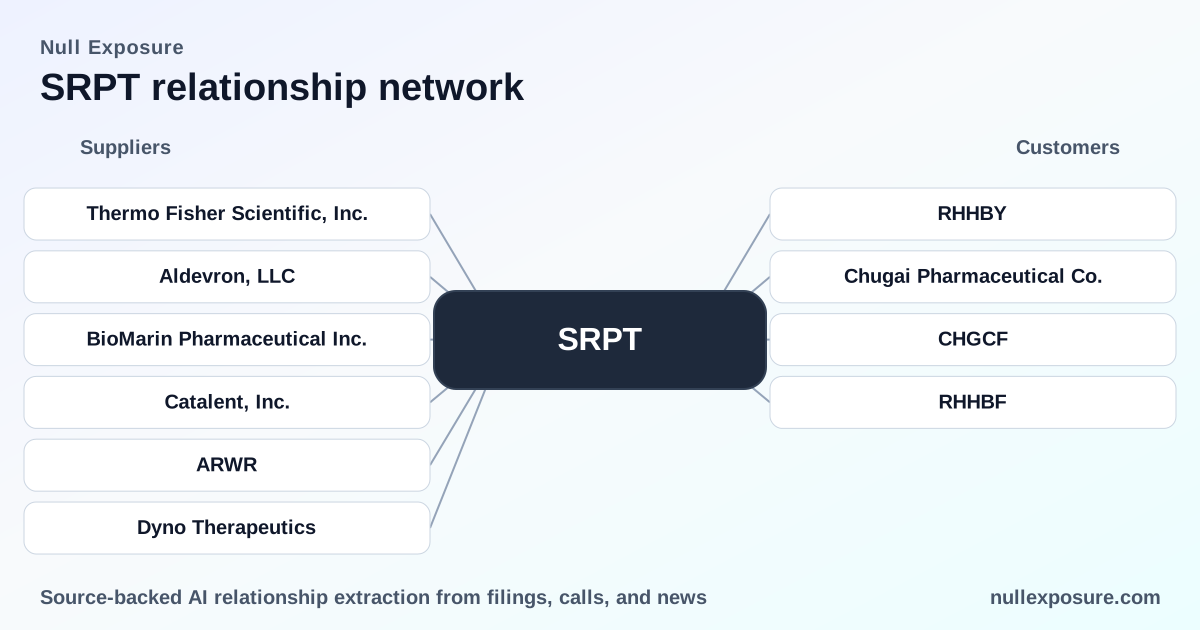
Sarepta Therapeutics: supplier relationships that shape production, risk and near‑term cash flows
Sarepta Therapeutics operates as a commercial-stage biotech focused on RNA-targeted therapies and gene therapy, monetizing through product sales, licensing and strategic collaborations while outsourcing substantial portions of drug substance and drug product manufacture. Revenue comes from commercial launches and milestone-driven licensing arrangements; cost and execution risk are concentrated in a small set of manufacturing and supply partners, making supplier relationships a direct lever on both margins and program delivery. Visit https://nullexposure.com/ for a concise supplier-risk profile and deeper counterparty intelligence.
How Sarepta contracts and why it matters for investors
Sarepta’s operating model blends long-term manufacturing commitments with flexible, cancellable clinical services. The company relies on specialized contract manufacturing organizations (CMOs) for plasmid DNA, APIs and finished gene-therapy product, while distributing commercial PMO products through specialty pharmacies and a limited distributor network. This structure produces three investment-relevant characteristics:
- Concentration and criticality: a limited number of CMOs and reserved clean-room capacity create single‑point operational risk for regulated gene therapies.
- Mixed contracting posture: long-term reservations (multi‑year CMO and supply commitments) coexist with cancellable CRO engagements, concentrating capital exposure in manufacturing while retaining tactical flexibility for early-stage work.
- Material committed spend: the company reports large manufacturing and CRO commitments that are relevant to cash flow planning and restructuring risk.
For more detailed supplier maps and commitment analytics, see the company profile at https://nullexposure.com/.
The supplier roll call — each relationship and what it means
Below are the relationships surfaced in public filings and press reporting, each summarized in plain English with its documentary source.
Thermo Fisher Scientific / Brammer Bio MA, LLC
Sarepta had a development, commercial manufacturing and supply agreement with Brammer Bio (a Thermo Fisher affiliate) dating to June 2018, with multiple amendments, and issued a termination notice effective August 21, 2024; the company recorded approximately $91.9 million of costs associated with terminating that agreement. (Source: Sarepta 2024 Form 10‑K, FY2024)
Aldevron, LLC
Sarepta entered a clinical and commercial supply agreement with Aldevron in December 2018 (amended June 2020) for plasmid DNA and Aldevron agreed to reserve manufacturing capacity on a quarterly basis; the Aldevron agreements have definitive term language that expires December 31, 2026. (Source: Sarepta 2024 Form 10‑K, FY2024)
BioMarin Pharmaceutical Inc. (BioMarin Parties)
Sarepta holds a royalty-bearing, worldwide license from BioMarin under certain patents and know‑how pursuant to a license agreement (with amendments in 2019 and 2021), establishing IP and royalty obligations tied to licensed technologies. (Source: Sarepta 2024 Form 10‑K, FY2024)
Catalent, Inc. (formerly Paragon Biosciences)
Sarepta executed a manufacturing collaboration and later a manufacturing and supply agreement with Catalent (October 2018 and February 2019); Catalent committed two dedicated clean room suites with an option for additional suites, and the arrangement was modified in November 2022 to extend the term through December 31, 2028. (Source: Sarepta 2024 Form 10‑K, FY2024)
Arrowhead Pharmaceuticals — Huntington’s therapy reporting
A Huntington’s Disease News story reported that Arrowhead originally developed a CNS-targeted RNA interference therapy and entered an agreement with Sarepta in 2024 granting Sarepta exclusive global rights for the treatment’s clinical development. This is indicative of Sarepta’s strategy to acquire clinical-stage assets via licensing/collaboration. (Source: Huntington’s Disease News, March 2026 report)
Dyno Therapeutics — delivery collaborations
A BiopharmaDive piece documented that Dyno Therapeutics has deals with Novartis, Roche and Sarepta to improve AAV delivery efficiency, signaling Sarepta’s active use of external delivery platforms to de‑risk vector performance. (Source: BiopharmaDive, March 2026)
Arrowhead — corporate commentary on pipeline access
A BioSpace news item quoting Sarepta management highlighted the 2024 partnership with Arrowhead and confirmed that the arrangement gave Sarepta access to promising programs including SRP-1003 for myotonic dystrophy (DM‑1), underlining the strategic rationale behind the Arrowhead deal. (Source: BioSpace, March 2026)
Arrowhead — Sarepta press release on 2025 financials
Sarepta’s own 2025 year-end results disclosed a $583.6 million increase in up‑front expenses tied to the licensing and collaboration agreement and a $300.0 million milestone paid to Arrowhead related to the DM1 program, representing substantial near-term cash deployment to advance licensed programs. (Source: Sarepta press release via BioSpace, FY2025)
Financial and operational constraints that shape decisions
Sarepta’s SEC filing and corporate disclosures create several company-level signals for operators and investors:
- Long-term manufacturing commitments are explicit (Aldevron reservations, Catalent term extension), anchoring capacity but locking in spend through the mid‑late 2020s.
- Large committed spend exists: the 10‑K lists roughly $1.24 billion in manufacturing commitments and approximately $594.5 million of cancellable future CRO commitments as of December 31, 2024, which is directly relevant to liquidity planning.
- Dual posture on contract flexibility: while some contracts are multi‑year and capacity‑reserved, SRPT retains cancellable relationships for CRO services — a hybrid that concentrates operational risk on manufacturing while preserving clinical agility.
- Lifecycle and maturity signals: Sarepta now “controls two clean room suites,” indicating partial in‑house capacity and a transition toward more direct control of commercial manufacturing environments.
These constraints influence valuation sensitivity to manufacturing interruptions, milestone cadence and the timing of royalty or upfront payments to licensors.
Investment implications and recommended monitoring
- Operational risk is concentrated. Investors should treat manufacturing counterparties and committed capacity as primary failure modes for near‑term commercialization and regulatory timelines.
- Large upfront & milestone payments to partners (Arrowhead) move cash quickly and alter runway assumptions; track announced payments and contingent liabilities disclosed in periodic filings.
- IP and royalty liabilities (BioMarin license) add persistent margin pressure if programs commercialize.
For a tailored supplier risk score or to track counterparty exposures across the supply chain, visit https://nullexposure.com/ to request a focused supplier diligence brief.
Final takeaways for investors and operators
Sarepta’s supplier architecture mixes strategic long-term manufacturing commitments, a compact distribution network, and transactional clinical services, producing concentrated operational risk with outsized impact on cash flow and margins. The termination of the Thermo agreement and the large Arrowhead payments in 2025 demonstrate that supplier moves and licensing deals will continue to drive near-term earnings volatility and cash requirements. Monitor Aldevron capacity reservations through 2026, Catalent commitments through 2028, and the cadence of milestone payments to partners as the clearest supply‑side indicators of program continuity and financial strain.
If you need consolidated supplier exposure analytics or a bespoke counterparty risk briefing for SRPT, start here: https://nullexposure.com/.