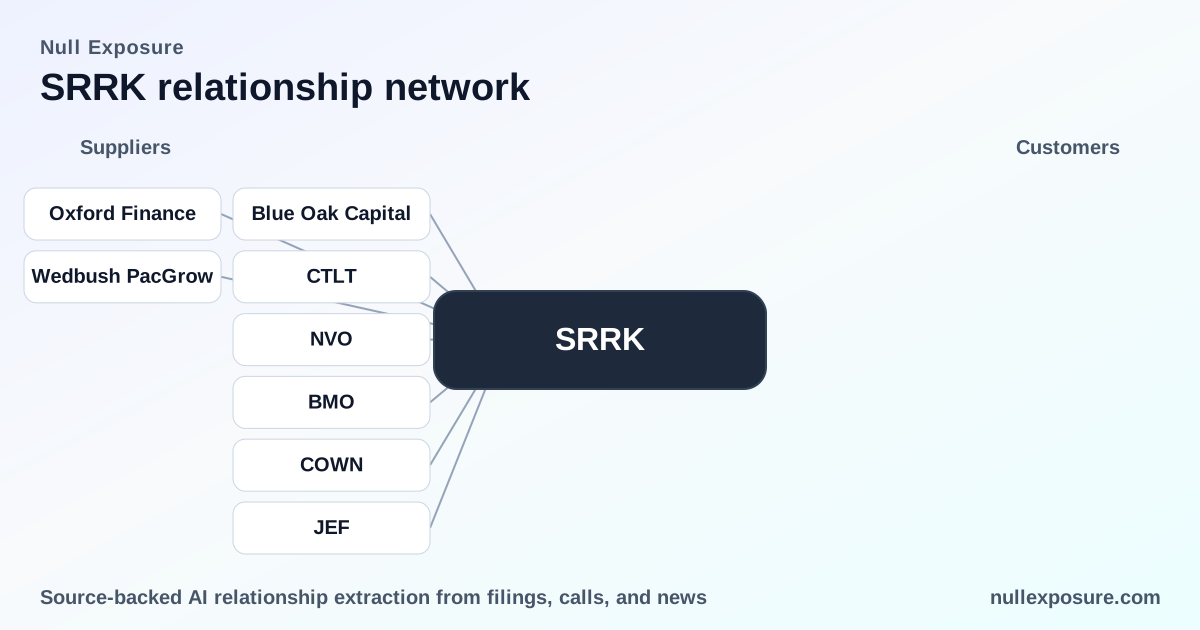
Scholar Rock (SRRK) — supplier landscape and what it means for investors
Scholar Rock is a clinical‑stage biopharmaceutical company that develops therapies targeting protein growth‑factor signaling; it currently monetizes through R&D progress and potential future product approvals, at which point revenue would derive from product sales, licensing, and commercial partnerships. The company outsources virtually all clinical manufacturing and relies on a small set of third‑party partners, making supplier relationships a direct driver of clinical timelines, regulatory risk, and valuation. For a concise view of SRRK’s supplier intelligence and related exposure, visit https://nullexposure.com/.
Why suppliers are a core part of the investment thesis
Scholar Rock has no recurring product revenue today and negative operating margins; the pathway to commercial value runs through successful clinical development and regulatory approvals. That pathway is tightly coupled to external manufacturing, inspection outcomes, and selected distribution partners. The company’s operating posture is clearly outsourcing‑centric: it does not own clinical manufacturing facilities, uses single‑source suppliers for key compounds, and anticipates limited distribution models if a product is approved. These structural traits produce four investment implications:
- Concentration risk: single‑source manufacturing elevates the probability that a single facility problem delays an approval or launch.
- Regulatory sensitivity: inspections and warning letters at a partner site can force BLA rework and Type A meetings, directly impacting timelines.
- Liquidity interplay: balance‑sheet events (debt facilities, repayments) change runway and optionality for mitigation of supplier issues.
- Execution criticality: third‑party CRO and manufacturing performance is a primary operational lever for SRRK’s value creation.
If you want a quick supplier risk dashboard to share with portfolio teams, see the overview at https://nullexposure.com/.
Mapping the public supplier and partner mentions (every relationship in the record)
Below are the named counterparties that appear in SRRK‑related filings and coverage, with a concise, plain‑English summary and the cited source context.
-
Blue Oak Capital — Management announced a new debt facility of up to $550 million secured with Blue Oak Capital during SRRK’s Q4 2025 earnings call; that facility immediately provided liquidity and replaced a prior lender. (Q4 2025 earnings call; also cited in an InsiderMonkey transcript in FY2026.)
-
Catalent — Catalent’s Indiana operations are referenced by SRRK as the manufacturing site whose FDA inspection status triggered a BLA resubmission plan; SRRK management discussed resubmission preparations in public commentary following the inspection. (InsiderMonkey coverage, FY2026; Q4 2025 earnings call.)
-
Novo Nordisk — Novo Nordisk is named in multiple accounts as the current owner/operator of the Bloomington, Indiana manufacturing site formerly operated by Catalent; public mentions describe Novo Nordisk’s rapid response to the FDA and its operational role in the site inspection cycle. (Q4 2025 earnings call; SimplyWallSt and TS2.Tech reporting, FY2025.)
-
BMO Capital Markets — BMO is identified in market commentary as one of the underwriters that handled SRRK’s IPO, a historical capital markets relationship relevant for broker coverage and syndicate context. (MarketBeat instant alert, FY2025.)
-
Cowen — Cowen served as an IPO underwriter for SRRK and remains part of the capital markets footprint that established the public float and analyst coverage. (MarketBeat instant alert, FY2025.)
-
Jefferies — Jefferies likewise functioned as an IPO underwriter for SRRK and is part of the underwriting syndicate cited in market reports; that syndicate history frames sell‑side relationships. (MarketBeat instant alert, FY2025.)
-
Wedbush PacGrow — Wedbush PacGrow is listed as co‑manager on SRRK’s IPO underwriting syndicate and is therefore part of the company’s historical capital markets network. (MarketBeat instant alert, FY2025.)
-
Oxford Finance — SRRK repaid a prior $100 million facility with Oxford Finance using proceeds from the newly secured Blue Oak facility; the repayment was disclosed as immediate and deliberate management action. (InsiderMonkey coverage, FY2026.)
-
Catalent Indiana LLC (Bloomington site) — The Bloomington manufacturing site (formerly Catalent Indiana LLC) was classified by the FDA as “official action indicated,” and SRRK requested a Type A meeting and planned to resubmit its biologics license application in response to that classification. This specific site is central to the company’s manufacturing exposure. (TS2.Tech and SimplyWallSt reporting, FY2025; Q4 2025 earnings call.)
Each of these summaries ties back to primary remarks in SRRK’s Q4 2025 earnings call and subsequent press coverage in late 2025 and early 2026; the timeline of inspection, warning letter, Type A meeting, and debt facility adjustments is the central public narrative investors must track.
Contracting posture and operational constraints investors should price
The available disclosures and excerpts reveal company‑level signals about how SRRK runs its operations:
-
Critical materiality: SRRK explicitly states it relies on a limited number of third‑party manufacturers for R&D, clinical and potential commercial supply, which the company classifies as a material operational risk; that elevates the criticality of any single partner’s inspection outcome or capacity issue.
-
Manufacturer role (outsourced, single‑source emphasis): SRRK outsources all clinical manufacturing and references single‑source suppliers for key assets such as apitegromab and SRK‑181, creating single points of failure that can delay approvals.
-
Distributor posture (limited distribution expectation): The company anticipates using limited distribution agreements post‑approval, concentrating distribution risk among a small number of specialty pharmacies and raising the risk of access or capacity bottlenecks.
-
Service provider reliance: SRRK depends on third parties for antibody discovery optimization and clinical trial conduct; clinical execution is therefore dependent on external CRO and CMC performance.
These constraints are company‑level characteristics and should be incorporated into scenario analyses for timelines, probability of technical success, and required liquidity cushions.
If you need a snapshot of how these supplier constraints influence valuation scenarios, review the SRRK supplier risk models at https://nullexposure.com/.
What investors should watch next
- FDA reinspection outcomes at the Bloomington site and any follow‑up letters or remediation timelines; such events directly affect BLA resubmission dates.
- Debt facility utilization and covenant terms with Blue Oak Capital and the extinguishment of the Oxford Finance loan; these determine SRRK’s runway and ability to respond to manufacturing setbacks.
- Manufacturing continuity plans: announcements of alternative manufacturing sources, tech transfer progress, or secondary suppliers would reduce single‑source exposure.
- Commercial distribution strategy if regulatory approval approaches; limited distribution choices create concentrated operational risk that will influence launch execution.
For teams conducting due diligence, monitoring both regulatory notices and partner ownership changes (Catalent → Novo Nordisk) is essential to discipline timeline and risk assumptions. For more supplier intelligence and monitoring tools, go to https://nullexposure.com/.
Bottom line
Scholar Rock’s value realization is a function of clinical and regulatory execution that is materially influenced by a small set of external suppliers and service providers. The company’s outsized dependency on single‑source manufacturing and the recent FDA interactions at the Bloomington site create a binary risk profile where partner remediation and inspection timing are primary drivers of near‑term valuation. Investors should weight balance‑sheet flexibility, partner remediation disclosures, and any announced secondary manufacturing arrangements when sizing positions.