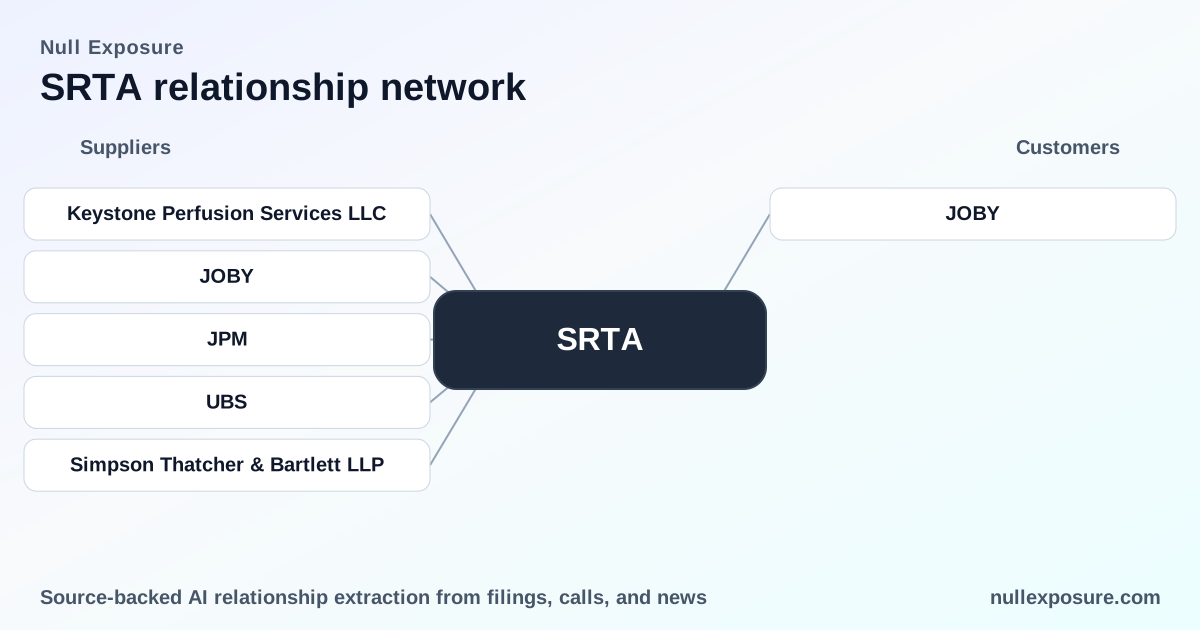
Strata Critical Medical (SRTA): Supplier relationships that drive an asset-light organ logistics platform
Thesis: Strata Critical Medical operates an asset-light, time-critical medical logistics business that monetizes by coordinating specialized transport and clinical services for organ recovery and other urgent medical missions, generating revenue from service fees and expanding via M&A and financing to scale a national platform. For investors, the critical levers are Strata’s supplier network (third-party operators and service partners), its ability to convert partnerships into owned capabilities through acquisitions, and access to flexible capital to fund roll-ups and fleet-adjacent investments. Learn more at https://nullexposure.com/.
How Strata runs the business and where suppliers sit in the value chain
Strata sells time-critical logistics and specialized clinical services to hospitals and organ procurement organizations. The company uses an asset-light model: it contracts third-party aircraft operators, perfusion and clinical service providers, and financing partners to deliver missions while focusing internally on scheduling, clinical quality, and customer relationships. Revenue comes from mission fees and clinical services; gross margin depends on effective operator contracting and utilization.
Company-level signals from recent disclosures and reporting show several defining characteristics of the operating model:
- Usage-based contracting is core. Contracts historically pay operators on a fixed hourly basis for actual flight hours, creating a variable cost structure tied to utilization.
- A mix of long-term and annual contracts. The company negotiates fixed hourly rates but often revisits terms annually; some multi-year commitments include fixed rate escalators.
- Geographic breadth. Technology and operator networks support simultaneous cross-regional missions, indicating national (and potentially international) operational scope.
- Material reliance on partner-operated flights. Flight costs under contracted provider agreements represent a material portion of operating cost and include volume guarantees in certain contracts.
- Spend and commitments signal mid-market supplier economics. Reported payments and future unfulfilled obligations fall in bands that suggest many relationships are in the mid-six-figure to low seven-figure range (per company disclosures).
These characteristics make supplier relationships both operationally critical and structurally flexible, which supports growth but concentrates risk around counterparties and financing access. If you want an organized view of partnerships and counterparties, visit https://nullexposure.com/.
Strategic supplier and financing relationships (what we found)
Keystone Perfusion Services LLC
Strata completed an acquisition of Keystone Perfusion after a multi-year commercial partnership during which Keystone recovered hundreds of organs on behalf of Strata customers, giving Strata an on‑the‑ground perfusion capability to offer nationally. Source: GlobeNewswire press release, September 16, 2025; CityBiz coverage, 2025.
Joby Aviation (JOBY)
Strata has a long-term agreement that gives it access to Joby’s electric aircraft for medical missions, positioning Strata to pilot eVTOL capability for short-range, time-critical transports. Source: DroneLife, August 4, 2025.
J.P. Morgan / JPMorgan Chase (JPM)
Strata closed a $30 million asset‑backed credit facility with J.P. Morgan to support M&A and working capital needs, with an option to upsize to $50 million and with structural flexibility tied to unencumbered aircraft availability. Source: TradingView and The Globe and Mail reporting on Strata’s FY2026 results and press commentary (2026).
UBS Investment Bank
Coverage of related aviation transactions noted UBS Investment Bank serving as exclusive financial advisor to Blade’s board in a strategic transaction context that intersects Strata’s market, and UBS is referenced in transaction reporting that accompanies the ecosystem consolidation narrative. Source: DroneLife, August 4, 2025.
Simpson Thacher & Bartlett LLP
Legal counsel Simpson Thacher & Bartlett LLP was reported as acting for parties in the Blade transaction referenced in the same coverage that mentions Strata’s strategic positioning — reflecting the high‑touch advisory network around consolidation in time‑sensitive air transport services. Source: DroneLife, August 4, 2025.
(Each relationship above is drawn from public press coverage and company reporting; see the cited articles for direct quotes and transaction detail.)
What these relationships mean for investors
- Operational de‑risking through vertical integration: The Keystone acquisition converts a supplier relationship into an owned capability, reducing counterparty dependence for perfusion services and enhancing control over clinical quality. This is an important strategic move to capture more margin on the clinical side.
- Technology and aircraft access for product differentiation: The Joby arrangement gives Strata access to eVTOL platforms, which could shorten mission times and create routes not feasible with traditional rotorcraft, presenting potential unit‑economics improvements for short-haul organ missions.
- Levered roll‑up strategy funded by asset‑backed lending: The $30M asset‑backed facility from J.P. Morgan provides immediate dry powder for tuck‑in acquisitions and working capital; the facility’s unencumbered aircraft clause preserves agility for future financing. Financing availability is a direct growth enabler.
- Advisory and legal relationships highlight consolidation momentum: Mentions of UBS and Simpson Thacher in adjacent aviation transactions indicate that well‑capitalized advisory firms are active in the sector, which supports a market environment receptive to M&A and strategic sales.
Operational constraints and risk signals to monitor
Company documents and excerpts report several consistent constraints that shape supplier risk and contract economics:
- Contracting posture: predominantly usage‑based with some long‑term elements. The firm pays fixed hourly rates for flights only when flown, producing predictable variable costs but exposing Strata to rate inflation and renegotiation cycles.
- Materiality of operator costs: A significant share of flight costs are subject to contracted guarantees in some CPAs, which can create fixed cost pressure if utilization dips.
- Active supplier network with unfulfilled obligations: Filings disclose remaining unfulfilled operator obligations and mid‑range spend bands, signaling committed capacity and contingent cash needs.
- Spend-band signals: Reported payments to jet operators in the referenced filings are recorded as 317 and 369 for the years ended Dec 31, 2024 and 2023, and future unfulfilled contractual obligations are reported at 5,789 for 2025 — each line item is a company‑level disclosure that investors should reconcile with the financial statements and notes.
These constraints imply that Strata’s margins will track utilization and contract renewal dynamics; supplier pricing power and financing access are the primary levers that determine near‑term profitability.
If you want a structured supplier risk profile and transaction timeline to support diligence or operations planning, visit https://nullexposure.com/ for extended supplier analytics and relationship mapping.
Conclusions and investor actions
Strata is executing an asset‑light strategy while selectively buying capabilities that are mission‑critical, such as perfusion through Keystone. The company’s ability to convert supplier relationships into owned services, secure asset‑backed financing, and integrate new aircraft modalities like eVTOL will determine whether it sustains scale economics and margin improvement.
Key calls to action for investors:
- Monitor utilization trends and CPA renewal timing to forecast margin dynamics.
- Track KPIs on integration outcomes from the Keystone acquisition and operational trials with Joby aircraft.
- Watch the size and draw of the J.P. Morgan facility as a signal of deal cadence and M&A pacing.
For ongoing updates, counterparty maps, and supplier‑level risk assessments that inform investment decisions, go to https://nullexposure.com/.