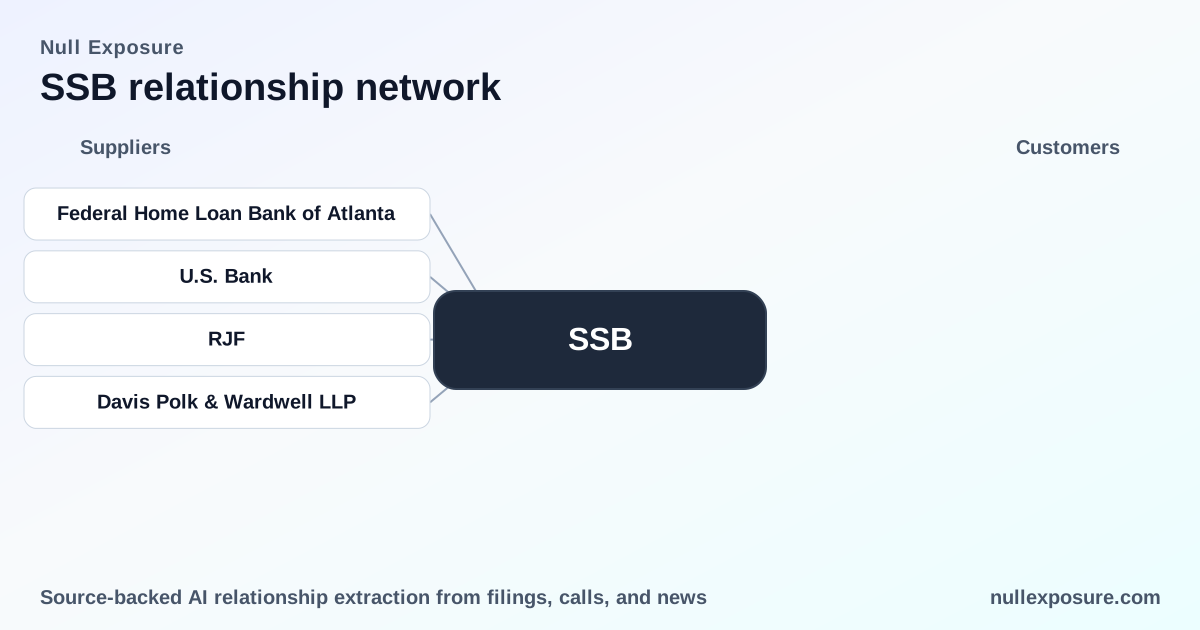
SouthState Corporation (SSB) — Supplier Relationships and Operational Implications
SouthState Corporation runs a regional bank franchise that monetizes through net interest margin on loan portfolios, fee income from deposit and payment services, and strategic M&A that expands the deposit base and loan inventory. Liquidity and advisory relationships are core operating inputs: secured credit lines, Federal Home Loan Bank access, and external financial and legal advisers underpin growth and short-term funding flexibility. For a concise, navigable view of these supplier relationships and their investor implications, explore NullExposure’s supplier coverage: Full supplier analysis at NullExposure.
What the supplier map tells investors about how SouthState funds and transacts
SouthState manages a layered liquidity posture. Short-term funding channels — repurchase agreements, federal funds, and correspondent bank lines — sit alongside large committed facilities with the Federal Home Loan Bank of Atlanta and a secured line of credit with U.S. Bank. This dual structure reduces single-point funding risk while keeping immediate liquidity options available for balance-sheet management. SouthState also leverages third-party advisers and legal counsel to execute acquisitions, signaling an active M&A strategy funded by both deposits and capital markets activity.
Explore more supplier intelligence at NullExposure: Visit NullExposure.
Direct relationships disclosed (each item is sourced from the public record)
-
Federal Home Loan Bank of Atlanta
SouthState lists advances from the Federal Home Loan Bank of Atlanta as a primary committed borrowing facility and reports a total FHLB credit facility of $6.8 billion with full availability at year-end, establishing the FHLB as a large-scale, secured liquidity backstop. According to SouthState’s 2024 Form 10‑K, the FHLB facility is a cornerstone of short-term and contingent funding (FY2024 10‑K). -
U.S. Bank
SouthState maintains a secured line of credit with U.S. Bank that it explicitly cites as an available source of liquidity alongside other short-term measures. The 2024 Form 10‑K identifies this line as part of the company’s immediate funding toolkit (FY2024 10‑K). -
Raymond James & Associates, Inc. (RJF) — FortWorthInc report
Raymond James is serving as exclusive financial adviser to SouthState for the acquisition of Independent Bank Group, positioning RJF as the lead investment bank on a material M&A transaction that drives growth and integration execution risk. A Fort Worth Inc. news report covering the transaction noted RJF’s advisory role (news, March 2026). -
Davis Polk & Wardwell LLP
Davis Polk is acting as legal counsel to SouthState on the Independent Bank Group acquisition, providing top-tier transaction legal support that reduces execution and regulatory risk on the deal side. Dallas Innovates reported Davis Polk’s role in the transaction coverage (news, March 2026). -
Raymond James & Associates, Inc. — Dallas Innovates report
Dallas Innovates corroborates that Raymond James served as exclusive financial advisor, reinforcing RJF’s central advisory role across multiple press reports and indicating market-recognized lead-advisor status for the transaction (news, March 2026).
Interpreting the constraints: what the disclosed excerpts imply for contracting posture and risk
-
Contracting tenor is bifurcated. The company runs high-frequency short-term instruments (federal funds, repos) for day-to-day liquidity, while simultaneously holding long-term commercial lease obligations with renewal options extending up to 20 years. This shows an intentional blend of short- and long-duration contractual exposures that support both liquidity agility and stable branch/operating footprints (10‑K excerpts).
-
Counterparty mix includes government-sponsored banks. The FHLB and the Federal Reserve Discount Window are explicitly named sources of funding, which positions certain counterparty relationships as lower credit-risk but critical for liquidity stress scenarios (10‑K).
-
Materiality profile is mixed. The firm flags cybersecurity exposures at third-party vendors as potentially material to operations and reputation, a company-level risk signal that elevates the importance of vendor selection and oversight. Conversely, equipment leases are identified as immaterial in aggregate, indicating limited financial concentration in routine equipment contracts (10‑K).
-
Relationship roles are transactional and active. SouthState functions both as a recipient of liquidity (lines of credit, FHLB advances) and as an acquirer of loan assets (increase in loans held for sale tied to purchased SBA loans from third-party originators), demonstrating active balance-sheet management and market participation as both buyer and funding borrower (10‑K).
What this means for investors and operators
-
Liquidity resilience is a strength. The combination of a large FHLB facility, a secured U.S. Bank line, and active repo/federal funds activity provides multiple, staggered funding lanes that reduce single-counterparty concentration and support deposit-led growth. Investors should view the FHLB facility as a strategic, low-cost backstop for stress scenarios.
-
M&A execution depends on external advisers. Raymond James as exclusive financial adviser and Davis Polk as lead counsel signals that SouthState recruits high-caliber external partners for deal execution, which lowers transaction execution risk but also concentrates advisory spend and decision-making in a small set of firms. Successful integration will determine whether M&A translates into durable ROE uplift.
-
Operational risk requires vendor governance. The company’s own disclosure elevates third-party cyber risk to material status; investors should expect robust third-party risk management practices and scrutiny in regulatory exams. Operators should prioritize vendor security controls and contractual indemnities for any counterparty with access to sensitive customer data.
-
Contract maturity mix implies interest-rate and roll-over dynamics. Short-term repo and federal-funds activity exposes funding costs to market spikes, while long-term lease obligations anchor fixed operating costs. This mix favors an institution that manages both interest-rate risk and short-term funding volatility actively through hedging and liquidity buffers.
Actionable takeaways
- For capital allocators: prioritize monitoring of FHLB availability, usage of secured lines, and repo market activity as leading indicators of funding stress or opportunistic leverage.
- For operations: formalize third-party cyber risk assessments and contractual remedies with key vendors and advisers to contain the material risks disclosed in the 10‑K.
- For governance: track advisor and counsel engagement costs and outcomes from recent M&A to evaluate whether external spend converts into accretive growth.
Further reading and ongoing coverage are available at NullExposure: View supplier intelligence at NullExposure.
SouthState’s supplier map reflects a deliberate funding architecture and a transaction-driven growth strategy that balances short-term liquidity instruments with long-term operational commitments; investors should evaluate liquidity execution, vendor governance, and M&A integration as primary drivers of near-term performance.