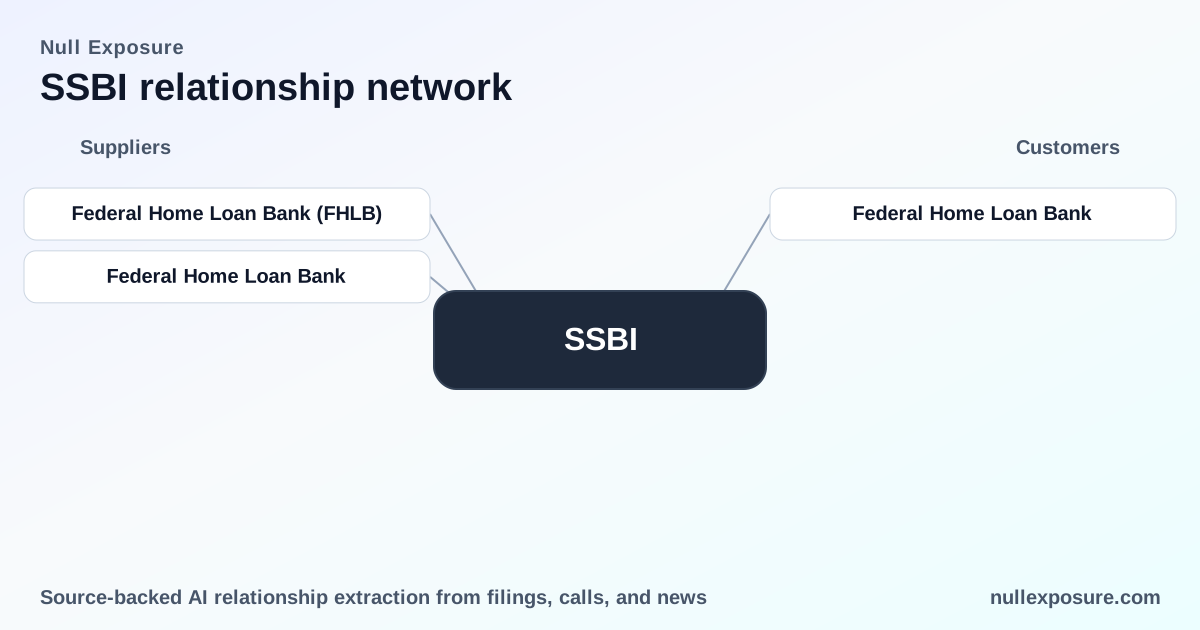
Summit State Bank (SSBI) — supplier relationships and what they mean for investors
Summit State Bank operates as a regional commercial bank headquartered in Santa Rosa, California, monetizing through net interest income from a loan portfolio, fee-based services for individuals and businesses, and investment income from securities and equity positions. The company’s public filings and press releases show routine use of Federal Home Loan Bank (FHLB) products—both equity investments and advances—which is a common liquidity and balance-sheet management strategy for community banks. For investors evaluating counterparty exposure and funding resiliency, the supplier record is narrow but material: the FHLB is the only counterparty referenced in supplier disclosures, and that has direct implications for liquidity, contracting posture, and concentration risk. Learn more at https://nullexposure.com/.
The supplier record in plain English
Summit State Bank’s supplier-related mentions across public releases and news items are limited and concentrated. All captured references identify the Federal Home Loan Bank (FHLB) in the context of small recorded holdings and advances. Below are each of the supplier mentions from the available results, presented without omission.
Federal Home Loan Bank (FHLB) — GlobeNewswire FY2026 (press release)
Summit State Bank’s FY2026 press release discloses an investment in Federal Home Loan Bank stock at cost of 5,889, recorded consistently across disclosure lines, indicating a small, stated equity position with FHLB. The press release is dated January 27, 2026 and is the primary company-published source for the entry. (Source: GlobeNewswire press release, Jan 27, 2026)
Federal Home Loan Bank — Yahoo Finance FY2025 (earnings note)
A financial news summary covering FY2025 notes that the Federal Home Loan Bank provided advances totaling 5,500, signaling use of FHLB borrowings as a funding source during the period. This item appears in a Yahoo Finance earnings summary referencing the bank’s financial results. (Source: Yahoo Finance earnings report summary, reporting on FY2025 results)
Federal Home Loan Bank (FHLB) — GlobeNewswire FY2026 (duplicate)
The GlobeNewswire FY2026 release appears a second time in the supplier results with the same investment figure for FHLB stock at cost of 5,889; this repetition underlines that the company emphasized the FHLB position in its public earnings release. The duplication is in the captured news entries and corresponds to the January 27, 2026 filing. (Source: GlobeNewswire press release, Jan 27, 2026)
Why a single supplier record matters: concentration and criticality
Summit State Bank’s supplier references are concentrated entirely on the Federal Home Loan Bank system. That concentration is not atypical for small regional banks—FHLB membership, stock purchases, and advances are standard mechanisms for securing standby liquidity and managing interest rate and funding mismatches—but the operational and financial exposure is concentrated.
- Contracting posture: The entries indicate a conventional counterparty relationship: Summit State Bank purchases FHLB stock (equity requirement for membership) and uses advances. Those actions reflect standard, long-term contractual ties rather than spot-market counterparties.
- Concentration: All supplier references point to a single counterparty class (FHLB), so the bank’s public supplier disclosure is narrow and focused.
- Criticality: For community banks, FHLB access is critical to funding flexibility. The recorded advances and the required stock purchase show the FHLB functions as both a capital partner and a liquidity backstop.
- Maturity and disclosure: The investment and advance figures are small on absolute terms in the disclosures provided, but their presence across filings signals an established, ongoing relationship rather than a one-off transaction.
These company-level characteristics should factor into any counterparty risk assessment even though the public record here is brief. If you want a structured cross-check of counterparty exposures, see additional supplier analytics at https://nullexposure.com/.
Financial context that matters to the counterparty picture
Summit State Bank is a compact regional bank by scale. Relevant financial markers from the latest public data:
- Market capitalization: $88.0 million
- Price-to-book: 0.883, indicating the market values the firm slightly below book equity
- Return on equity (TTM): 7.05%
- Revenue (TTM): $32.8 million
- Shares outstanding and ownership: Insiders hold ~28.66% and institutional ownership is ~28.87%, a relatively concentrated ownership base.
These figures put the supplier relationship in perspective: FHLB access is disproportionately important to a small-bank funding profile, and balance-sheet management choices (advances vs. deposit pricing, securities holdings, and required FHLB stock) influence capital ratios and earnings volatility more materially than they would at a larger institution. Investors should treat FHLB activity not as a peripheral footnote but as a functional element of liquidity strategy.
Risk checklist for investors and operators
- Counterparty dependency: The public supplier record shows a single counterparty class; confirm whether other funding lines or vendor relationships exist off-record or in more detailed filings.
- Liquidity sensitivity: Advances from a central liquidity provider reduce deposit dependency but increase interest-rate exposure and lender covenants—confirm covenant terms and maturity structure with management.
- Disclosure completeness: Repeated mention of FHLB in a small set of supplier references suggests limited supplier reporting; conduct targeted diligence on third-party vendor concentration beyond FHLB (technology providers, correspondent banks, payments processors).
- Governance and ownership: With significant insider ownership and modest institutional ownership, governance posture will materially affect decisions about liquidity management and counterparty selection.
How to act on this information
Investors should prioritize a short due-diligence dialogue with management to obtain:
- Confirmation of current FHLB advance balances and maturity schedule,
- Details on any other material counterparties not reflected in the supplier disclosures,
- The bank’s contingency funding plan and how FHLB access fits into that plan.
Operators and risk teams should validate FHLB covenant terms against stress scenarios and ensure vendor concentration reporting is complete and current. For a concise supplier and counterparty overview built for investor use, visit https://nullexposure.com/.
Bottom line
The supplier record for Summit State Bank is narrow and dominated by the Federal Home Loan Bank relationship, which functions as both an equity requirement and a potential funding source via advances. For a small regional bank with modest market capitalization and near-book valuation, that relationship is operationally meaningful and should be treated as a core element of any risk and liquidity assessment. For a deeper supplier-risk review tailored to institutional investors, see the resources at https://nullexposure.com/.