Starry Sea Acquisition Corp (SSEA): supplier map and what it means for investors
Starry Sea Acquisition Corp operates as a classic SPAC: it raised capital through an initial public offering, placing sponsor resources and cash in a trust while sourcing external advisors and service providers to move toward a business combination. SSEA monetizes through transaction execution — converting a blank-check vehicle into an operating company via merger fees, sponsor economics and potential post-combination equity value; until a target is announced, its financials show no operating revenue and a balance driven by IPO proceeds and trust accounting. For primary documentation and ongoing monitoring, visit https://nullexposure.com/.
How this SPAC contracts for capital markets services — a concise operating model view
SSEA’s operating model is transaction-centered and intentionally lean. The company relies on a small number of specialist suppliers for underwriting, auditing, transfer agency, and legal work; these contracts are short-term, high-importance engagements tied to the life cycle of the SPAC offering and any subsequent business combination. That contracting posture is transactional and concentrated: selecting an exclusive book-runner and named legal/audit partners reduces procurement complexity but increases vendor criticality during deal execution.
- Criticality: these suppliers are mission-critical for completing the IPO and enabling future M&A — failure or substitution late in the process can delay filings or affect market perception.
- Concentration: a handful of named firms cover core functions, creating single-vendor risk for underwriting and legal advisory during the offering.
- Maturity: SSEA is in the pre-transaction stage; supplier relationships are nascent and focused on capital markets execution rather than long-term operational outsourcing.
- Contract posture: engagements are standard in the SPAC market (underwriter, trustee, auditors, and counsel) and are priced/structured for a finite offering lifecycle.
No supplier-specific constraints were recorded in the source set; there are likewise no company-level constraint disclosures tied to supplier performance in filings referenced here.
The supplier roster — every named relationship and what they do
Below I cover each supplier relationship disclosed in public reporting; these are the vendors on whom the IPO and subsequent deal processes depend.
-
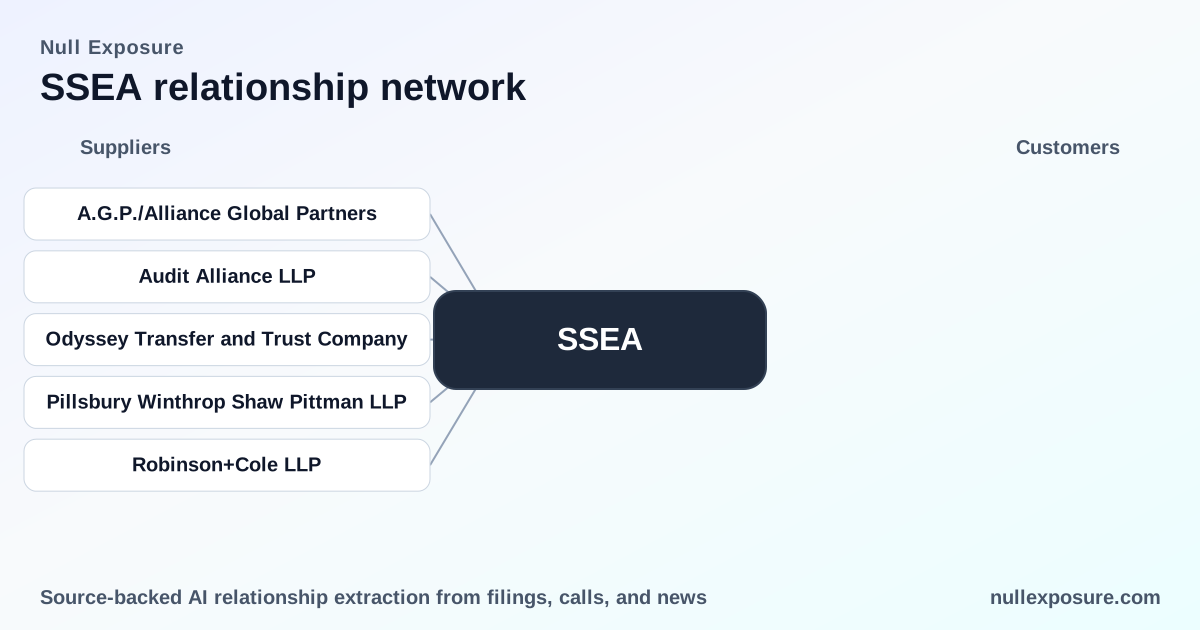
A.G.P./Alliance Global Partners — A.G.P. served as the sole book-running manager for SSEA’s IPO, responsible for syndicate execution, pricing and distribution of the offering that raised $50 million. A SPACInsider report dated March 10, 2026 documents the firm’s role in the transaction: https://www.spacinsider.com/news/headline-post/starry-sea-acquisition-corp-sseau-prices-50m-ipo.
-
Audit Alliance LLP — Audit Alliance LLP is listed as SSEA’s auditor, providing the independent financial statement attestations necessary for the IPO registration and periodic reporting. The same SPACInsider coverage (March 10, 2026) notes Audit Alliance’s engagement: https://www.spacinsider.com/news/headline-post/starry-sea-acquisition-corp-sseau-prices-50m-ipo.
-
Odyssey Transfer and Trust Company — Odyssey Transfer and Trust Company is acting as trustee/transfer agent for the SPAC’s trust account and shareholder recordkeeping, a procedural but legally essential role for redemptions and capital accounting. This assignment is noted in the March 10, 2026 SPACInsider article: https://www.spacinsider.com/news/headline-post/starry-sea-acquisition-corp-sseau-prices-50m-ipo.
-
Pillsbury Winthrop Shaw Pittman LLP — Pillsbury serves as Issuer’s Counsel, shepherding registration statements, disclosure documents and SEC interactions that enable the offering and set governance terms for the SPAC. The engagement is reported by SPACInsider on March 10, 2026: https://www.spacinsider.com/news/headline-post/starry-sea-acquisition-corp-sseau-prices-50m-ipo.
-
Robinson+Cole LLP — Robinson+Cole is serving as Underwriter’s Counsel, providing the underwriting-side legal work that supports the book-runner and syndicate during pricing and offering execution. This role is identified in the SPACInsider report dated March 10, 2026: https://www.spacinsider.com/news/headline-post/starry-sea-acquisition-corp-sseau-prices-50m-ipo.
What those relationships imply for investors and counterparties
These supplier choices are conventional for a newly listed SPAC: a single book-runner, dedicated issuer and underwriter counsel, an auditor and a trustee. That configuration produces several actionable signals for investors evaluating SSEA exposure:
- Execution risk is concentrated but transparent. With a named book-runner and legal teams, process milestones and public filings become predictable; however, reliance on a single lead manager increases the impact of any underwriter reputational or execution issues.
- Cost structure is front-loaded and event driven. The SPAC carries fees for underwriting, legal and audit services that are realized around the IPO and potential de-SPAC transaction rather than through recurring revenue.
- Governance and disclosures are standard IPO-era controls. Engagement of established counsel and auditor supports robust disclosure, reducing information asymmetry for institutional holders (SSEA lists roughly 58.6% institutional ownership and about 9.8% insiders).
- Liquidity and sponsor alignment remain the primary investment levers. Until a target is announced, shareholder value is driven by trust balances, sponsor commitments, and the quality of the eventual acquisition target rather than by operational performance.
For portfolio teams tracking SPAC counterparties, these are the relationships to monitor for changes in engagement or scope.
If you want a centralized view of SPAC supplier networks and deal-level signals, check the platform for more structured monitoring at https://nullexposure.com/.
Near-term catalysts and monitoring checklist
Investors should watch a short list of high-impact events that will reshape supplier criticality and SSEA’s risk profile:
- Announcement of a target or deal terms — will shift suppliers from transactional IPO roles to M&A integration advisors and potentially introduce new professional services relationships.
- Redemptions and trust-account balance movements — these directly affect the capital available for a transaction and the economics available to sponsors and counterparties.
- Any change in auditor or counsel — substitutions are rare but materially informative about regulatory, disclosure or due diligence stress.
- Underwriter communications and pricing updates — market reception to the offering and any aftermarket trading will reflect the market’s appraisal of the SPAC sponsor’s pipeline.
Bottom line and next steps
SSEA is a standard, early-stage SPAC with a concise, high-importance supplier roster that supports a $50 million IPO. The company’s commercial model is transactional: value will be created (or not) by the quality of a future business combination, not by current operating revenue. For analysts focused on counterparty concentration, key risks are the single book-running manager and the short lifecycle of vendor engagements.
For ongoing tracking, deal alerts and a supplier-focused lens on SPAC mechanics, visit https://nullexposure.com/ for curated monitoring and citation-backed updates.
Stay positioned to act when SSEA moves from trust to target — that transition is the only material re-rating mechanism for this security, and supplier disclosures will be the first place performance and execution signals surface.