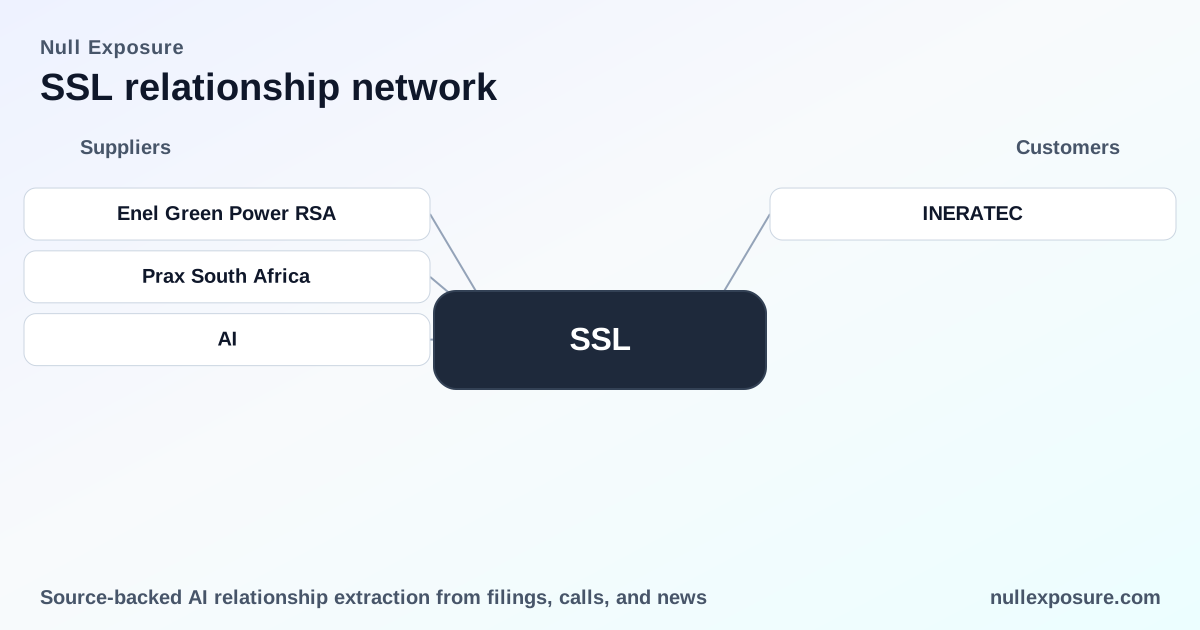
Sasol Ltd (SSL): Supplier Relationships that Drive Secunda and the Balance Sheet
Sasol is an integrated energy and chemicals company that monetizes large-scale hydrocarbons and chemical processing assets through product sales, refinery throughput and industrial feedstock contracts. The company’s earnings depend on continuous feedstock, power and industrial-gas supply into its flagship Secunda complex and related refineries, while capital allocation and margin capture reflect long-term contracts and asset intensity. Investors should treat supplier relationships as strategic levers — they affect operating continuity, capital intensity and margin volatility.
Explore supplier intelligence at https://nullexposure.com/ for deeper coverage.
Why suppliers are strategic for Sasol investors
Sasol’s business model is highly asset-centric: large, integrated plants require uninterrupted power, oxygen and feedstocks. Operational continuity is a revenue driver and a direct determinant of realized margins. Contracts that secure those inputs change cashflow predictability and capital requirements: long-term power purchase agreements (PPAs) and multi-year industrial gas services reduce short-run volatility but lock the company into long-tail commitments. At the same time, concentration of supplier exposure creates single-point failure risk that directly transmits to EBITDA.
The supplier relationships to know today
Below I cover every supplier relationship surfaced in public reporting and news monitoring tied to Sasol’s supplier footprint. Each entry is a concise, plain-English summary with a source reference.
Enel Green Power RSA
According to an Air Liquide press release, Sasol has arranged long-term renewable power capacity including an additional 110 MW supplied by Enel Green Power RSA to support the Secunda site, reflecting moves to diversify power sources for large industrial loads. (Air Liquide press release, Feb 26, 2024; reported in 2026 monitoring).
Source: Air Liquide press release (Feb 26, 2024) reporting PPAs that include Enel Green Power RSA for additional renewable power to Secunda.
Prax South Africa
A March 2026 industry news piece noted that Natref refinery output strengthened partly because of additional volumes linked to Sasol’s stake in Prax South Africa, indicating feedstock and offtake interdependence between Sasol’s downstream operations and regional refinery partners. (TS2 news, March 2026).
Source: TS2 coverage on Sasol’s fuel-sales outlook and Natref output (reported March 2026).
Air Liquide
Air Liquide publicly documents a substantial operational footprint at Secunda, reporting that it operates additional Air Separation Units (ASUs) for Sasol and runs 17 ASUs with total capacity of about 47,000 tonnes/day of oxygen, underscoring the outsized role of industrial-gas supply in sustaining Sasol’s chemical processes. (Air Liquide press release, Feb 26, 2024; highlighted in later monitoring).
Source: Air Liquide press release (Feb 26, 2024) describing ASU operations at Secunda.
What these relationships tell investors about Sasol’s operating posture
The public signals above translate into observable company-level characteristics that investors should treat as constraints on performance and strategy:
- Contracting posture — long-duration commitments dominate. Public reporting and press releases emphasize multi-year PPAs and dedicated industrial services, which increase cashflow visibility but raise long-tail obligations and reduce near-term flexibility.
- Concentration risk — a small set of strategic suppliers. Power and industrial-gas suppliers serve mission-critical functions for the Secunda complex; that concentration creates disproportionate operational and counterparty risk.
- Criticality — supplier inputs are operationally essential. Oxygen and reliable power are not peripheral inputs; interruptions directly cut production and revenue. This elevates supplier credit risk into an operations risk for the company.
- Maturity and capital intensity — entrenched, asset-heavy relationships. The relationships are capital-intensive (ASUs, PPAs) and therefore tend to be long-lived, favoring incumbents and increasing switching costs.
These are company-level signals drawn from public disclosures and news coverage rather than a single contract excerpt.
Investment implications: upside, risk and what to monitor
Sasol’s supplier map creates a mixed investment profile:
- Upside: Long-term PPAs and stable industrial-gas contracts increase predictability of utility costs and support steady-throughput economics at Secunda. Renewable power commitments can reduce fuel volatility exposure over time and potentially lower operating carbon costs.
- Risks: Supplier concentration and the operational criticality of oxygen and power mean outages, contract disputes or counterparty financial stress would propagate quickly to EBITDA. Geopolitical and regional energy access issues (for example, broader Mozambique gas concerns flagged in market commentary) remain a watch item for feedstock and pricing dynamics.
- What to monitor: contract renewal timelines, counterparty creditworthiness, ASU capacity utilization, PPA pricing terms, and operational uptime statistics for Secunda and Natref.
Midway check: if you want case-level intelligence and more granular supplier credit signals, visit https://nullexposure.com/ to request a focused review.
Actionable signals for portfolio managers and operators
- Require management disclosure on supplier contract duration, termination rights and contingency arrangements for mission-critical inputs. Short disclosures on counterparty concentration are insufficient for high-capex operators.
- Stress-test cashflows under scenarios of partial power or oxygen loss for 1–4 weeks — quantify EBITDA and capex implications. Resilience planning should be financially explicit.
- Track regional gas supply headlines and refinery output reports (e.g., Natref) on a monthly cadence; small changes in throughput have outsized P&L effects for integrated feeders.
Bottom line: supplier relationships are balance-sheet drivers
Sasol’s supplier ecosystem — especially large power and industrial-gas arrangements — is central to both operational continuity and financial leverage. For investors, supplier risk is not operational color; it is an earnings and capital-allocation lever. The relationships cited in public reports point to long-term contracts and concentrated, critical counterparties, which should be incorporated into valuation scenarios and active monitoring frameworks.
Final step: to access more in-depth supplier profiles and tailored risk matrices for Sasol, go to https://nullexposure.com/ — our coverage connects disclosures, press reporting and operational signals into investable intelligence.