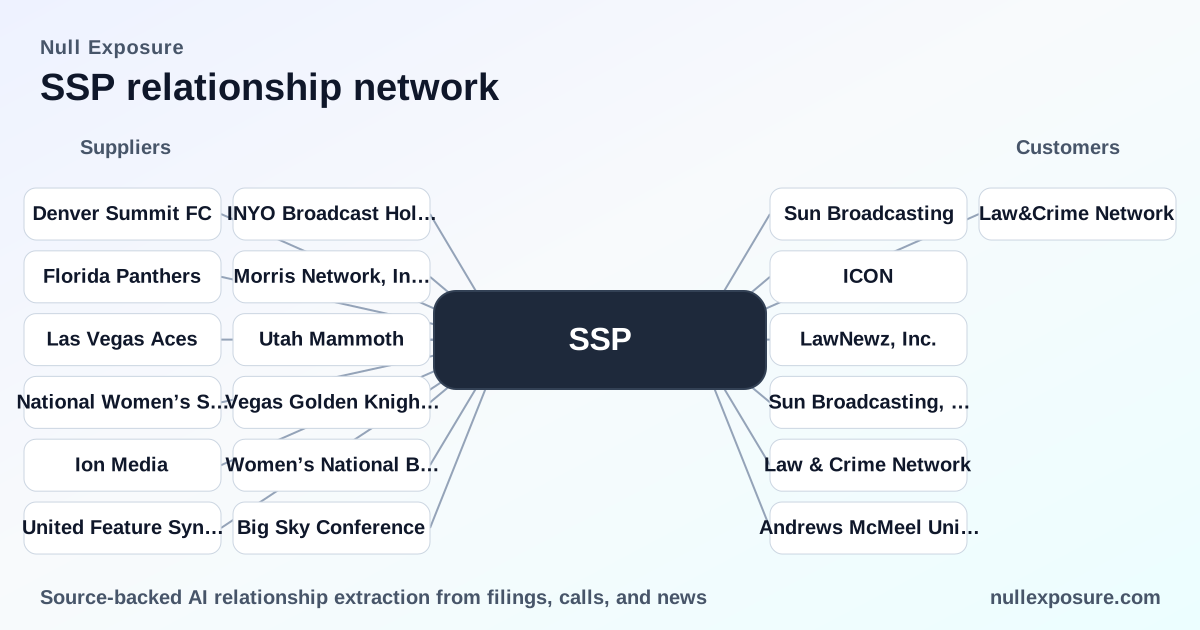
E.W. Scripps (SSP): Supplier relationships that define content reach and capital intensity
E.W. Scripps operates as a local-and-national media owner that monetizes through advertising, retransmission and carriage fees, and distribution of owned content across broadcast affiliates and newly scaled sports-rights channels. The company balances organic audience growth with targeted station acquisitions and sports partnerships to increase local ad inventory and subscription-style carriage revenue, while its supplier posture is characterized by multi-year contracts, licensor dependencies, large fixed commitments and active M&A. For an investor or operator evaluating Scripps as a counterparty, those features create both durable revenue levers and concentrated capital risk. Learn more at https://nullexposure.com/.
How Scripps structures supplier and partner economics
Scripps’s commercial model is built on three predictable primitives: content supply (networks and sports rights), distribution (owned TV stations and local affiliates), and capital allocation (station deals and network acquisitions). Affiliation agreements and long-term supply contracts lock in programming streams and fees, while sports and conference deals extend local exclusivity that drives ad premiums. At the same time, Scripps carries significant contractual commitments, reflecting a capital-intensive operating posture that impacts liquidity and strategic optionality.
According to the company’s disclosures, fixed contractual commitments aggregate materially over multiple years (reported minimum payments include nearly $936 million due in 2025 with follow-on obligations thereafter), underscoring a high spend band and elevated near-term cash commitments (company filing excerpts, Dec 31, 2024). This is a company-level signal of capital concentration and extended payment schedules rather than a single-supplier dependency.
Constraints and what they signal about operating risk
- Long-term contracting posture: Scripps describes supplier agreements that typically run three to five years with fixed-fee payments, indicating predictable expense run-rate but reduced flexibility in a revenue downturn.
- Licensor dependency: The company functions as an affiliate operator — broadcasting programming licensed from major networks in exchange for affiliation fees — which makes programming supply critical to station economics.
- Service-provider relationships: Scripps uses external managed security services and maintains operating leases for offices and data centers, signaling reliance on third-party operations for non-content controls.
- High absolute spend: Reported contractual minimums place Scripps in a $100M+ spend band, a company-level capital intensity signal that constrains balance sheet flexibility.
These constraints create a trade-off: stable, contract-protected inventory and content supply that supports monetization, against concentrated capital obligations that raise execution and refinancing risk.
Catalog of supplier relationships and what each means for investors
Below is a concise, relationship-by-relationship read that covers the reported items in the public record.
-
INYO Broadcast Holdings — Scripps exercised call options to re-acquire 23 ION-affiliated television stations previously divested to INYO for an estimated aggregate purchase price of about $54 million, subject to FCC approvals and walk-away rights (Globe and Mail press report; FY2026). Source: https://www.theglobeandmail.com/investing/markets/stocks/SSP-Q/pressreleases/466781/scripps-extends-ceo-contract-amid-transformation-and-expansion/
-
INYO Broadcast Holdings (earlier reporting) — MarketScreener also recorded Scripps’s agreement to purchase the 23 ION-affiliated stations for $54 million, reflecting a strategic roll-up of distribution assets (FY2024 press coverage). Source: https://www.marketscreener.com/quote/stock/THE-E-W-SCRIPPS-COMPANY-44136878/news/E-W-Scripps-1Q-Revenue-Up-on-Political-Advertising-Push-Begins-Public-Process-for-Sale-of-Bounce-TV-46684085/
-
Morris Network, Inc. — Scripps agreed to purchase WTVQ (Lexington, KY) from Morris Network for $15.8 million, a targeted broadcast acquisition that increases local footprint and ad inventory (announced Mar 4, 2026; also reported in Nov 2025). Source: https://scripps.com/press-releases/scripps-adopts-limited-duration-shareholder-rights-plan/ and https://www.globenewswire.com/news-release/2025/11/26/3195178/0/en/Scripps-adopts-limited-duration-shareholder-rights-plan.html
-
Utah Mammoth — Scripps Sports lists the new Utah Mammoth among its partnerships, indicating local broadcast rights for emerging regional franchises and incremental local sports ad inventory (Sahm Capital coverage, Dec 2025). Source: https://www.sahmcapital.com/news/content/scripps-sports-becomes-local-tv-home-for-nwsls-denver-summit-fc-2025-12-19
-
Vegas Golden Knights — Scripps Sports has partnership ties to the Vegas Golden Knights, reflecting rights and promotional alignments that enhance regional premium sports content (Sahm Capital, FY2025). Source: https://www.sahmcapital.com/news/content/scripps-sports-becomes-local-tv-home-for-nwsls-denver-summit-fc-2025-12-19
-
Women’s National Basketball Association (WNBA) — Scripps Sports lists the WNBA as a partner, signaling national league content relationships that feed local broadcast windows and sponsorship sales (Sahm Capital, Dec 2025). Source: https://www.sahmcapital.com/news/content/scripps-sports-becomes-local-tv-home-for-nwsls-denver-summit-fc-2025-12-19
-
Big Sky Conference — Scripps Sports has a partnership with the NCAA’s Big Sky Conference, which supplies collegiate programming that delivers local and regional viewership spikes and associated advertising revenue (Sahm Capital, FY2025). Source: https://www.sahmcapital.com/news/content/scripps-sports-becomes-local-tv-home-for-nwsls-denver-summit-fc-2025-12-19
-
Denver Summit FC — Scripps Sports secured exclusive local broadcast rights to Denver Summit FC, the NWSL’s new franchise launching in 2026, a move that adds first-mover local exclusivity for women’s pro soccer (Sahm Capital, Dec 2025). Source: https://www.sahmcapital.com/news/content/scripps-sports-becomes-local-tv-home-for-nwsls-denver-summit-fc-2025-12-19
-
Florida Panthers — Scripps Sports counts the NHL’s Florida Panthers among its partnerships, supplying premium sports inventory that commands higher ad rates in local markets (Sahm Capital, FY2025). Source: https://www.sahmcapital.com/news/content/scripps-sports-becomes-local-tv-home-for-nwsls-denver-summit-fc-2025-12-19
-
Las Vegas Aces — Scripps Sports is the local television partner for the WNBA champion Las Vegas Aces, supporting both brand reach and sponsorship monetization in prime markets (Sahm Capital, Dec 2025). Source: https://www.sahmcapital.com/news/content/scripps-sports-becomes-local-tv-home-for-nwsls-denver-summit-fc-2025-12-19
-
National Women’s Soccer League (NWSL) — The company’s sports division has partnerships with the NWSL, anchoring local broadcast agreements and creating recurring seasonal inventory for local advertisers (Sahm Capital, FY2025). Source: https://www.sahmcapital.com/news/content/scripps-sports-becomes-local-tv-home-for-nwsls-denver-summit-fc-2025-12-19
-
Ion Media — Historical reporting notes Scripps’s acquisition of Ion Media in a prior, large-scale transaction (reported FY2020), a strategic purchase that massively expanded national station reach and required substantial capex and integration. Source: https://www.nexttv.com/features/burgess-ponders-what-hell-do-after-selling-ion-media
-
United Feature Syndicate — A historical content supplier to Scripps’s publishing roots, United Feature Syndicate — noted in historical summaries — supplied columns and comic strips that later became valuable intellectual property (Britannica background, FY2025 contextual reference). Source: https://www.britannica.com/money/EW-Scripps-Company
Strategic implications for suppliers and counterparties
- Counterparty criticality: Network affiliation and sports-rights suppliers are critical to Scripps’s revenue generation; those relationships are governed by multi-year contracts that create stability but limited near-term renegotiation levers.
- Concentration of spend: Large multi-year commitments compress flexibility and elevate sensitivity to ad-cycle volatility; suppliers and lenders should price for execution risk over 12–36 months.
- M&A-driven supplier changes: Active station acquisitions and re-acquisitions (e.g., INYO, Morris) change the supplier map and require counterparties to manage integration and regulatory approvals (FCC), which temporarily concentrate operational risk.
- Service-provider dependence: Outsourced security and leased infrastructure represent operational dependencies where supplier performance contributes directly to broadcast continuity and regulatory compliance.
For detailed counterparty diligence and monitoring of Scripps’s evolving supplier map, visit https://nullexposure.com/ to explore structured analysis and alerts.
Bottom line and recommended investor actions
Scripps’s supplier and partner footprint shows a dual strategy of locked-in programming through long-term licensor arrangements and growth via selective acquisitions and sports partnerships. That structure creates predictable revenue streams but also concentrated capital commitments that require close monitoring of cash flow and leverage metrics. Operators and investors should prioritize three actions: (1) stress-test exposure to long-term affiliation fees and sports-rights costs, (2) monitor FCC-driven transaction timing and integration milestones for station deals, and (3) re-evaluate counterparty performance on security and infrastructure services.
For ongoing monitoring and deeper relationship-level intelligence, go to https://nullexposure.com/.