SSR Mining (SSRM): Supplier Relationships and What They Mean for Investors
SSR Mining operates and monetizes by owning and operating precious metals mines across the Americas and Turkey, selling produced gold and silver into global markets while extracting value through concentrated, high-margin operations and periodic asset acquisitions. The company generates revenue from mineral production, benefits from strong operating margins, and supplements growth through strategic M&A — all dependent on a compact network of critical suppliers for site services, utilities, and third‑party technical reviews. For investors, supplier relationships are a channel-level risk and operational lever: they influence cost variability, asset uptime and regulatory remediation exposure.
Learn how SSRM’s supplier footprint drives operational continuity and capital allocation at https://nullexposure.com/.
Quick read: How suppliers tie into SSRM’s economics
SSR Mining’s margin profile (Operating Margin TTM ~43%) and positive free cash generation depend on uninterrupted mineral processing and on-site services. Key suppliers — particularly those delivering utility-scale services like oxygen production and specialized technical consulting — operate under long-term, usage‑linked contracts that create both predictable capacity and exposure to variable costs. Contract structure therefore converts certain fixed-capex advantages into ongoing operating variability that investors must price into forecasts.
What the filings and press disclose — the supplier relationships you should know
Below I cover each supplier relationship found in the source material and the direct citation for each.
-
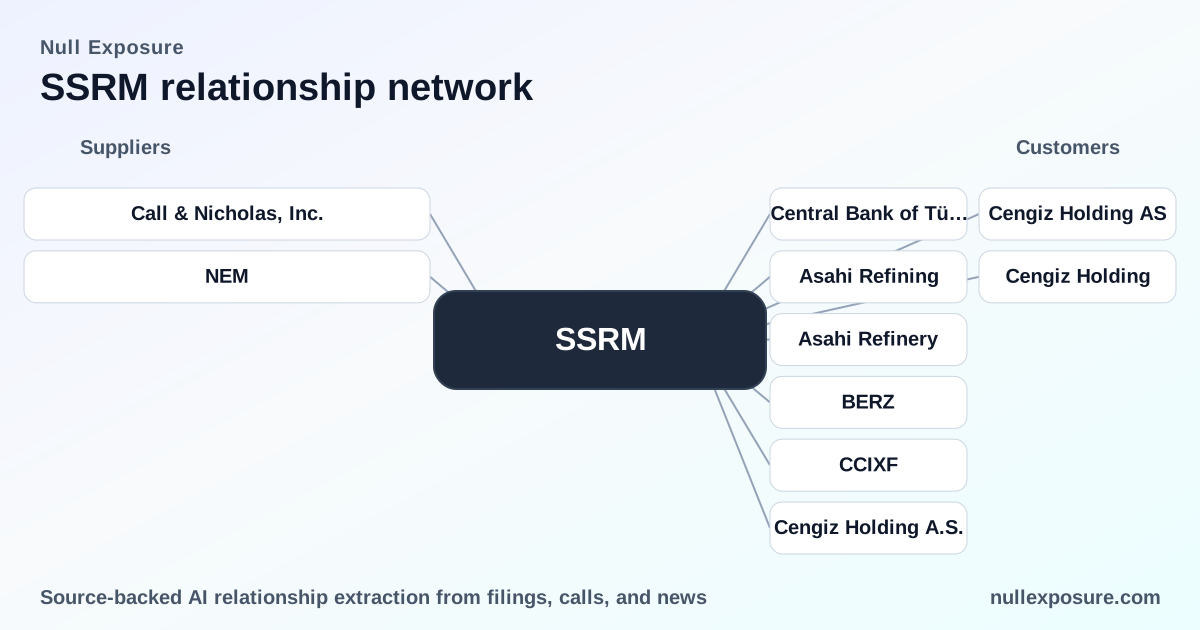
Call & Nicholas, Inc. (CNI) — SSR Mining retained this international mining consulting firm to perform an independent review of a heap leach failure at the Çöpler mine. The engagement is positioned as a technical, third‑party verification and remediation input to SSR’s incident response and disclosures (SSR Mining 2024 Form 10‑K).
According to SSR Mining’s 2024 Form 10‑K, the company commissioned Call & Nicholas to conduct an independent review of the heap leach failure at Çöpler (FY2024 10‑K disclosure). -
Newmont (NEM) — SSR Mining completed an acquisition of the Cripple Creek & Victor Mine in Colorado from Newmont, an asset purchase that transfers operational responsibility and supplier relationships tied to that mine into SSRM’s corporate perimeter. A local news report recounted the closing and timing of the transaction (Elko Daily, March 2026).
A news article in Elko Daily reported that SSR Mining acquired the Cripple Creek & Victor Mine from Newmont in February 2025 (news report, FY2026).
Contracting posture and supplier constraints: what the evidence shows
SSR Mining’s public disclosures and constraint excerpts reveal a mixed contracting posture with clear operational implications:
-
Long‑term contractual commitments for critical site infrastructure. The company disclosed a multi‑year lease for an oxygen production plant (the Air Liquide Plant) at Çöpler that includes a non‑cancellable period and extension options, explicitly tied to the life‑of‑mine planning horizon. This creates a predictable capacity envelope but locks SSRM into multi‑year commitments through at least 2033 with extensions to 2038. (Excerpt evidence in the company’s lease disclosures.)
-
Usage‑based cost structure for certain utility inputs. The same Air Liquide lease contains variable monthly payments pegged to an index and consumption‑based charges that are accounted for in Cost of Sales, converting part of SSRM’s previously fixed input cost into variable expenses. That structure amplifies margins’ sensitivity to production volumes and inflation‑linked indices.
-
Critical service‑provider relationships. SSRM relies on third‑party suppliers for oxygen supply and other mission‑critical services; the company also outsources IT systems and interfaces with external providers. These suppliers function as essential service providers rather than optional vendors, increasing operational and cybersecurity concentration risk where supplier failure would directly affect mining operations.
-
Mid‑sized financing linkages at the company level. A disclosed borrowing capacity connected to related-party or associated entities (Artmin’s loans with Horizon) shows financing exposures in the range of tens of millions of dollars ($10m–$100m), which signals that SSRM has mid‑sized contingent credit and liquidity relationships across its corporate structure.
Collectively, these constraints tell a consistent story: SSR Mining locks in long-term capability through outsourced infrastructure while shifting some cost risk to variable, usage‑linked payments. That model supports operational scale but elevates sensitivity to volume swings and index‑linked cost inflation.
How each supplier relationship changes the risk‑return profile
-
Call & Nicholas, Inc.: The technical review engagement is a governance and remediation control. For investors, this reduces information asymmetry around the Çöpler incident and supports faster regulatory closure; it is not revenue‑generating but decreases execution and legal risk by providing independent engineering validation (SSR 2024 10‑K).
-
Newmont: The purchase of Cripple Creek & Victor expands SSRM’s asset base and transfers legacy supplier arrangements into SSRM’s P&L. This deal materially increases production optionality and integrates new supplier contracts that will drive near‑term capex and opex choreography; acquisition‑driven growth increases both earnings leverage and supplier integration risk (Elko Daily, March 2026).
-
Air Liquide (contract excerpts): While not listed among the results, the lease excerpts explicitly name Air Liquide and reveal a strategic supplier relationship with long-term tenure and consumption‑linked billing. This is a critical supplier for Çöpler’s oxygen requirements and therefore a potential single‑point operational dependency (lease disclosures).
Investment implications and what to watch next
- Monitor cost indexation and production volumes: Because oxygen and other utilities are usage‑based and indexed, near‑term margin variability will track production throughput and commodity cost inflation. Forecasts must include indexed operating cost escalation, not just commodity price moves.
- Watch supplier concentration and contingency plans: SSRM relies on a small number of critical providers for plant utilities and third‑party services; any operational disruption at these suppliers would have outsized impact on mine uptime. The company’s use of independent consultants like Call & Nicholas is a positive governance signal but does not eliminate operational concentration.
- M&A integration execution is pivotal: The Cripple Creek & Victor acquisition increases scale but requires rapid supplier and workforce integration to realize synergies and avoid one‑off execution costs.
If you want a deeper supplier‑level risk map and to track supplier contracts that affect SSRM’s valuation, explore full relationship analytics at https://nullexposure.com/.
Bottom line: read supplier contracts like capital projects
SSR Mining’s profitability and future multiple will be driven as much by how it manages supplier commitments and indexed costs as by metal prices. Long‑term leases for critical plants provide capacity certainty but transfer inflation and consumption risk into operating lines; acquisition activity boosts scale while importing new supplier dependencies. Investors should underwrite SSRM not only as a gold producer but as a company managing a compact set of high‑criticality, long‑duration supplier contracts.
For ongoing monitoring and supplier disclosure tracking on SSRM and peer producers, visit https://nullexposure.com/ for structured relationship intelligence and alerts.