SSS supplier intelligence: what investors and operators should know
SSS operates as a solutions provider that sells products and services to corporate and consumer clients, monetizing through direct commercial sales and ongoing service delivery tied to sustainability and technology-driven efficiency. The business model is revenue-first and client-facing: value is captured at the point of sale and through client retention, not via financial engineering, which makes supplier continuity and brand alignment key operational levers. For a deeper supplier-risk briefing and to map counterparty exposure to business outcomes, visit https://nullexposure.com/.
How SSS runs the supply side of the business (what the public signal shows)
Public information on SSS is sparse: the company overview returned with generic positioning, and nearly all standard financial and disclosure fields are blank or zero. That absence of supplier-level constraints or contract disclosures in public records is itself a material signal — it indicates limited public visibility into supplier terms, concentration, and operational criticality. From an investor and operator perspective, that translates into three practical inferences about SSS’s operating model:
- Contracting posture: Lack of disclosed supplier constraints points to a standard, flexible contracting posture rather than a heavily centralized or long-dated supplier lock-in. Investors should not assume long-term exclusivity or favorable supplier economics without direct confirmation.
- Concentration and criticality: Without supplier lists or constraint excerpts, supplier concentration is unknown; therefore, the default risk assumption is elevated until primary suppliers and their revenue exposure are verified.
- Maturity of supplier governance: Sparse public signals suggest supplier governance and disclosure practices are immature or not aimed at public transparency, which increases the need for targeted diligence before underwriting material exposure.
These are company-level signals based on the absence of constraints in the record; no constraint excerpt ties these characteristics to any specific counterparty.
Material relationship identified in the public record
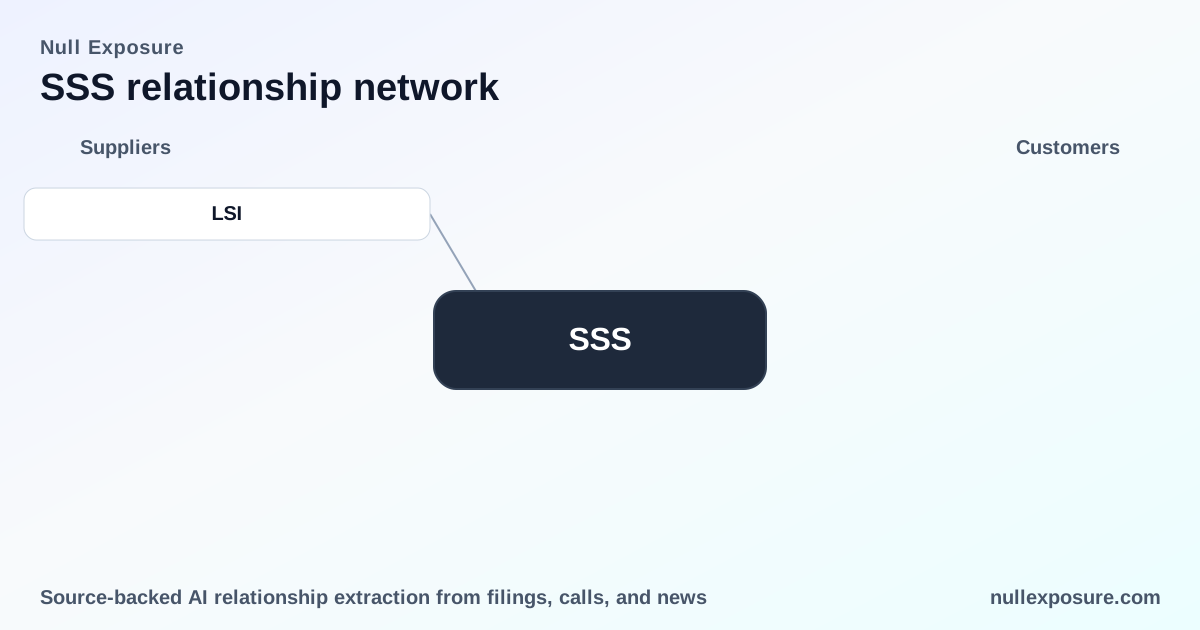
SSS’s supplier-scope results include one discrete relationship record in news sentiment; every item returned by the dataset is covered below.
Life Storage (LSI) — a news-driven link to the self-storage sector
A March 10, 2026 SpareFoot article reported that Sovran Self Storage completed a $1.3 billion acquisition of 84 stores from Life Storage and retired the Uncle Bob’s Self Storage brand following the deal. The record links Life Storage to SSS’s supplier scope via news sentiment, with the relationship indexed as FY2024 and first seen in March 2026. According to SpareFoot, the acquisition and brand transition were the primary news items (SpareFoot, March 10, 2026).
What that Life Storage mention means for SSS relationships
The Life Storage entry is a news-sentiment hit rather than a supplier contract excerpt, so the record documents market activity involving Life Storage but does not confirm the nature, duration, or financial terms of any SSS–Life Storage commercial relationship. Investors should treat this as a pointer that SSS’s public footprint intersects with counterparty activity in the self-storage sector, not as proof of material supplier dependence.
Operational implications and what to verify immediately
This data slice creates a short, actionable diligence list for investors and operators evaluating SSS supplier exposure:
- Confirm counterparty role. Determine whether Life Storage (or similar entities in the self-storage or property services sector) supplies services or products to SSS, or whether the mention reflects third-party market coverage unrelated to work-for-hire or supply contracts.
- Request primary contracts. Secure copies of material supplier agreements, focusing on term, termination rights, exclusivity, and service-level commitments.
- Assess concentration. Obtain a supplier spend and revenue-at-risk schedule to quantify single-supplier exposure and the financial impact of supplier transitions.
- Validate transition plans. If suppliers are changing brand ownership or consolidating (as Life Storage’s transaction illustrates), confirm SSS’s operational contingency and vendor-replacement playbooks.
For direct supplier-mapping and access to ongoing monitoring tools, go to https://nullexposure.com/ — the platform centralizes supplier signals and helps convert sparse public records into actionably prioritized diligence.
Key risks exposed by the record
- Information opacity: Public profiles and financial fields for SSS are largely blank; lack of disclosure is an immediate governance and informational risk that increases due diligence cost and execution risk for new investments.
- Event-driven noise: The single relationship in the results stems from a sector acquisition story; news-driven matches can confuse vendor exposure with market activity unless reconciled against contract-level data.
- Concentration uncertainty: No supplier constraints are recorded, so supplier concentration risk is unquantified and must be assumed non-trivial until vendor spend is validated.
Practical next steps for investors and operators
- Demand a supplier roster and top-10 vendor spend for the last 24 months.
- Obtain redacted copies of any master services agreements that drive material recurring cost or revenue linkage.
- Build a transition-cost estimate for replacing top vendors and stress-test scenarios where a major supplier exits or consolidates (the Life Storage acquisition is a practical scenario to model).
- Integrate a monitoring feed for brand and ownership changes among critical suppliers; leverage market-news signals to trigger contract reviews.
Bottom line: what to act on now
SSS’s public supplier record is light but not silent: a single news-sentiment hit ties the company’s supplier universe to activity in the self-storage sector, and the broader lack of constraints in public data is a meaningful governance signal that elevates the need for primary-document diligence. Prioritize confirming the nature of the Life Storage mention, validate top-vendor exposure, and secure primary contracts before sizing material investment or operational commitments.
For a structured supplier-risk briefing and continuous monitoring tailored to SSS, visit https://nullexposure.com/ — the platform converts limited public signals into prioritized, actionable intelligence for investors and operators.