ShotSpotter (SSTI) — supplier relationships and operational constraints investors should price in
ShotSpotter (SSTI) sells a SaaS-enabled public safety platform built around its acoustic gunshot detection sensors, law-enforcement search tools, and a suite of adjunct security products; the company monetizes through recurring municipality and campus subscriptions for ShotSpotter services, hardware sales of proprietary sensors, and licensing/partnership integrations for complementary products. Revenue is a mix of recurring software service fees and hardware procurement, which concentrates economic exposure on the company's sensor manufacturing and third-party integrations. For deal teams evaluating vendor risk or investors modeling downside scenarios, these supplier linkages and the company's contracting posture are primary inputs. Learn more about supplier intelligence at the NullExposure homepage: https://nullexposure.com/
Industry context and investment thesis ShotSpotter positions itself as a platform player in public safety: acoustic sensors and network infrastructure feed cloud analytics and investigator tools that lock municipalities into ongoing subscriptions and incident-response workflows. The combination of hardware dependence and recurring software pricing creates dual risk drivers — supply-chain concentration for sensors and service concentration for key third-party integrations — that materially affect cash flow continuity and growth scalability.
What follows is a concise, relationship-by-relationship read on every supplier mentioned in recent coverage, followed by a company-level synthesis of contracting, concentration, and criticality.
Key relationships you need to know
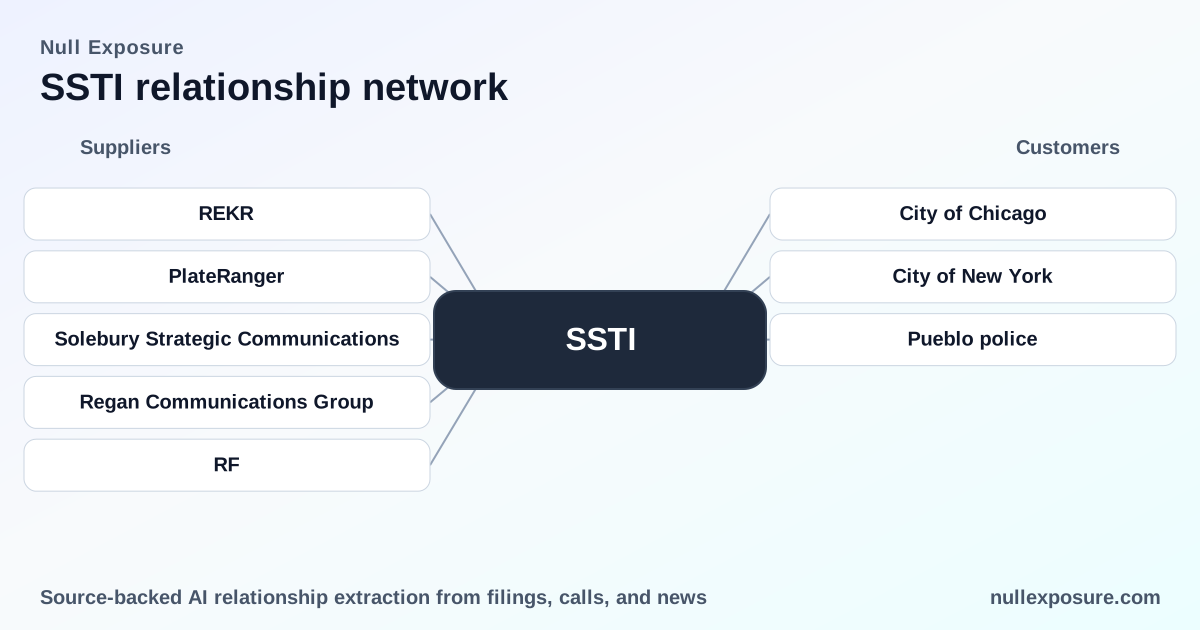
Rekor (REKR) Rekor is cited repeatedly as the provider behind PlateRanger, an automatic license-plate recognition (ALPR) integration that SoundThinking includes within its SafetySmart platform; ShotSpotter bundles PlateRanger as a third-party capability to augment investigations and situational awareness. According to multiple company press releases and media summaries in late 2025, PlateRanger is described as “powered by Rekor,” signaling a strategic product-level integration rather than an equity tie (GlobeNewswire and related press, Oct–Dec 2025).
PlateRanger (product) PlateRanger appears in media coverage as an integrated solution used in campus and municipal deployments to enhance perimeter and vehicular tracking alongside ShotSpotter sensors; communications in late 2025 reference campus deployments and public-safety use cases where PlateRanger complements acoustic detection. TradersUnion and other market write-ups in FY2025–FY2026 discussed PlateRanger’s role in campus security and incident follow-ups (TradersUnion, FY2025–FY2026).
Solebury Strategic Communications Solebury Strategic Communications is identified as ShotSpotter’s investor relations / PR firm and contact for several press releases; investor-relations messaging is routed through Solebury, indicating an ongoing retained communications relationship. The company’s press releases list Ankit Hira at Solebury as the IR contact across FY2025–FY2026 announcements (GlobeNewswire and press distributions, Oct 2025–Feb 2026).
Regan Communications Group Regan Communications Group is listed as a media contact in a product announcement, indicating ad-hoc or campaign-level PR support for specific launches rather than sole-agency control of corporate communications. A press release in Oct 2025 referenced David Procopio at Regan for media relations tied to product messaging (GlobeNewswire, Oct 2025).
Regions Bank Tower (lease) ShotSpotter opened a permanent Alert Review Center in downtown Orlando occupying 1,872 square feet under a three‑year renewable lease in the Regions Bank Tower, which signals a near-term fixed-cost commitment and geographic anchoring for SafePointe operations. Coverage of the Orlando center and the lease terms was published in late 2025 (Globe and Mail/GlobeNewswire, Oct 2025).
How these supplier signals shape operational risk and valuation ShotSpotter’s supplier mix reveals four structural characteristics investors must price:
-
Concentrated manufacturing exposure. Management disclosures indicate a single contract manufacturer produces the proprietary ShotSpotter sensors and is engaged on a purchase-order basis without a long-term manufacturing contract. This is a material, and partially critical, single-point dependency for physical product fulfillment. The company recognizes that interruptions at this manufacturer would cause material costs and delays that would adversely affect operations (company filings, FY2025 disclosures).
-
Licensing and third-party software reliance. ShotSpotter explicitly licenses third‑party software and depends on third‑party services for components of its solutions, making integration partners like Rekor economically important for feature breadth and upsell potential (company statements on licensed software, FY2025).
-
Geographic concentration of components. Standardized sensor components are manufactured in concentrated regions, particularly Greater China, which concentrates geopolitical, logistics, and quality risks into a small set of nodes (management disclosures on supply geography, FY2025).
-
Service-provider dependencies beyond manufacturing. The company relies on wireless carriers for sensor connectivity and uses external cybersecurity consulting and managed detection services; these service relationships are operationally critical to uptime and trust in the platform (FY2025 risk disclosures).
Contracting posture, concentration, criticality, maturity — what to model
-
Contracting posture: transactional, purchase-order manufacturing rather than long-term, capacity-guaranteed contracts increases supply-side elasticity but raises execution risk; investors should assume a non‑locked manufacturing relationship unless a new supplier contract is disclosed.
-
Concentration: high, both for the proprietary sensor manufacturer and for component sourcing regions; model scenarios with multi-week lead-time shocks and price dislocations.
-
Criticality: sensors are mission-critical to the recurring revenue base — hardware unavailability directly limits new deployments and can constrain revenue recognition tied to hardware delivery and activation.
-
Maturity of supplier relationships: PR and IR relationships (Solebury, Regan) suggest institutionalized investor communications, but these do not offset operational supply concentration; the Orlando lease illustrates a disciplined rollout of permanent operations for SafePointe deployments (FY2025–FY2026 press).
Risk-adjusted actionables for investors and operators
-
For valuation: apply discounted cash flow stress to recurring revenue growth tied to sensor rollouts and add a near-term capex/supply-disruption haircut to margins for at least one fiscal year following any major supply interruption.
-
For procurement diligence: prioritize confirmation of long-term manufacturing commitments, alternative-source readiness, and inventory buffer plans; absence of contract manufacture agreements implies near-term negotiating leverage for suppliers.
-
For partner diligence: quantify revenue and expansion potential tied to Rekor/PlateRanger integrations separately from core ShotSpotter subscriptions; partnerships that broaden addressable markets can partially mitigate hardware bottlenecks.
If you want systematic tracking of these supplier signals and how they change over time, visit the NullExposure homepage for tailored supplier intelligence: https://nullexposure.com/
Closing synthesis and investor checklist ShotSpotter is a platform with a duality of recurring SaaS economics and concentrated hardware exposure; the single-source manufacturing posture, reliance on third-party licensed software for adjunct features, and localized component manufacturing in Greater China are the principal operational concentrations investors must price into downside scenarios. For deal teams, the near-term priority is verification of manufacturing continuity and contractual remedies for supply interruptions; for equity analysts, incorporate a supply‑side disruption probability into revenue trajectory and margin sensitivity. For continuous monitoring and to see how these relationships evolve in real time, return to the NullExposure homepage: https://nullexposure.com/