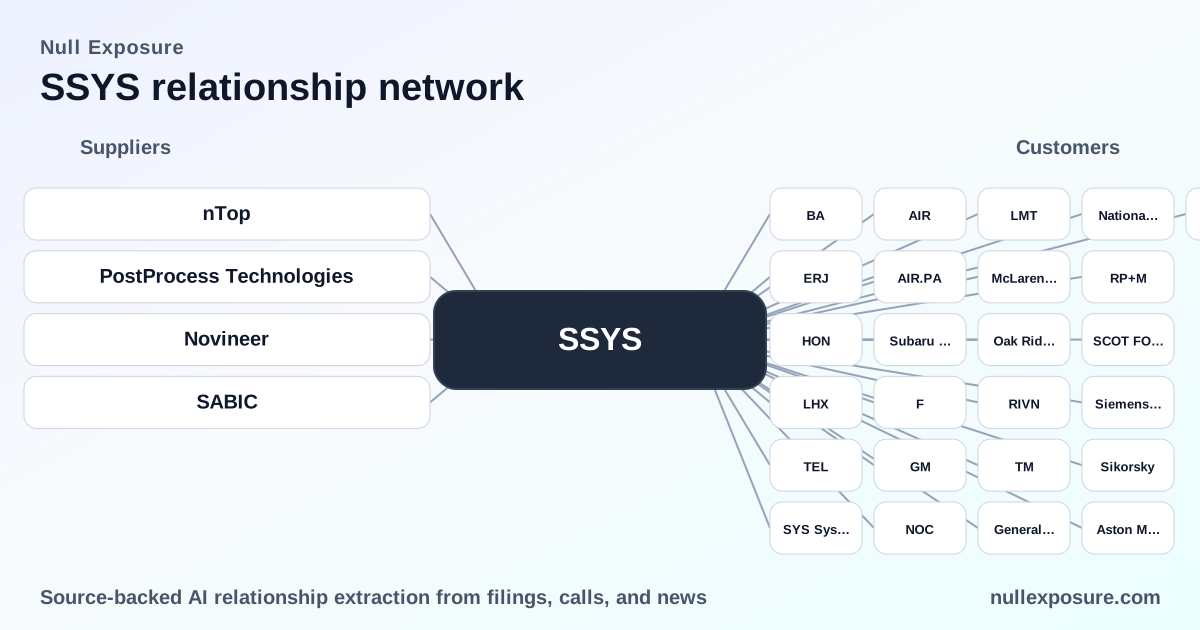
Stratasys (SSYS) — Supplier relationships that shape revenue streams and execution risk
Stratasys sells connected, polymer-based 3D printing systems and complementary software and materials, monetizing through capital equipment sales, recurring consumables and material licenses, and paid software integrations for professional workflows. Revenue depends on hardware placement plus an expanding software and validated-solution ecosystem that locks customers into recurring spend. For investors evaluating supplier counterparty risk and strategic positioning, the partner list signals a deliberate move to capture value beyond machines and into workflows and materials licensing. Explore detailed supplier intelligence at Null Exposure.
How Stratasys builds a commercial moat
- Stratasys drives hardware sales and aftermarket revenue through material licensing (e.g., ULTEM), validated post-processing as a bundled purchase, and embedded simulation/printing software that shortens customer time-to-value.
- The company’s financials show $551.1M revenue TTM with negative EPS and slim operating margins, so partnerships that accelerate adoption and reduce customer friction are central to achieving scale and margin expansion.
- High institutional ownership (62%) and a mixed analyst view (buy/strong-buy leaning) reflect investor focus on execution from product-led partnerships.
Partnerships and supplier relationships investors should track Stratasys has publicly disclosed several supplier and partner relationships that directly affect product capability, customer onboarding, and materials supply. Each relationship below is summarized with the cited source.
nTop — design and simulation integration for professional workflows
Stratasys integrated nTop’s generative modeling and simulation technology into GrabCAD Print Pro to strengthen design-to-print workflows and reduce development cycles for complex parts. This integration is positioned as a workflow acceleration play to improve machine utilization and customer ROI. (InsiderMonkey Q4 2025 earnings call transcript, posted March 10, 2026)
PostProcess Technologies — validated post-processing sold alongside systems
Stratasys announced PostProcess as a first partner for validated post-processing equipment that customers can buy in a single Stratasys order alongside printers, simplifying procurement and deployment of end-to-end solutions. This creates a bundled offering that drives higher average transaction value on system sales. (InsiderMonkey Q4 2025 earnings call transcript, posted March 10, 2026)
Novineer — NoviPath FDM performance simulation with GrabCAD Print Pro
Stratasys partnered with Novineer to integrate NoviPath, a polymer performance simulation solution, with GrabCAD Print Pro to reduce physical testing time and costs for load-bearing parts, thereby accelerating qualification cycles for industrial customers. This is deployed as a targeted productivity enhancement for engineering users. (Business Wire / Morningstar press release, Dec 17, 2025)
SABIC — licensed materials (ULTEM and related trademarks)
Stratasys uses SABIC-licensed trademarks such as 9085 and ULTEM™ and states these are used under license from SABIC or affiliates, reflecting a formal licensing relationship for critical high-performance thermoplastics used in aerospace and industrial applications. Control of licensed material is a commercial dependency for certain end markets. (Business Wire / Morningstar press releases, Dec 17, 2025 and Dec 10, 2025)
What these relationships reveal about operating model and risk posture Stratasys’ supplier mix reveals a clear strategic posture: shift value capture from hardware alone into software-enabled workflows and validated solution bundles. That creates four investor-relevant characteristics:
- Contracting posture: Stratasys uses a mix of licensing (materials), OEM or distribution bundling (post-processing equipment), and integration partnerships (simulation/software). This hybrid contracting approach optimizes for customer stickiness and recurring revenue while outsourcing specialized capabilities.
- Concentration signal: While no single partner dominates disclosure, the SABIC material license represents a higher criticality link for high-performance thermoplastic applications; software partners broaden capability without heavy capital commitment from Stratasys.
- Operational criticality: Materials licensing for ULTEM is operationally critical in aerospace-grade segments because material certification and proprietary formulations directly affect part acceptance. Software and post-processing partners are strategically critical for market adoption and customer retention through workflow simplification.
- Maturity and sourcing: SABIC is an established global supplier consistent with mature supply arrangements; Novineer, nTop, and PostProcess represent modern, software-centric collaborators intended to speed product development and reduce friction for industrial buyers.
Constraints and governance signals
- The available relationship data set contains no extracted contractual constraints (no explicit limits, termination clauses, exclusivity statements, or modeled supply covenants were pulled), so there are no direct, public red flags in the supplied constraint feed. This absence should be treated as a neutral signal and not as proof of absence of contractual risk in real-world agreements.
- Company-level implication: investors should assume standard commercial licensing and integration agreements exist and should probe for exclusivity, supply continuity, and price escalation clauses where materials like ULTEM are mission-critical for end customers.
Mid-report action suggestion If you are underwriting execution risk or supplier concentration for Stratasys, augment this partner view with targeted diligence on material supply continuity (SABIC), validated post-processing contractual terms (PostProcess), and software commercialization economics (Novineer, nTop). Get deeper supplier coverage at Null Exposure.
Valuation and portfolio implications
- Catalyst: Software and validated-solution integrations are direct levers to increase recurring revenue and aftermarket margin; successful enterprise workflows reduce churn and support higher utilization of installed base.
- Risk: Material-license dependency and negative EPS create execution risk; if licensing terms shift or supply tightens, margin recovery will be harder. SABIC’s licensed materials are the largest single operational dependency disclosed.
- Investor action: For growth-oriented investors, monitor adoption metrics for GrabCAD Print Pro integrations and bundled system+post-process order penetration; for risk-averse holders, prioritize transparency on material supply agreements and contingency plans.
Final takeaways and next steps
- Stratasys is transitioning from hardware vendor to workflow platform provider, using partnerships to deliver integrated solutions that command higher total contract values.
- Material licensing (SABIC) is a strategic dependency; software and post-processing partners are strategic levers to accelerate revenue per customer.
- For a focused supplier diligence packet and ongoing supplier monitoring, visit Null Exposure to align supplier intelligence with investment thesis and operational due diligence.