Sensata Technologies (ST): Why the March 2026 liability-management roster matters to suppliers and investors
Sensata Technologies manufactures sensors, sensor-based solutions and control systems and monetizes primarily through product sales to automotive, industrial and other equipment OEMs worldwide; the company converts engineering scale and factory throughput into recurring revenue and aftermarket follow-on sales, supporting a gross profit of roughly $1.08 billion on $3.70 billion in trailing revenue and an operating margin near 15%. The March 2026 filings and press release around a cash tender offer show Sensata actively managing its capital structure with top-tier banks and a specialized tender agent engaged—an action that affects counterparty exposures, cash priorities and the optionality around future supplier investments. For investor diligence and supplier oversight, this is a liquidity and governance signal worth tracking.
Explore connected supplier intelligence at https://nullexposure.com/.
Why the selected advisers matter for supply-side stakeholders
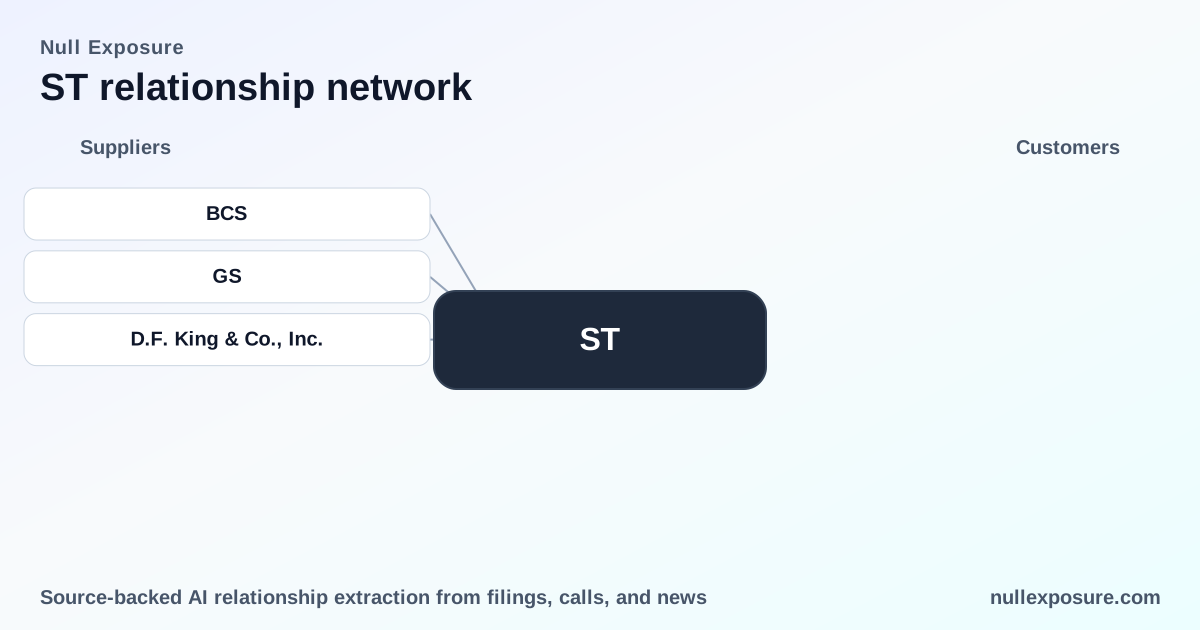
Sensata retained Barclays Capital and Goldman Sachs as Dealer Managers and D.F. King as the tender and information agent for a March 2026 cash tender offer for senior notes. These appointments are not routine bookkeeping: engaging global banks and a recognized tender agent signals a formal debt-repurchase program with institutional distribution mechanics, which impacts near-term cash flow priorities and covenant monitoring. Institutional counterparties managing the tender increase the visibility of the process to bondholders and to large commercial suppliers who need clarity about working capital continuity.
A March 10, 2026 news release covering the tender offers lists Barclays Capital Inc. and Goldman Sachs & Co. LLC as Dealer Managers and D.F. King & Co., Inc. as the Tender and Information Agent. According to that press release on AIJourn, those firms are the named external partners running the transaction. (AIJourn, March 10, 2026 — https://aijourn.com/sensata-technologies-holding-plc-announces-cash-tender-offers-by-certain-subsidiaries-for-senior-notes/)
Who’s on the roster — and what each role means for counterparties
- Barclays Capital Inc. — Barclays is retained as a Dealer Manager to execute the tender offer, coordinating buy-side outreach and pricing for the exchanged notes, which drives how quickly Sensata reduces debt outstanding and reallocates cash. According to the March 10, 2026 press release on AIJourn, Barclays is one of two Dealer Managers for the transaction.
- Goldman Sachs & Co. LLC — Goldman Sachs shares Dealer Manager duties and will execute distribution and investor engagement for the tender offer, directly influencing acceptance rates and execution costs on the liability-management program. The same March 10, 2026 news release lists Goldman Sachs as a Dealer Manager.
- D.F. King & Co., Inc. — D.F. King is the appointed Tender and Information Agent, responsible for handling the offer documents and investor communications, which centralizes information flow and reduces legal ambiguity for noteholders and large suppliers monitoring covenant outcomes. The AIJourn release specifies D.F. King as the tender and information agent and provides contact routing for offer materials (AIJourn, March 10, 2026).
What these relationships mean for Sensata’s operating model and supplier posture
Sensata’s own disclosure that “we manufacture most of our products, subcontracting only a limited number to third parties” is a company-level signal about its contracting posture: the firm runs a vertically integrated manufacturing model that lowers supplier concentration but shifts operational risk inward. That posture implies the following business-model characteristics:
- Contracting posture: Direct manufacturing reduces supplier dependence, giving Sensata more control over quality and lead times but concentrating operational risk in its own facilities and capital expenditure cycles.
- Concentration: Limited subcontracting reduces external supplier concentration risk, but the company remains exposed to a narrower set of internal production sites and critical equipment vendors.
- Criticality: For OEM customers, Sensata’s components are mission-critical; for Sensata, retaining capital flexibility to service debt and invest in production is equally critical. The March 2026 tender process shifts cash allocation priorities toward liability management.
- Maturity: High institutional ownership and an established adviser lineup indicate a mature, widely followed issuer that runs formal capital markets processes rather than ad hoc financing.
Key investor takeaway: the combination of internal manufacturing focus and active liability management implies Sensata prioritizes control over operations while using capital-markets tools to manage financial risk—this is positive for supply reliability if cash for capex remains available, and negative if liability reductions materially constrain working capital.
How the tender-agent and banks change supplier risk calculus
The selection of Barclays and Goldman Sachs as Dealer Managers and D.F. King as the Tender Agent accelerates bondholder communications and puts the liability-management outcome into a compressed timeline. For suppliers and procurement teams, the implications are concrete:
- Near-term cash priority shifts. A successful tender will require cash outflows or new financing; suppliers should monitor projected cash burn and covenant headroom.
- Improved transparency but faster resolution. Professional dealers and a dedicated agent reduce uncertainty about the process, yet the rapid execution typical of Dealer-Manager-led tenders compresses the window for suppliers to adjust exposure.
- Counterparty signaling. Using major banks and a specialist tender agent signals sufficient scale and governance to execute complex debt actions—a vote of confidence in management’s capability to handle capital structure workstreams.
If operational suppliers require further reassurance, they should request updated cadence on covenant metrics and cash flow forecasts tied to the tender timeline.
Explore supplier-specific risk reports and counterparty histories at https://nullexposure.com/ to align procurement and treasury actions.
Relationship-by-relationship concise notes (one place for diligence)
Barclays Capital Inc.: retained as a Dealer Manager for Sensata’s March 2026 cash tender offer, responsible for investor outreach and execution mechanics for the notes tender. (AIJourn press release, March 10, 2026 — https://aijourn.com/sensata-technologies-holding-plc-announces-cash-tender-offers-by-certain-subsidiaries-for-senior-notes/)
Goldman Sachs & Co. LLC: also retained as a Dealer Manager alongside Barclays to manage distribution and investor engagement for the tender offer, shaping acceptance dynamics and pricing. (AIJourn press release, March 10, 2026 — https://aijourn.com/sensata-technologies-holding-plc-announces-cash-tender-offers-by-certain-subsidiaries-for-senior-notes/)
D.F. King & Co., Inc.: appointed as the Tender and Information Agent to administer offer materials and investor communications, centralizing responses and document distribution for the tender. (AIJourn press release, March 10, 2026 — https://aijourn.com/sensata-technologies-holding-plc-announces-cash-tender-offers-by-certain-subsidiaries-for-senior-notes/)
Investment implications and recommended next steps for suppliers and investors
For investors, the engagement of leading Dealer Managers and a specialist tender agent is consistent with an issuer seeking orderly liability reduction while preserving market access; Sensata’s operating metrics (about $3.70B revenue TTM, operating margin approx. 15%) support a runway for professional liability-management activity. For large suppliers, the immediate priority is securing clarity on cash-conversion cycles and whether the tender consumes operational liquidity versus refinancing.
Actionable next steps:
- Request the latest covenant compliance schedule and projected cash flow statement covering the tender window.
- For procurement and treasury: align payment terms and optional contingency inventory actions to the tender timeline.
- For investors: track acceptance rates and subsequent debt outstanding; a successful tender reduces gross leverage and improves credit optionality.
For access to a consolidated view of Sensata’s counterparty roster and tailored supplier risk scoring, visit https://nullexposure.com/ — useful for procurement and investor diligence alike.
Final read: the strategic mix matters
Sensata’s dealer and agent selections for the March 2026 tender reflect a structured, institutionally managed liability action that reduces ambiguity for creditors and suppliers while re-prioritizing near-term cash flows. Suppliers should interpret this as a signal to shore up visibility into cash and covenant dynamics; investors should treat successful execution as an improvement in capital structure optionality. For tailored counterparty reports and deeper supplier relationship analytics, see https://nullexposure.com/.