STAG Industrial: how supplier relationships and capital partners shape growth and risk
STAG Industrial is a single‑tenant industrial REIT that acquires, owns and operates freestanding warehouse and light industrial properties across the United States and monetizes through rental cash flows, portfolio disposal gains and opportunistic equity raises. Its operating model is acquisition‑driven: STAG sources assets from institutional builders and owners, stabilizes occupancy under long‑term leases, and uses capital markets—including an at‑the‑market (ATM) equity program—to fund growth and recycle capital. For investors, the combination of predictable cash rents and active capital deployment defines both upside and execution risk.
Explore more company relationship analysis at https://nullexposure.com/.
What the recent supplier activity tells investors about STAG’s playbook
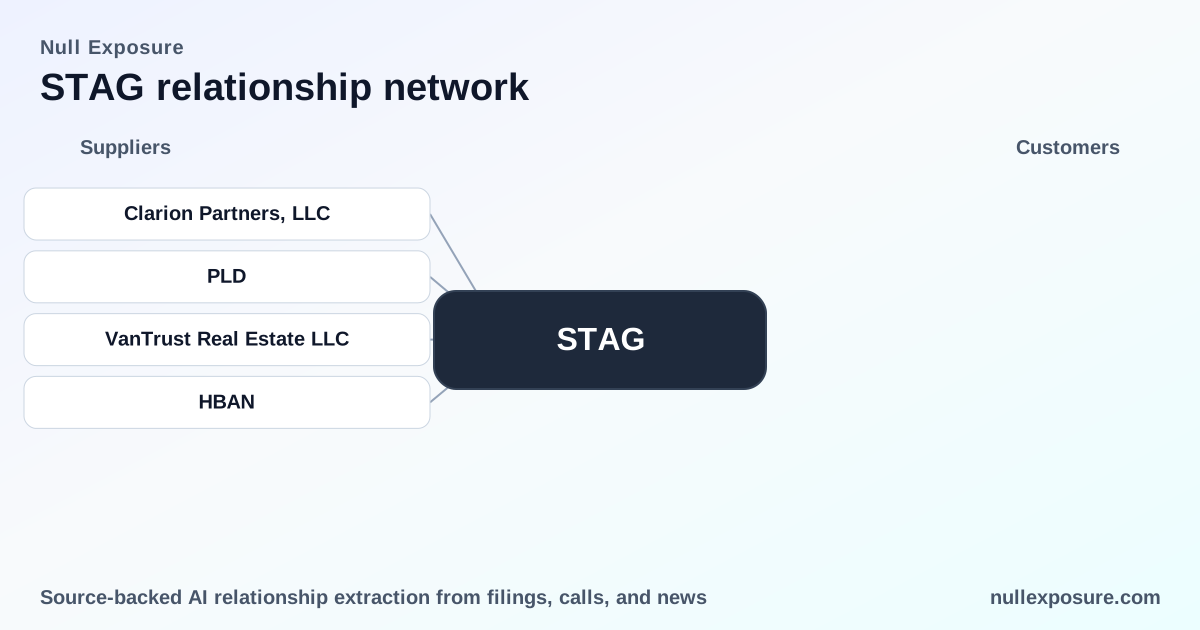
STAG’s FY2026 activity shows an explicit preference for transacting with institutional industrial developers and owners—companies that can deliver large, stabilized buildings or scale product quickly. These acquisitions are accretive to scale and maintain STAG’s single‑tenant footprint, but the pattern also highlights dependence on a relatively narrow pool of industrial sellers for growth.
STAG’s ATM expansion and the addition of Huntington Securities as a syndicate member underscore a capital‑markets‑oriented financing posture: the company is prepared to dilute equity opportunistically to support acquisitions rather than relying exclusively on debt. This increases funding flexibility while transferring execution risk to capital markets performance and investor appetite.
If you track counterparty exposure and capital partners for portfolio construction, our coverage links relationship detail to real investment considerations: https://nullexposure.com/.
How these supplier and capital relationships map to STAG’s operating constraints
STAG’s public information does not list formal operational constraints from supplier contracts, but the relationship pattern implies key company‑level signals investors must weigh:
- Contracting posture: STAG transacts through outright purchases from institutional owners rather than complex JV or build‑to‑suit structures, signaling a preference for asset acquisition and control versus development partnerships.
- Concentration considerations: Regular purchases from large industrial developers create a reliance on a limited universe of counterparties capable of delivering large, single‑tenant properties; this is a growth concentration risk rather than an immediate counterparty solvency issue.
- Criticality of partners: Sellers like Prologis and VanTrust are high‑quality counterparties whose inventories are important to STAG’s ability to scale quickly; these relationships are strategically useful but not operationally critical on a day‑to‑day leasing basis.
- Maturity and scale: Transactions recorded in FY2026 indicate STAG sources mature, income‑producing assets as a primary growth vector rather than early‑stage development partnerships.
Taken together, these signals reflect a mature acquisition program supported by active equity issuance, with supplier concentration and capital‑market dependency as the principal strategic tradeoffs.
On the capital side: ATM syndicate expansion and what it means
STAG expanded its ATM equity distribution syndicate in FY2026, adding Huntington Securities as a sales agent and forward counterparty. This is a clear financing lever for maintaining acquisition cadence without materially increasing leverage, but it also exposes timing and dilution risk to market conditions. Investors should monitor issuance volumes relative to acquisitions and the company’s stated $750 million ATM capacity for signs of acceleration or retrenchment.
If you rely on counterparty and capital‑markets intelligence for investment decisions, find additional relationship context at https://nullexposure.com/.
Relationship-by-relationship breakdown (FY2026 activity and sources)
Clarion Partners, LLC
STAG acquired KCI Logistics Center Buildings III and VI from Clarion Partners, indicating STAG’s willingness to buy multi‑building logistics assets from institutional owners to expand scale in targeted markets. According to MarketScreener’s earnings flash dated March 10, 2026, these assets were part of STAG’s FY2026 acquisition activity.
Prologis, L.P. (PLD)
STAG purchased a 215,334‑square‑foot warehouse in Sharonville from Prologis for $22.2 million, representing a direct portfolio add from the nation’s largest industrial landlord and reinforcing STAG’s strategy of buying single‑tenant, freestanding product. This transaction is reported in MarketScreener’s March 10, 2026 coverage of STAG’s Q4/FY2026 results.
VanTrust Real Estate LLC
STAG acquired Building B (748,833 square feet) in the Platte International Commerce Center in Missouri from VanTrust for $80.6 million, a large‑format purchase that increases STAG’s exposure to big‑box industrial inventory in the Midwest. MarketScreener’s March 10, 2026 earnings flash lists this FY2026 acquisition.
Huntington Securities, Inc. (HBAN)
On February 12, 2026, STAG and its operating partnership expanded the ATM equity distribution syndicate by adding Huntington Securities as a sales agent, forward seller and/or forward purchaser, broadening the bank group supporting the company’s up‑to‑$750 million ATM program. The Globe and Mail published STAG’s press release announcing the agreement in February 2026.
Key investment implications — what to watch next
STAG’s FY2026 relationship profile yields several actionable points for investors and operators:
- Growth funded by market access: STAG will continue to rely on ATM capacity and syndicate partners to fund acquisitions, creating a direct link between capital‑market sentiment and near‑term growth ability.
- Counterparty quality matters: Acquiring assets from institutional owners like Prologis and Clarion improves asset quality and underwriting transparency, but concentration among large sellers increases strategic dependence.
- Execution risk is financing risk: The company’s preference for buying stabilized assets reduces development execution risk but shifts emphasis to the timing and cost of capital—monitor ATM utilization and forward sales closely.
Consider these signals when sizing positions or negotiating lending and service arrangements.
Final thoughts and next steps
STAG’s FY2026 activity is a concise expression of its strategy: buy income‑producing single‑tenant industrial assets from institutional owners and fund growth through flexible equity programs. That combination supports steady NOI growth while concentrating execution on capital markets and a small set of industrial suppliers.
For deeper counterparty analysis, ongoing alerts, and cross‑reference tools for portfolio managers, visit https://nullexposure.com/ to integrate supplier risk into your investment process. For bespoke research and monitoring of STAG’s counterparties and financing posture, start at https://nullexposure.com/.