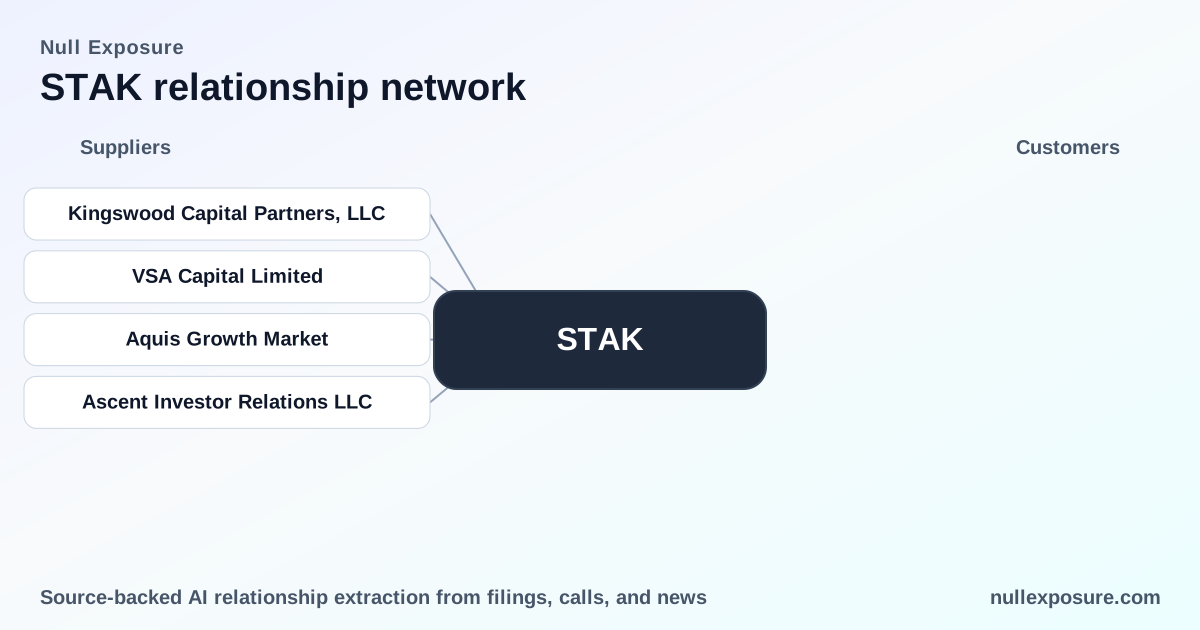
STAK Inc. (STAK) — Supplier relationships, capital-market partners, and what operators should know
Thesis: STAK monetizes as a small oilfield equipment and services provider that sells hardware and related services to energy-sector clients while intermittently accessing public markets to raise equity capital; its primary revenue drivers are equipment sales and service contracts, while capital-market relationships (underwriters, advisers, market venues, and investor‑relations firms) supply liquidity and financing capacity when operational cash flow is constrained. For investors and procurement operators, the practical question is whether these supply-side commercial contracts and the capital-market partners provide reliable funding and distribution or signal elevated governance and concentration risk. Learn more about how we track supplier relationships at NullExposure.
How STAK makes money and why supplier and capital relationships matter
STAK operates in the oil & gas equipment and services segment and records revenue from sales and field services; trailing twelve‑month revenue is roughly $24.9 million with gross profit of approximately $7.7 million, but the company is currently loss-making at the operating level (operating margin TTM: -67.5%). The company relies on periodic capital raises and market access to bridge negative operating cash flow, so partnerships with underwriters, corporate advisers, and investor relations firms are not cosmetic — they are functional to financial continuity.
Operationally, STAK is small and concentrated: market capitalization is about $19.6 million, insiders hold roughly 91.9% of shares, and institutional ownership is under 1%. That ownership profile drives both governance concentration and liquidity constraints that procurement, investors, and counterparties must price into commercial terms. For background and continuously updated relationship analytics visit NullExposure.
Who STAK is working with — the relationships that move capital and markets
Kingswood Capital Partners, LLC — representative of the underwriters (FY2025)
Kingswood Capital Partners acted as the representative of the underwriters in STAK’s offering process, a role that places Kingswood at the center of pricing, distribution and settlement for that transaction. This relationship shows STAK uses boutique underwriters for equity placements rather than large bulge‑bracket banks. According to a STAK press release distributed on Yahoo Finance (reported March 10, 2026), Kingswood was identified as the underwriter representative.
Ascent Investor Relations LLC — investor‑relations support and contact (FY2025)
STAK lists Ascent Investor Relations as its investor relations contact — including a named representative and direct contact details in the company release — signaling that STAK actively outsources investor communications and market outreach. The company press release on Yahoo Finance (March 10, 2026) provides Ascent’s contact information for investor queries.
VSA Capital Limited — AQSE corporate adviser and broker (FY2026)
VSA Capital Limited is listed as the AQSE corporate adviser and broker on a STAK-related press notice tied to a FY2026 capital action, which indicates STAK engages U.K.-based advisory capacity when accessing the Aquis Growth Market or related venues. The Aquis‑listing press note published via Bolsamania (reported March 10, 2026) names VSA as the corporate adviser and broker.
Aquis Growth Market — admission venue for new ordinary shares (FY2026)
STAK applied to admit new ordinary shares to trading on the Aquis Growth Market, with Admission expected on 11 February 2026 per the corporate notice, showing STAK leverages non‑U.S. small‑cap venues to broaden liquidity and investor reach. The admission notice appeared in a press release carried by Bolsamania (reported March 10, 2026).
What these relationships collectively tell investors and operators
- Capital access is relationship‑driven. STAK’s active use of underwriters, a corporate adviser, and an investor‑relations firm demonstrates reliance on intermediaries to execute financings and manage market communications.
- Liquidity strategy includes non‑U.S. growth markets. The Aquis Growth Market admission underscores a deliberate strategy to extend liquidity beyond U.S. microcap channels.
- Vendor selection is boutique and specialized. The partners are boutique and regional specialists rather than global franchises — useful for tailored execution but adding counterparty concentration risk.
For further supplier and partner analysis tailored to your diligence workflow, see our research hub at NullExposure.
Operating-model constraints and company-level signals
The dataset of explicit contractual constraints returned no direct constraint entries; that absence itself is a signal: there are no captured contractual restrictions tied to these supplier relationships in the public feed, so negotiation posture and contractual criticality must be inferred from company-level metrics:
- Concentration: Insider ownership ~91.9% and institutional ownership ~0.97% indicate highly concentrated control and very limited free float, which constrains trading liquidity and makes minority-investor influence negligible.
- Financial posture: Market cap ~ $19.6M, negative EBITDA (~ -$2.8M), and operating margin of -67.5% show STAK operates at a loss and depends on financing. Capital partners are functionally critical to short- and medium-term solvency.
- Growth vs. profitability mix: Quarterly revenue growth year-over-year is positive (~50%), showing top-line momentum despite weak margins; growth requires capital to scale to profitability.
- Maturity and scale: Small shares outstanding and sub‑$25M annual revenue place STAK squarely in the microcap, early-stage commercial maturity bucket — procurement should price single‑supplier and scale risk accordingly.
These are company-level signals and do not attribute contractual specifics to any named partner.
Investment implications and risk‑reward for operators and procurement teams
STAK’s supplier network and capital-market partners create a dual-edged profile for buyers and investors. On one hand, dedicated underwriters and a corporate adviser enable access to capital and market channels; on the other, extreme insider concentration and weak operating profitability elevate counterparty and funding risk. Operators negotiating supply contracts should insist on performance-linked terms, escrowed payment mechanisms, or staged deliveries to mitigate funding-driven delivery risk.
Key risk points:
- Funding dependence on small-cap raises and regional venues increases execution risk for larger procurement projects.
- Limited institutional oversight raises governance risk that can influence counterparty stability and dispute resolution.
Practical next steps for diligence:
- Validate settlement and escrow procedures used in recent financings overseen by Kingswood and VSA.
- Confirm the operational footprint (manufacturing and fulfillment addresses) versus public filings to reconcile the company’s operational risk map.
- Audit investor-relations disclosures to ensure there are no outstanding material unresolved liabilities advertised in market communications.
If you want a structured supplier-risk scorecard and relationship map for STAK, contact our team or start a research subscription at NullExposure.
Bottom line and action plan
STAK is a microcap energy-equipment company that depends materially on boutique capital-market partners for financing and market access while operating with negative margins and concentrated insider control. For investors, the upside is revenue momentum and potential upside from successful financings executed via these partners; for commercial operators, the dominant concern is counterparty continuity and funding-driven delivery risk.
To convert this analysis into procurement protection and investment monitoring, visit NullExposure to access supplier relationship tooling, alerts, and deeper counterparty profiles.