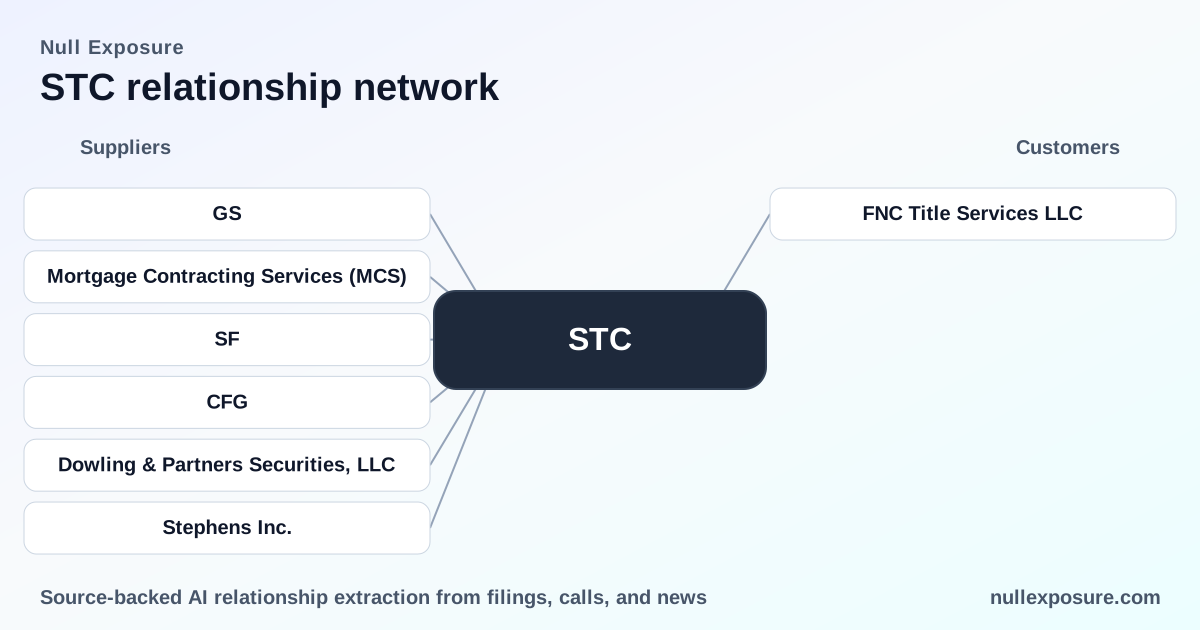
Stewart Information Services Corp (STC): supplier relationships that matter for investors
Stewart Information Services Corp operates as a title-insurance and real-estate-services platform that monetizes through underwriting title insurance, escrow and closing services, and an expanding suite of default and property-preservation offerings. Revenue is driven by transactional volumes in residential and commercial real estate plus recurring services tied to mortgage lifecycle work; capital markets activity (debt issuance and equity offerings) supports balance-sheet flexibility for acquisitions and working capital. For investors evaluating supplier and advisor relationships, Stewart’s mix of investment-bank partners on capital raises and recent acquisitions that expand its service footprint are the clearest levers for scale and risk transfer.
Explore more company supplier profiles at https://nullexposure.com/.
Why these relationships matter to a capital-market investor
Stewart’s supplier network is part advisory/placement (investment banks) and part operational expansion (acquired service providers). The banks named on a public offering indicate market access and underwriting depth when the company raises equity; the acquisition of Mortgage Contracting Services (MCS) signals strategic vertical integration into property preservation and default services that increase cross-sell opportunity and operational complexity. Both types of relationships influence cash flow stability, capital costs, and execution risk.
If you want a consolidated view of supplier exposures and counterparties for due diligence, start with the company hub at https://nullexposure.com/.
Relationship-by-relationship read (concise, source-backed)
Goldman Sachs & Co. LLC
Goldman Sachs acted as lead book-running manager for Stewart’s public offering, giving Stewart top-tier underwriting distribution for capital raises. Finviz reported the bank’s lead role in the offering on March 10, 2026: https://finviz.com/news/251233/stewart-announces-pricing-of-public-offering-of-common-stock.
Citizens Capital Markets
Citizens Capital Markets participated as a book-running manager alongside Goldman Sachs, providing additional placement capacity on the same public offering and expanding investor reach for the equity issuance. Source: Finviz coverage of the pricing of the public offering (March 10, 2026): https://finviz.com/news/251233/stewart-announces-pricing-of-public-offering-of-common-stock.
Keefe, Bruyette & Woods, a Stifel Company
Keefe Bruyette & Woods served as a co-manager on the offering, contributing distribution to institutional and sector-focused investors. The role is documented in the March 2026 Finviz report on Stewart’s offering: https://finviz.com/news/251233/stewart-announces-pricing-of-public-offering-of-common-stock.
Dowling & Partners Securities, LLC
Dowling & Partners acted as a co-manager on the same equity offering, supporting placement reach among smaller institutional accounts and niche buy-side desks. See Finviz coverage dated March 10, 2026: https://finviz.com/news/251233/stewart-announces-pricing-of-public-offering-of-common-stock.
Stephens Inc.
Stephens Inc. joined as a co-manager on Stewart’s public offering, adding regional and middle-market distribution to the book-runners’ network. This participation is noted in the Finviz announcement on the offering’s pricing (March 2026): https://finviz.com/news/251233/stewart-announces-pricing-of-public-offering-of-common-stock.
Mortgage Contracting Services (MCS)
Stewart closed the acquisition of MCS, a property preservation service provider, in late December, expanding Stewart’s default-services capability and enabling cross-selling into loan-servicing and REO workflows. The acquisition and its strategic intent were described in Stewart’s Q4 2025 earnings call transcript coverage (InsiderMonkey), filed in early 2026: https://www.insidermonkey.com/blog/stewart-information-services-corporation-nysestc-q4-2025-earnings-call-transcript-1690175/.
Operational constraints and what they say about Stewart’s business model
Stewart’s supplier and operational posture is shaped by company-level constraints and long-term financial commitments rather than by any single vendor.
- Long-term capital commitments are explicit. Stewart carries unsecured senior notes — an underwritten offering of $450 million of 3.6% Senior Notes due November 15, 2031 — which imposes scheduled interest and principal obligations and sets a long-term financing horizon for capital allocation decisions.
- Service-provider dependency is structural, not anecdotal. The company routinely uses third-party actuaries for reserve analysis, reinsures portions of title risk with other underwriters, and contracts third-party investment advisors for asset management. These are consistent signals that Stewart’s operating model blends in-house processing with outsourced expertise and risk-transfer mechanisms.
- Contract maturity and complexity are elevated. Long-dated debt and multi-party reinsurance arrangements create a contracting posture that is medium-to-long term and operationally interdependent, which increases the importance of counterparty credit and operational controls at scale.
None of these constraints is assigned to a specific supplier unless the company explicitly named a counterparty in a constraint excerpt; these are company-level signals that inform how Stewart structures supplier relationships overall.
Investment implications — what investors should watch next
- Capital-access capability is a competitive asset. The presence of Goldman Sachs and a syndicate of book- and co-managers on a public offering demonstrates Stewart’s ability to tap equity markets when needed, which lowers liquidity risk and supports strategic M&A. That said, investors should monitor issuance cadence versus internal cash generation (Revenue TTM ~$2.93bn; Market Cap ~$1.95bn).
- Operational integration risk with acquisitions. The MCS acquisition expands addressable services and revenue diversification, but integration of field operations and regulatory compliance in default services increases execution risk and requires strong vendor oversight.
- Debt maturity profile constrains capital allocation. The November 2031 Senior Notes create a clear timeline for refinancing or repayment decisions; capital markets access evidenced by the syndicate reduces refinancing friction but also links Stewart’s cost of capital to market conditions.
- Counterparty diversification reduces concentration risk. The use of multiple co-managers on the offering and third-party service providers indicates diversity of external relationships, which improves resilience but raises governance needs.
For a deeper supplier-risk checklist and comparative supplier mapping, visit https://nullexposure.com/ to see how Stewart’s profile compares with peers.
Bottom line and actionable takeaways
Stewart’s supplier relationships split into two strategic buckets: capital markets partners that enable balance-sheet manoeuvring and operational suppliers/acquisitions that expand service revenue. Both are material to valuation and risk. Key investor actions: validate integration milestones for MCS, monitor covenant and cash-interest coverage tied to the Senior Notes, and track subsequent capital raises that involve the same underwriting syndicate. For ongoing supplier surveillance and portfolio due diligence, review the company hub at https://nullexposure.com/.