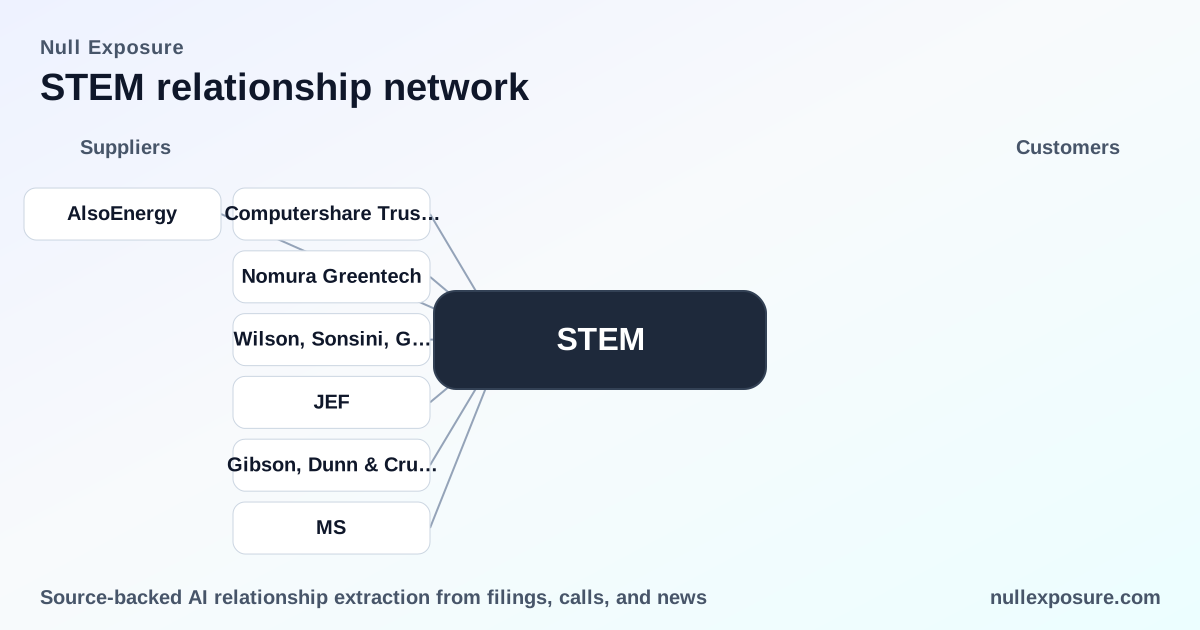
Stem Inc (STEM): supplier relationships that shape operations and risk
Stem operates a hybrid business that monetizes energy storage hardware, its Athena software platform, and energy services by aggregating and optimizing distributed batteries to capture capacity, ancillary and merchant energy revenues. The company generates reported revenue through equipment sales, recurring software and operations contracts, and monetization of grid services; at scale these relationships determine margin capture and execution risk (Revenue TTM $156.3M; Market Cap ~$92.8M). For investors, the supplier map is not ancillary — it is central to delivery, capital structure and margin stability.
Explore supplier intelligence and relationship context at https://nullexposure.com/.
Why suppliers matter to Stem’s business model
Stem’s product is not purely software — Athena requires physical storage systems and integration partners to deliver contracted customer outcomes. That duality creates a procurement-driven operating model where supplier availability, quality and contractual terms translate directly into revenue recognition and service performance. The company’s public filings and press releases surface three firm-level signals:
- High supplier concentration and criticality. Stem discloses reliance on a small number of energy storage system suppliers; a disruption would constrain delivery and could materially affect results. This is a company-level signal indicating concentrated sourcing with high operational impact.
- Buyer contracting posture. Stem is explicitly a buyer of key hardware and equipment, which frames its negotiation leverage as dependent on supplier market structure and inventory lead times.
- Platform dependency on cloud infrastructure. Stem hosts Athena on Amazon Web Services (AWS), creating a technical service-provider dependency for operations and data availability. The AWS relationship is a distinct operational dependency named in company disclosures.
These characteristics create a profile of a capital-light software operator constrained by heavy, concentrated hardware supply risk and cloud service dependency.
Every named supplier and advisor relationship (concise, investor-focused)
Computershare Trust Company, N.A.
Computershare acted as Stem’s exchange and transfer agent for the reverse stock split disclosed in early 2026, a transactional role tied to corporate actions rather than operations. According to a Finance Yahoo notice in March 2026, Computershare served as the exchange agent and transfer agent for that corporate step (Finance Yahoo, March 2026).
Nomura Greentech
Nomura Greentech served as a financial advisor to Stem in the company’s 2021 business combination, providing strategic capital markets and transaction advisory support during the SPAC merger process. This role is documented in the company’s 2021 press release announcing the business combination (GlobeNewswire, April 2021).
Wilson, Sonsini, Goodrich & Rosati
Wilson Sonsini provided legal advisory services to Stem around the 2021 combination, reflecting use of elite transactional counsel to manage securities, disclosure and corporate governance matters. The legal engagement was disclosed in the business-combination announcement (GlobeNewswire, April 2021).
Gibson, Dunn & Crutcher LLP
Gibson Dunn served as legal advisor to Stem in both the 2021 business combination disclosures and in capital transactions through FY2025, indicating an ongoing relationship for major corporate and financing matters. The firm’s role is referenced in the 2021 business-combination release and again in FY2025 financing announcements (GlobeNewswire, April 2021; Finance Yahoo, March 2026).
Jefferies LLC
Jefferies acted as exclusive financial advisor and placement agent to Stem in a FY2025 transaction that strengthened the company’s balance sheet, reflecting reliance on institutional placement capabilities to source growth and liquidity capital. The engagement is described in the company’s FY2025 financing disclosure (Finance Yahoo, March 2026).
Morgan Stanley & Co. LLC
Morgan Stanley served as lead financial advisor to Stem during the 2021 business combination, underscoring use of major investment banks to structure the SPAC merger and positioning in public markets. This relationship is noted in Stem’s 2021 press release about the transaction (GlobeNewswire, April 2021).
AlsoEnergy
AlsoEnergy’s PowerTrack software integrates with asset management and monitoring workflows referenced in Stem’s European expansion commentary, indicating a technology integration partner for PV + storage monitoring and optimization in certain markets. Marketscreener coverage in FY2025 highlights AlsoEnergy’s role in simplifying asset management and connecting assets, owners and markets (MarketScreener, FY2025).
What these relationships imply for investors and operators
The roster of advisors—Jefferies, Morgan Stanley, Gibson Dunn and Wilson Sonsini—signals that Stem structures capital and legal events with top-tier counsel and banks, reflecting a mature approach to transactions and capital formation. That sophistication reduces execution risk on financings and corporate actions.
Conversely, the supplier constraint built into Stem’s filings is a material operational risk: the company relies on a small number of energy storage equipment suppliers, which is critical to revenue delivery. This concentration elevates counterparty risk for project timelines and margins, and puts a premium on inventory strategy, supplier contracting terms, and diversification plans. Stem’s role as buyer gives it procurement responsibility but limited protection if supplier capacity or price dynamics shift.
The AWS hosting disclosure is operationally important: Athena’s cloud deployment on AWS creates dependency for uptime, security and data continuity. For customers and investors, the AWS relationship is a non-negotiable operational input that links tech performance to a third-party infrastructure supplier.
Middle-market integrations such as AlsoEnergy for asset control and monitoring demonstrate pragmatic partnering in markets where Stem needs local stack compatibility; these relationships are strategic for go-to-market execution outside core U.S. deployments.
If you want structured supplier profiles and counterparty risk scoring for portfolio monitoring, visit https://nullexposure.com/ for tailored supply-chain intelligence.
Practical risk checklist for due diligence
- Supplier concentration: Verify long-lead items, existing purchase commitments and alternative qualified suppliers for core storage modules.
- Contractual protections: Confirm warranties, delivery SLAs, liquidated damages and termination rights in procurement contracts.
- Capital support and advisors: Recognize that major investment banks and law firms are engaged for financing and M&A, which lowers capital-transaction risk but does not remove operational delivery risk.
- Cloud operations: Validate third-party service agreements and incident response plans for Athena hosted on AWS.
Bottom line: what investors should act on
Stem’s business value is a function of software-driven optimization layered on physical battery delivery; supplier availability and cloud reliability determine whether that value converts to revenue. The company demonstrates institutional capital-market sophistication through high-quality advisors, but the operational profile remains tied to a small set of equipment suppliers and AWS hosting. Investors and operators must prioritize supplier diversification, contractual protections and operational readiness as part of any exposure decision.
For deeper supplier relationship mapping, risk scoring and real-world counterparty histories, start here: https://nullexposure.com/.