STEW supplier relationships: who runs the portfolio, who lists the shares, and what that means for investors
SRH Total Return Fund Inc. (ticker: STEW) is a non‑diversified closed‑end investment company that pursues total return through a mix of equities, fixed income and hybrid instruments, monetizing for shareholders via net asset value appreciation and quarterly distributions. The fund outsources active portfolio management to external advisers and operates as a listed vehicle on the NYSE, creating a classic closed‑end structure where third‑party service relationships directly affect fund performance, cost profile and governance outcomes. For a concise supplier map and operational implications, see more at https://nullexposure.com/.
Executive snapshot: how supplier ties drive the economics
Closed‑end funds monetize by capturing excess return on invested capital while distributing a portion of income to shareholders; the productive leverage on that spread rests largely with the fund’s advisers and service providers. For STEW, press releases and market summaries identify named investment advisers and the exchange listing as the primary supplier relationships that determine portfolio construction, fee flows and secondary‑market liquidity. That outsourcing model concentrates investment decision authority in named advisers and exposes shareholders to the operational and style risk associated with them.
Explore supplier intelligence and implications in depth at https://nullexposure.com/.
What the record shows — relationship inventory and plain‑English takeaways
Below I list every supplier relationship captured in the available results and give a short, sourced summary for each.
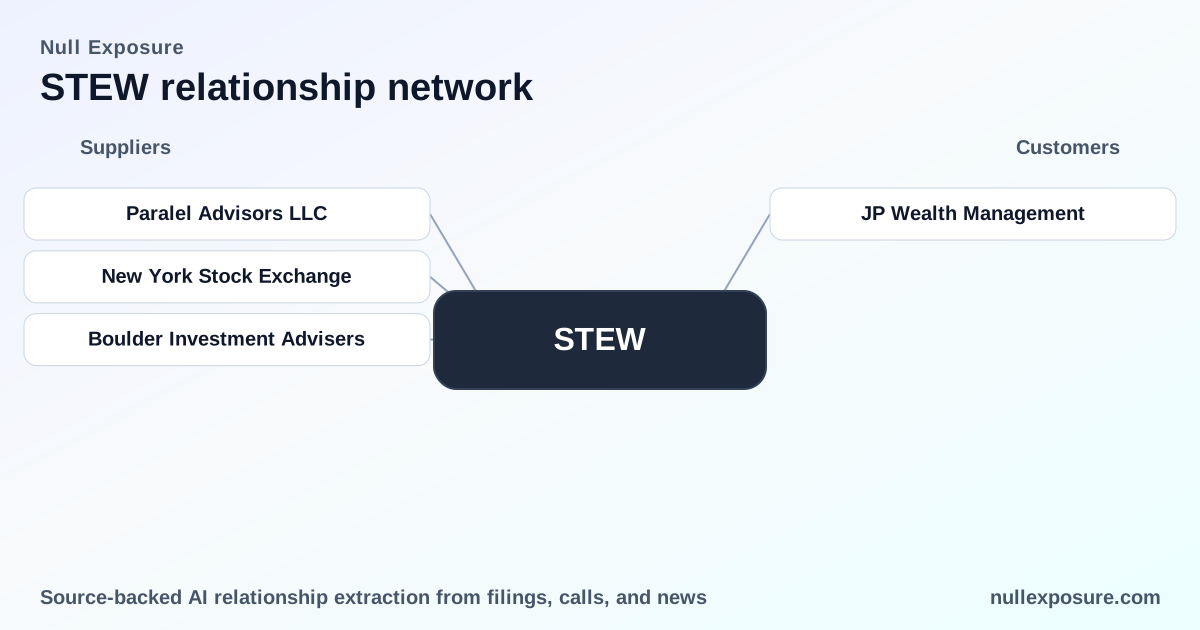
Paralel Advisors LLC
Paralel Advisors LLC is repeatedly documented as the investment adviser to the SRH Total Return Fund in multiple press releases covering FY2025 and FY2026, indicating an adviser role in portfolio management and distribution communications. According to AccessNewswire press releases in FY2025/FY2026, Paralel Advisors LLC “serves as the investment adviser to the SRH Total Return Fund” (AccessNewswire, FY2025–FY2026). Additional distribution notices that cite the adviser role were also syndicated by market outlets such as FinancialContent/AccuWire and Bitget (2026).
New York Stock Exchange
STEW is listed on the New York Stock Exchange, confirming public market trading and the governance and disclosure regime that follows an NYSE listing. An AccessNewswire release explicitly states the fund is “traded on the New York Stock Exchange under the trading symbol ‘STEW’” (AccessNewswire, FY2025).
Boulder Investment Advisers
A market profile in The Globe and Mail identifies Boulder Investment Advisers as a manager associated with the fund’s value‑oriented equity and fixed‑income strategy, describing STEW’s portfolio focus on dividend‑paying value stocks and corporate bonds (The Globe and Mail, FY2026).
What these relationships mean for investors and operators
- Advisory outsourcing is central: Multiple press releases naming an investment adviser indicate the fund relies on external managers for day‑to‑day portfolio decisions and communication of distributions. That model concentrates performance attribution and operational risk in a small set of suppliers.
- Listing on NYSE anchors liquidity expectations: Being an NYSE‑listed closed‑end fund provides secondary‑market access but also subjects STEW to market pricing dynamics (discount/premium to NAV) and NYSE rules for disclosure and governance.
- Potential for multi‑advisor signals: The record references more than one adviser name in public sources; operators should confirm the formal advisor contracts in filings (prospectus/annual report) to determine the primary adviser and any sub‑advisory arrangements.
Key takeaway: supplier configuration is simple but consequential — external advisers supply investment capability; the exchange supplies liquidity and regulatory overlay. Investors need to pair these supplier names with contract terms to assess fees, termination rights and concentration risk.
Operational constraints and company‑level signals
There are no supplier‑specific contractual constraints surfaced in the available results. At the company level, the observable operating model characteristics are:
- Contracting posture: Outsourced investment management, implying the fund’s economic performance depends on adviser skill and contractual fee arrangements.
- Concentration: public mentions focus on a small set of advisers — this is a signal of concentrated decision authority, not a quantified legal constraint, and warrants review of adviser concentration in fund filings.
- Criticality: advisers and the exchange are critical service providers for portfolio execution, compliance and distribution communications.
- Maturity: the fund shows typical closed‑end market characteristics (regular distributions, NYSE listing) and is operationally mature enough to maintain periodic public communications about distributions (FY2025–FY2026 press releases).
Operators and investors should review the fund’s latest prospectus and Form N‑CSR/N‑PORT equivalents to map contractual protections, fee schedules and termination triggers to these structural signals.
Risk implications that investors must weigh
- Performance concentration: Outsourced management concentrates tracking of alpha and downside protection in the named advisers; any adviser change or underperformance has immediate impact on NAV and distribution sustainability.
- Governance and alignment: With substantial insider ownership reported in public metrics, monitor how adviser compensation and board oversight align with minority shareholders.
- Liquidity vs. NAV discount: NYSE listing does not guarantee NAV parity; closed‑end funds routinely trade at discounts or premiums, and that arbitrage profile is a function of both portfolio performance and investor demand.
Where to go next
- Review the fund’s official filings and prospectus to validate adviser contracts, fees and sub‑advisory arrangements. The press inventory gives the names; filings give the terms. For a supplier due‑diligence workflow and deeper relationship mapping, visit https://nullexposure.com/.
- If you manage capital with exposure to closed‑end funds, set a monitoring cadence for adviser announcements and distribution notices — these are the operational triggers that change risk posture quickly.
Final read: decisive, actionable orientation
STEW is a classic closed‑end vehicle: outsourced active management, NYSE‑listed liquidity, and distribution‑oriented returns. The supplier landscape in public releases is compact — Paralel Advisors LLC and Boulder Investment Advisers as manager/adviser signposts and the NYSE as the trading venue — and that compactness both simplifies and concentrates risk. Investors should verify contractual terms in corporate filings and track adviser performance and communications as primary inputs to portfolio risk management.
For supplier intelligence that connects press signals to filing evidence and contract clauses, start your due diligence at https://nullexposure.com/.