STFS: Capital Markets Signal and Supplier Implications
Star Fashion Culture Holdings Limited (STFS) is a China-based provider of content marketing solutions that monetizes by selling campaign and content services to corporate clients and advertisers; revenue is recognized through client contracts while the company supplements working capital with public equity financings. Investors and procurement teams should evaluate STFS through two lenses: operational cash flow reliability for supplier payments, and capital-market activity that drives dilution and short-term liquidity—both of which bear directly on supplier risk and contract terms. For a deeper review of supplier relationships and market signals, visit https://nullexposure.com/.
What the company looks like to a supplier or counterparty
STFS reported roughly USD 120.8 million in trailing revenue and gross profit of USD 6.86 million, but it operates with negative operating and net margins and a materially negative EPS, highlighting operating pressure even at scale. Per company filings through the quarter ended 2025-09-30, the balance between top-line sales and cash generation is weak: price-to-sales is 0.04 and price-to-book is 0.74, while market capitalization sits near USD 4.93 million—indicative of a very small public equity base relative to revenue. This profile translates into supplier-relevant constraints: tight cash conversion cycles, heightened sensitivity to working-capital swings, and limited equity cushion for credit events.
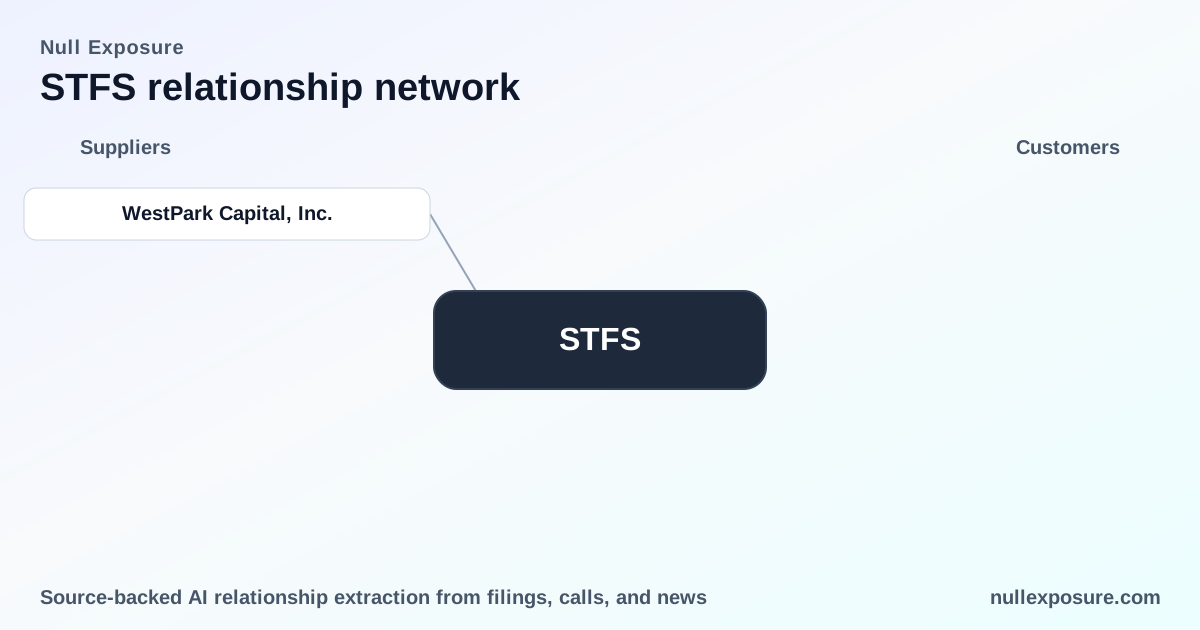
The single material capital-market relationship: WestPark Capital, Inc.
According to a GlobeNewswire press release dated July 3, 2025, STFS priced a public offering of 8 million Class A ordinary shares, and WestPark Capital, Inc. acted as placement agent for that offering (https://www.globenewswire.com/news-release/2025/07/03/3109799/0/en/STFS-Announces-Pricing-of-8-Million-Public-Offering-of-Class-A-Ordinary-Shares.html). This is the only supplier-scope relationship flagged in public coverage for STFS in the reviewed period.
- WestPark Capital, Inc.: WestPark served as the placement agent for STFS’s 8-million-share offering, facilitating the company’s access to equity capital in July 2025 (GlobeNewswire press release, July 3, 2025).
Why that placement-agent relationship matters to vendors and operators
A placement agent relationship of this nature is an explicit liquidity event: it injects immediate equity capital, alters share count, and resets investor expectations. For suppliers and contract managers the implications are clear:
- Near-term liquidity relief: equity proceeds relieve short-term cash pressure and reduce default probability on vendor payments.
- Dilution trade-off: issuance of shares translates into shareholder dilution and potentially reduced negotiating leverage over time.
- Signaling to counterparties: active capital-market engagement signals management’s need to shore up balance sheet rather than rely solely on operating cash flow.
These are operational realities for counterparties negotiating payment terms, security, or advance requirements.
Operating-model constraints and company-level signals
There are no explicit constraint excerpts tying to a particular supplier in the public relationship feed; therefore the following observations are company-level signals relevant for procurement and treasury teams:
- Contracting posture: STFS’s negative margins and minimal market capitalization create a contracting environment where suppliers should insist on stronger payment protections—advance payments, shorter terms, or guarantees.
- Concentration and liquidity: low institutional ownership (roughly 1.25%) and a small free float relative to insiders (insider ownership ~14.86%) indicate limited public-market depth, increasing the company’s reliance on occasional equity raises for liquidity.
- Criticality and maturity: the business is an operating content-marketing provider with recurring revenue characteristics, but profitability is immature, making supplier exposure dependent on ongoing capital access.
- Balance-sheet sensitivity: with slim gross margins and negative operating margins, cash conversion and working-capital cycles are critical—suppliers are exposed to revenue-seasonality and client-payment timing that will directly affect vendor receipts.
These constraints should inform supplier relationship design—payment cadence, conditional service delivery, and credit limits.
Practical implications for negotiation and risk management
For investor-facing procurement teams and vendor managers, the combination of STFS’s financial profile and its use of placement agents yields an actionable playbook:
- Require short payment terms or escrow arrangements for large campaigns until a consistent positive cash-flow run rate is demonstrable.
- Structure contracts with performance-linked milestones and holdbacks to limit exposure if client collections deteriorate.
- Factor in equity financing events as signal triggers: after a priced equity offering, revisit credit policy and potential renegotiation points, as liquidity profiles can change materially.
If you need comparative supplier intelligence or a tailored risk assessment for your vendor portfolio, start here: https://nullexposure.com/.
Bottom line and investor-oriented conclusion
STFS is a revenue-generating content-marketing operator that is not yet cash-flow healthy; equity raises facilitated by placement agents like WestPark are its chosen lever to manage liquidity. That dynamic reduces immediate default risk but increases dilution and keeps financial discipline at the top of supplier concerns. For counterparties, the dominant risks are payment timing and dependence on sporadic capital-market transactions rather than stable operating cash flow.
For a direct review of STFS supplier signals and to benchmark this relationship against peers, see the research hub at https://nullexposure.com/.
Contact your trading desk or procurement governance team to translate these observations into contract language: require milestone payments, monitor capital-market announcements closely, and adjust exposure limits in line with equity raises and quarterly cash-flow disclosures.