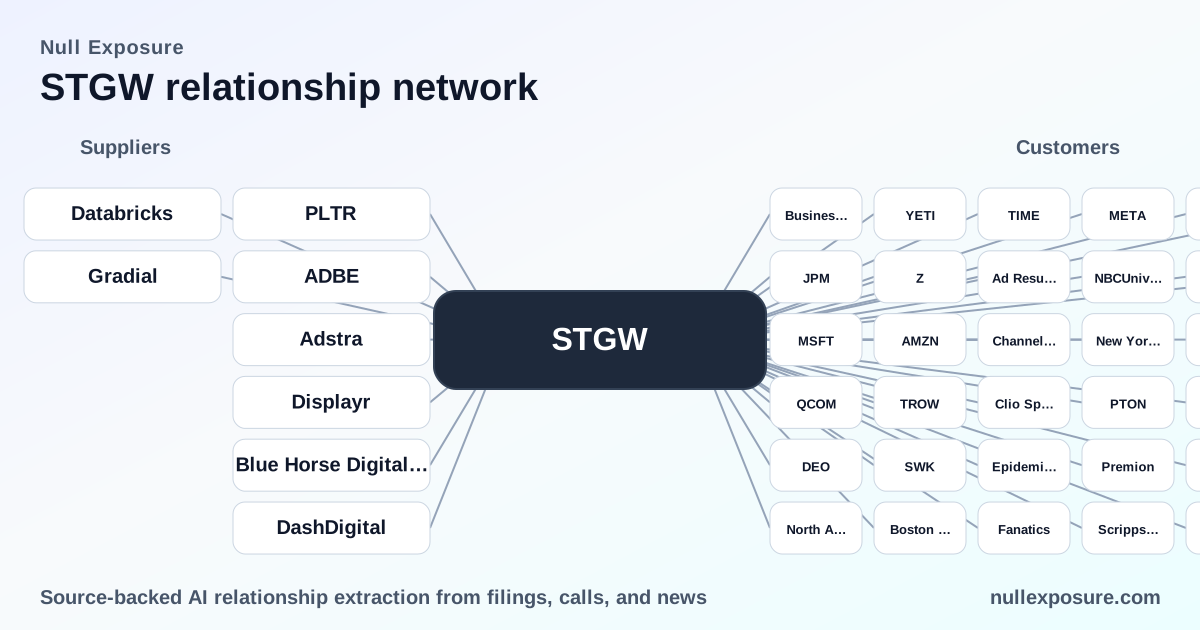
Stagwell (STGW): How supplier relationships drive a performance-first agency platform
Stagwell operates as a networked marketing and communications platform that monetizes through fee-for-service agency work, recurring technology-enabled subscriptions, and strategic licensing of data and content capabilities across its agency brands. The company's strategy is to productize agency tools (identity graphs, content management, analytics) and layer third-party enterprise software to scale client solutions globally, converting creative services into repeatable, higher-margin offerings.
For investors assessing supplier exposures, the critical questions are: which partners are foundational to Stagwell’s product stack, what contractual commitments lock in spend, and how concentrated or substitutable those relationships are.
For a focused supplier-risk snapshot and ongoing monitoring, visit https://nullexposure.com/ for more detailed coverage.
What the partnership pattern reveals about Stagwell’s operating model
Stagwell’s supplier map shows a deliberate hybrid model: proprietary assets (the Stagwell ID Graph and The Marketing Cloud) are augmented by enterprise software vendors rather than fully built in-house. This results in a contracting posture characterized by multi-year license and cloud commitments and a buyer role for media and cloud services. Public disclosures describe long-term, non-cancellable contracts with minimum spending obligations and a software license agreement that carries multi-year minimums — together these commitments produce predictable cost baselines but reduce near-term flexibility.
Key company-level signals:
- Long-term licensing and cloud contracts: filings describe non-cancellable agreements with minimum spend commitments across multiple years, indicating contractual maturity and vendor lock-in for core platform services.
- Middle-to-high spend bands: disclosed future minimum commitments include figures such as $14.1m, $28.5m, and $21.8m for 2025–2027 and a separate schedule showing $9.7m through $15.3m across 2025–2029, positioning these obligations in the $1m–$100m range depending on the agreement.
- Relationship roles: Stagwell acts predominantly as a buyer (media purchases, cloud services) and as a licensee for third-party software, which raises vendor concentration and operational dependency for certain platform components.
These constraints imply a mature, platform-driven commercial posture: Stagwell trades some flexibility for scale and repeatability. Investors should value the predictability of contracted costs and weigh it against vendor concentration and single-vendor failure modes.
For a deeper supplier-risk assessment, see https://nullexposure.com/ — the site hosts detailed supplier profiles and contract signal analysis.
Supplier map: partnerships that matter and what they mean
Palantir (PLTR)
Stagwell is partnering with Palantir to combine the Stagwell ID Graph with Palantir’s analytics and AI tooling to enhance performance media targeting, positioning Palantir as a strategic analytics enabler for campaign optimization. This relationship was disclosed in Stagwell’s investor-day announcement in March 2026.
Adobe (ADBE)
Stagwell has an enterprise partnership with Adobe to deploy advanced content management capabilities that will be included in a suite of data and content services offered to clients later in the year, integrating Adobe’s content tooling into Stagwell’s productized offerings. This was outlined in the same March 2026 investor-day release.
Adstra
Adstra is making its Conexa Identity Network available to The Marketing Cloud clients via Databricks Clean Rooms, enhancing Stagwell’s identity resolution and secure data collaboration capabilities for clients. The collaboration was reported in a March 2026 industry article covering TMC integrations.
Displayr
HarrisQuest, within Stagwell’s Marketing Cloud, announced a QuestDIY integration using Displayr to power analysis and reporting, which adds a rapid-insights reporting layer to Stagwell’s analytics stack. This integration was noted in a March 2026 media report on agency product launches.
Blue Horse Digital Marketing
Blue Horse (Malaysia) was added to Stagwell’s Global Affiliate Network to expand regional full-service digital capabilities, demonstrating Stagwell’s use of affiliate partnerships to scale geographically without heavy fixed investment. This addition was announced in a PR Newswire release covering FY2024 network expansion.
DashDigital
DashDigital (South Africa) joined the Global Affiliate Network alongside Blue Horse, extending Stagwell’s foothold in APAC and Africa through local affiliates that supply full-service and specialty digital solutions. The PR Newswire announcement (FY2024) described these affiliate additions.
Databricks
Stagwell’s Marketing Cloud collaborated with Databricks to enhance data collaboration capabilities for marketers, indicating Databricks is a core data platform partner for secure, large-scale customer data processing. Coverage of this collaboration appeared in industry reporting in March 2026.
Gradial
Stagwell entered a partnership with Gradial to bring an agentic marketing platform to the agency network, signaling an investment in automated, platform-driven campaign orchestration tools. The partnership news was published in November 2025.
What investors should take away — strategy, risks, and monitoring priorities
Stagwell’s supplier relationships show strategic coexistence with best-in-class enterprise vendors (Palantir, Adobe, Databricks) while using affiliates for local execution. That mix supports scale and productization but creates distinct risk vectors:
- Concentration risk: reliance on specific third-party platforms for analytics, identity, and content management increases vendor dependence and potential pricing or availability pressure. Monitor contract renewal terms and minimum spend escalators.
- Cost rigidity: multi-year, non-cancellable license and cloud commitments create fixed-cost floors that reduce operating leverage during downturns. The documented future minimums in the mid-single-digit to tens-of-millions per year are material to EBTDA sensitivity.
- Operational criticality: partnerships that integrate at the identity and analytics layer (Palantir, Databricks, Adstra) are functionally critical; any degradation in those services would materially impair Stagwell’s product offerings.
- Mitigants: Stagwell’s global affiliate network and agency brands provide substitution channels for regional services, and productizing services increases client stickiness and recurring revenues.
Action checklist for investors:
- Track renewal dates and disclosed minimum commitments for key vendor contracts.
- Monitor product adoption metrics for the integrated services that use Palantir/Databricks/Adobe tech.
- Review affiliate network expansion as a hedge against vendor concentration.
For timeline-driven supplier monitoring and alerts, explore more at https://nullexposure.com/.
Final read and recommendation
Stagwell’s supplier posture is deliberate: partner with enterprise software leaders to accelerate productized agency services while accepting multi-year contractual commitments. That trade-off enhances scale and predictable revenue conversion but elevates vendor concentration and cost rigidity as primary investment risks. Investors should focus on contract cadence, renewal economics, and the depth of technical integration with Palantir, Databricks, and Adobe when modeling upside or downside scenarios.
For a vendor-by-vendor exposure report and tailored supplier-risk scoring for STGW, visit https://nullexposure.com/ — our platform consolidates filings, press releases, and contract signals into investor-ready supplier intelligence.