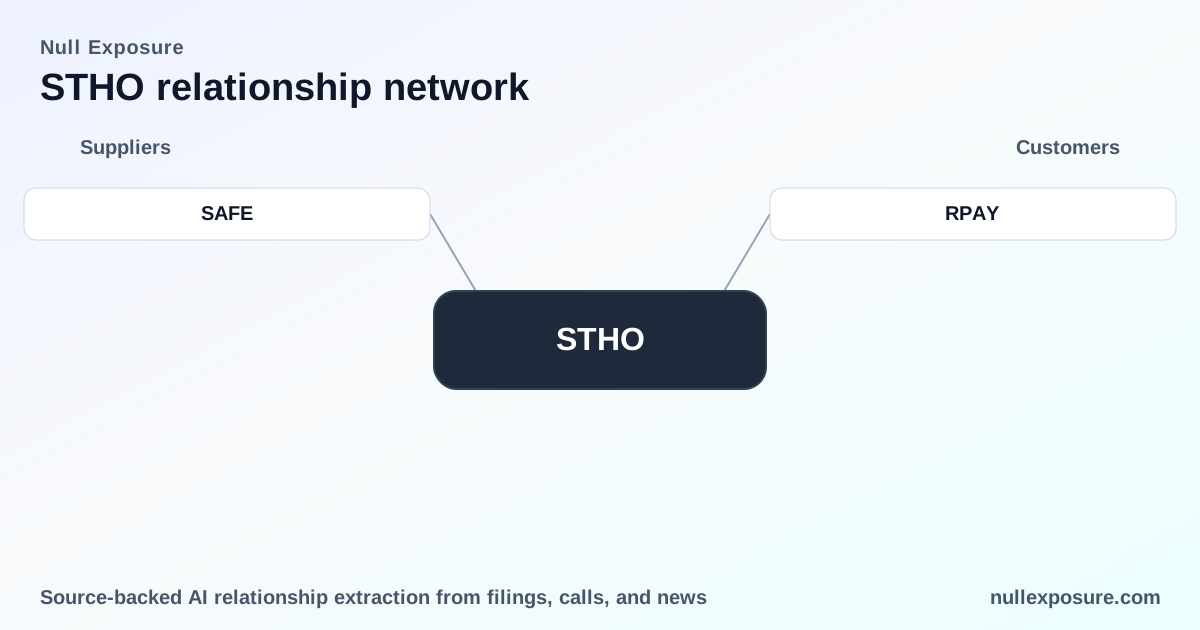
Star Holdings (STHO): Supplier relationships and where value (and risk) sits
Star Holdings operates a focused commercial real‑estate business model centered on non‑ground‑lease assets and outsources core management functions to an external manager. The company monetizes through property-level cash flows, leasing income and a layered service structure in which an external manager supplies executive leadership and oversight while independent hotel operators run day‑to‑day property operations; management fees are a material and recurring cash expense that effectively reallocate operating cash flow to the manager. For investors and operators evaluating supplier exposure, the manager relationship is the single largest commercial dependency in Star Holdings’ operating model.
Explore a concise supplier map and commercial due diligence on Star Holdings at https://nullexposure.com/.
Operational reality: how Star Holdings runs and gets paid Star Holdings’ core economic engine is property ownership and leasing, but the company transfers significant operational responsibility to contracted parties. The Management Agreement requires an external manager to provide executive management and personnel to operate the business, and Star Holdings records multi‑million dollar management fees on an annual basis. The company also contracts with independent hotel operators to manage property‑level day‑to‑day activity, creating a two‑layer outsourcing model: strategic management and local operational execution.
Key operating characteristics for investors:
- Contracting posture: centralized—an external manager holds executive authority under a formal Management Agreement and collects recurring fees.
- Spend concentration: material—management fees fall in a $10–100m band, representing a meaningful allocation of cash flow.
- Criticality: high—the manager supplies the executive team and supervises daily operations, making the relationship operationally critical.
- Maturity and governance: formal and documented—the Management Agreement is an established contract that governs compensation and responsibilities.
Supplier relationships in the public record
Safehold Inc. (SAFE) — external manager and executive appointment According to a press release published in The Globe and Mail on December 1, 2025, Safehold Inc., the external manager of Star Holdings, appointed Michael Trachtenberg as President of both Safehold Inc. and Star Holdings. The appointment consolidates executive leadership across manager and client and signals a governance alignment between the manager and Star Holdings. Source: The Globe and Mail press release, December 1, 2025 — https://www.theglobeandmail.com/investing/markets/stocks/STHO-Q/pressreleases/36419870/star-holdings-appoints-michael-trachtenberg-as-president/.
Why the Safehold relationship matters to capital allocators The manager relationship is not discretionary overhead; it is the mechanism through which executive control and a large portion of operating cash are delivered. Company materials state the Management Agreement requires the Manager to provide an executive management team and appropriate support personnel, and Star Holdings recorded management fees of $17.5 million and $19.7 million for the years ended December 31, 2024 and 2023 respectively. One excerpt shows the Company paid the Manager management fees of $25.0 million for the term ended March 31, 2024. These figures place the engagement squarely in the $10m–$100m spend band, making it a core commercial relationship with direct impact on free cash flow and EBITDA conversion.
Operational layering increases transition risk: independent hotel operators run property‑level operations while the Manager remains the executive decision‑maker. Changes in manager leadership — such as the December 2025 appointment of Michael Trachtenberg — therefore have immediate governance and operational implications. Source context: company management agreement excerpts and year‑end fee disclosures (company filings).
Financial and governance signals that shape supplier diligence Star Holdings’ balance of operating efficiency and headline profitability creates a specific lens for supplier evaluation. Operating margin is reported at 45.1% contrasted with a negative profit margin of -54.4%, indicating material non‑operating or one‑time charges that suppress GAAP earnings even as core operations generate positive margin. Market capitalization is modest (about $102.6 million) and institutional ownership is high (approximately 71.7%), concentrating stewardship and scrutiny among institutional shareholders.
Relevant market multipliers: EV/Revenue ~3.85 and EV/EBITDA ~2.73. These multiples, alongside the company’s reliance on an external manager for executive functions, create a governance‑heavy investment case where supplier terms — fee levels, termination rights, and operational KPIs — move enterprise value more than incremental property performance alone.
Mid‑analysis: prioritize contract terms and fee transparency For investors and operators, the primary diligence path runs through the Management Agreement: termination provisions, fee formulas, performance KPIs, and indemnities determine the cost of switching managers or responding to underperformance. Access the full supplier mapping and contract intelligence for Star Holdings at https://nullexposure.com/.
Risk checklist for supplier diligence
- Contract concentration: the manager supplies the executive team; a change in manager is functionally equivalent to a senior management turnover for the company.
- Fee scale and cash impact: recurring management fees in the tens of millions materially reduce distributable cash flow.
- Operational layering: property operations are run by independent hotel operators, creating operational dependence on third‑party operators plus strategic dependence on the manager.
- Governance alignment: dual appointments across manager and company leadership tighten control but raise potential conflict‑of‑interest scrutiny.
- Liquidity and market sensitivity: small market cap and negative EPS increase sensitivity to any supplier disruption or unexpected fee adjustments.
Practical implications for negotiation and monitoring Operators and investors should insist on transparent, KPI‑linked fee schedules, strong termination windows, and audited service performance metrics in any ongoing or new management arrangement. Given the fee scale, even modest percentage changes materially alter free cash flow and valuation; insist on contractual symmetry that protects the company against manager underperformance while preserving operational continuity through the independent hotel operators.
Bottom line: what to watch and next steps Star Holdings is a compact real‑estate company whose economic outcome is tightly coupled to its external manager relationship. The manager is both the delivery channel for executive capability and a significant recurring cost center, and leadership consolidation (the December 2025 appointment) increases governance concentration. For investors and counterparties, the highest‑value diligence topics are fee formulas, termination mechanics, and cross‑appointments that affect conflict governance.
For a deeper supplier map and contract‑level exposure analysis on Star Holdings and other RE services suppliers, visit NullExposure at https://nullexposure.com/.
Engage with our supplier intelligence to stress‑test contracts and quantify counterparty risk: https://nullexposure.com/.