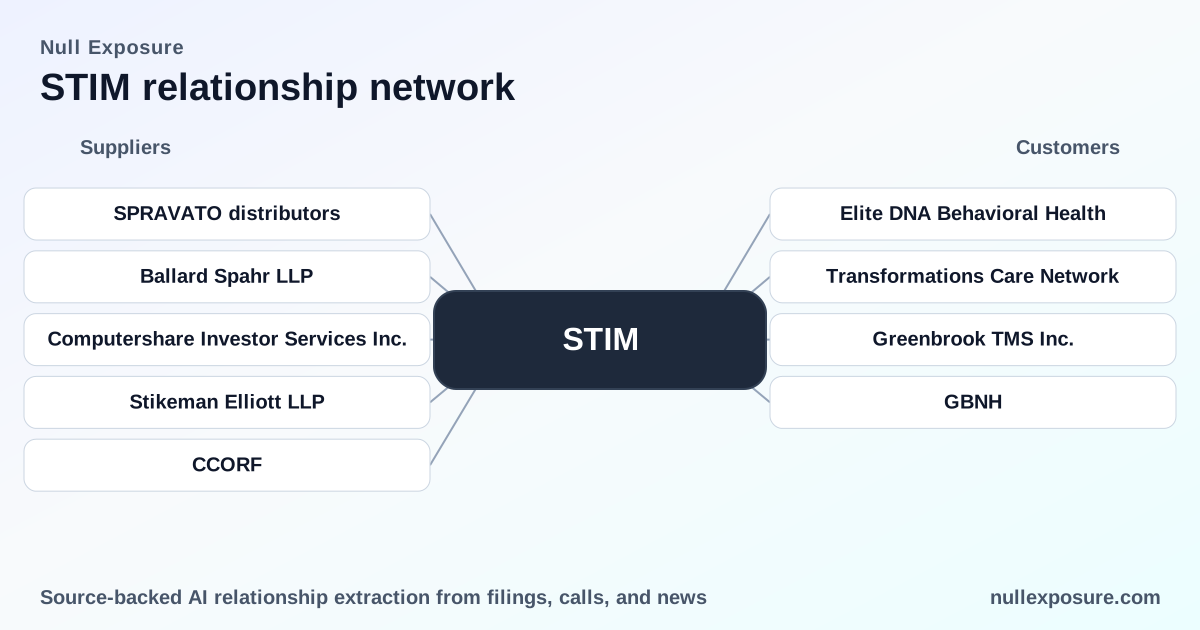
Neuronetics (STIM) — Supplier Relationships, Constraints, and What Investors Should Price In
Neuronetics builds and sells the NeuroStar family of transcranial magnetic stimulation systems and monetizes through device sales, recurring service and consumable revenue, leased treatment center operations, and strategic roll-ups (notably the Greenbrook TMS acquisition). The company's economics depend on hardware sales and the downstream cash flow of treatment centers and third‑party providers who operate them, while legal, banking and transfer agents support capital transactions that reshape its asset base. For an investor evaluating counterparty exposure, the interplay of short supplier contracts, a small number of critical manufacturing sources, and active transaction advisors defines near‑term execution risk.
Explore supplier intelligence and corroborating documents at https://nullexposure.com/.
How Neuronetics sources product and services — the operating posture investors must understand
Neuronetics outsources component and assembly manufacturing and leases many of its treatment locations rather than owning them outright. That operating posture produces two structural characteristics: (1) high supplier flexibility on paper — many relationships are cancellable on short notice — and (2) concentration risk — certain components and an assembly manufacturer are single‑sourced. The company explicitly documents supplier contracts and purchase orders that are typically terminable on short notice, while also holding some multi‑year, non‑cancelable leases for key treatment centers. These conflicting signals create a mix of tactical agility and strategic vulnerability.
- Contracting posture: contracts and purchase orders are often short‑term, enabling quick supplier changes but increasing exposure to supply interruptions and price volatility.
- Concentration and criticality: Neuronetics uses single‑source suppliers for some components and a single assembler for the NeuroStar system; replacement is not immediate if a supplier fails.
- Outsourcing maturity: the company is professionalizing manufacturing by transitioning console production to Ascential Technologies, reflecting a move to scale but also a period of integration risk.
- Lease exposure: many treatment centers are leased, with terms running from month‑to‑month up to seven years, concentrating operational risk in real estate and local operator relationships.
These constraints are documented in the company filings and internal disclosures and should be treated as company‑level operational signals for counterparty and supply risk.
Supplier and advisor relationships investors should track
SPRAVATO distributors
Neuronetics' filings reference that esketamine nasal spray treatments require SPRAVATO to be obtained through three distributors approved by the drug maker; this highlights an industrywide distribution model where certain therapies depend on an approved distributor set. According to Neuronetics' FY2024 10‑K, the company contrasts its own supply model against such distributor‑centric drugs, signaling the importance of channel access and third‑party distribution dynamics (FY2024 10‑K).
Ballard Spahr LLP
Ballard Spahr LLP served as legal counsel to Neuronetics in connection with the Greenbrook TMS acquisition, indicating that the company engaged top‑tier corporate counsel for integration and transactional governance. A March 2026 news release covering the completion of the Greenbrook transaction lists Ballard Spahr as legal counsel to Neuronetics (QuiverQuant, Mar 2026).
Stikeman Elliott LLP
Stikeman Elliott LLP also acted as legal counsel to Neuronetics for the Greenbrook transaction, providing cross‑border or specialist transaction support that complements domestic counsel. The same March 2026 coverage notes Stikeman Elliott in that legal counsel role (QuiverQuant, Mar 2026).
Computershare Investor Services Inc.
Computershare was appointed as the depositary for the Greenbrook share transmittal process, meaning Computershare handled the mechanics of converting Greenbrook shares as part of the arrangement and ensuring proper execution for registered holders. The March 2026 transaction notice advises registered holders to return letters of transmittal to Computershare (QuiverQuant, Mar 2026).
Canaccord Genuity
Canaccord Genuity acted as financial advisor to Neuronetics for the Greenbrook acquisition, a signal that management used external investment banking to structure and price the deal and to advise on financing and valuation. The QuiverQuant release in March 2026 names Canaccord Genuity as the lead financial advisor in the transaction (QuiverQuant, Mar 2026).
What these relationships imply for investors: an integrated assessment
The roster of counterparties is a mix of transactional advisors (Canaccord, Ballard Spahr, Stikeman Elliott, Computershare) tied to deal execution and distribution dynamics (the SPRAVATO reference) that illustrate broader channel constraints in mental‑health therapeutics. Investors should treat these relationships as two separate risk domains:
-
Transaction execution risk: the presence of reputable counsel and a named financial advisor signals competent deal execution for the Greenbrook acquisition, reducing legal and closing risk but increasing integration and working‑capital demands in the near term. The Computershare appointment is a standard transfer agent/depositary control for share consideration. (QuiverQuant, Mar 2026)
-
Operational and supply risk: the FY2024 10‑K discloses that many supplier contracts and treatment center leases are short‑term and that certain components and assembly remain single‑sourced, creating critical concentration risk for production continuity. The company is transitioning console manufacturing to Ascential Technologies to mitigate scale and quality issues, which is a positive step but introduces integration timing risk (FY2024 10‑K).
Key takeaway: investors should value Neuronetics not only on near‑term revenue from device sales and treatment rollouts but also on how successfully management reduces supplier concentration and stabilizes treatment center economics following the Greenbrook integration.
Explore deeper supplier-disruption signals and counterparties at https://nullexposure.com/.
Practical checklist for portfolio diligence
- Confirm counterparty concentration metrics for critical components and the status of the Ascential transition; short supplier contracts increase the need to stress‑test supplier continuity.
- Review lease maturities across treatment centers and the proportion of revenue tied to leased vs. owned locations; month‑to‑month leases create operational leverage to local market conditions.
- Monitor integration milestones and working‑capital requirements stemming from the Greenbrook acquisition; advisor appointments reduce transactional uncertainty but integration is the next execution risk.
- Evaluate third‑party distribution dynamics in adjacent therapies (SPRAVATO example) to benchmark how channel constraints could affect adoption curves for NeuroStar services.
Final read for active investors
Neuronetics is a commercial‑stage hardware and services company whose near‑term value is shaped equally by supply chain concentration and the success of recent M&A integration. The company runs a mix of short and long commitments — the former gives flexibility, the latter creates fixed obligations. Track the Ascential manufacturing transition, lease schedules, and the Greenbrook integration cadence as the highest‑impact variables for 12–24 month outcomes.
For continuously updated supplier and counterparty intelligence on Neuronetics and comparable healthcare suppliers, visit https://nullexposure.com/.