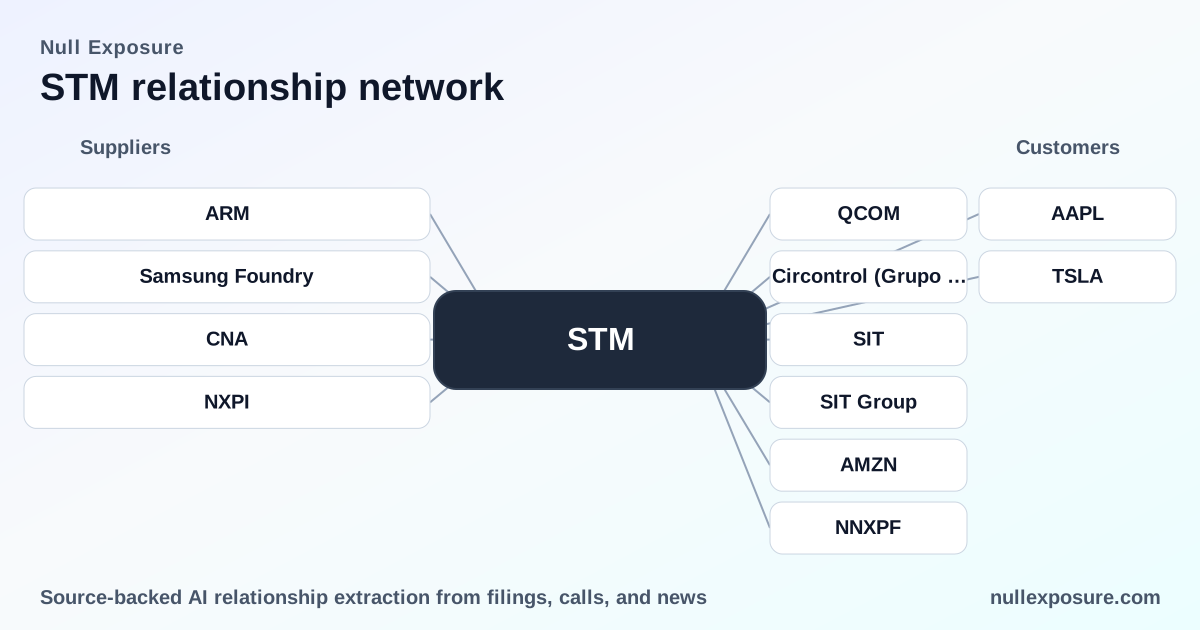
STMicroelectronics (STM): Supplier Relationships that Shape Capacity, Cost and Competitive Position
STMicroelectronics designs, manufactures and sells semiconductor chips across automotive, industrial and consumer markets, monetizing through product sales, IP licensing and vertically integrated manufacturing. The company combines in-house fabs with third-party foundry partnerships, long-term energy agreements and acquisitive growth to protect margins and secure capacity. For investors and operators, ST’s supplier relationships are primary levers of execution risk and upside—they determine wafer supply, energy cost stability and the pace of capability expansion. Learn more at https://nullexposure.com/.
Why counterparties matter to STM’s cash flow and risk profile
ST’s business model converts technology platforms into recurring chip revenue while managing capital intensity through a hybrid manufacturing posture. Key drivers for valuation and operations are: access to advanced nodes via foundries, stable power contracts for energy-intensive fabs, software/IP partnerships for microcontroller competitiveness, and tuck-in M&A to expand sensor capabilities. These relationships influence margin trajectory and capacity resilience as much as end-market demand.
If you want a consolidated view of counterparties and contract exposure, see the full platform at https://nullexposure.com/.
Counterparties and strategic partners you need on your radar
Arm
ST uses Arm CPU cores across its microcontroller and automotive product lines; the new STM32C5 family is built around the Arm Cortex‑M33 core and the company’s in‑house 40nm node for entry-level MCUs, underlining a product strategy that pairs Arm IP with ST’s process capability. According to coverage in Hackster and Thelec (March 2026), Arm cores also power ST’s higher‑performance automotive controllers described in company releases (GlobeNewswire, Feb 2026), which cite Arm Cortex variants delivering class‑leading CoreMark performance. These links show Arm licensing is a technology dependency that underpins STM’s MCU roadmap.
Source: Hackster (March 2026); Thelec (March 2026); GlobeNewswire press release (Feb 10, 2026).
Samsung Foundry
ST has positioned Samsung Foundry as a commercial foundry partner for advanced processes, while retaining volume manufacturing in European fabs; ST will use Samsung’s capabilities alongside its own fabs for next‑generation microcontrollers (18nm FD‑SOI with phase‑change memory reported). EE News Europe reported company commentary that ST will both source from Samsung and run the process in European facilities, indicating a dual-sourcing strategy for advanced nodes that balances capacity and geographic diversification.
Source: EE News Europe (March 2026).
Centrica Energy
ST signed a 10‑year power purchase agreement with Centrica Energy to supply solar energy to its Agrate and Catania manufacturing sites, a contract executed in April 2024 and cited in reporting on ST’s campus investments. This long‑dated PPA is material to energy cost predictability and ESG positioning, reducing exposure to spot electricity volatility for critical Italian fabs.
Source: DataCenterDynamics coverage referencing the April 2024 PPA.
NXP Semiconductors (MEMS sensors business)
ST completed the acquisition of NXP’s MEMS sensors business, an asset deal that integrates NXP’s sensor capabilities into ST’s product portfolio and consolidates sensor supply chain know‑how. Industry reporting confirms the transaction closing (iconnect007, FY2026 coverage), representing a strategic bolt‑on to expand ST’s MEMS roadmap and customer addressable market.
Source: iConnect007 (March 2026).
What these relationships imply for STM’s operating model and supplier constraints
There are no explicit third‑party constraint notices in the company’s supplier relationship feed for the FY2026 cycle; accordingly, the following are company‑level signals derived from observed counterparties and disclosed deals:
- Contracting posture: ST exhibits a hybrid contracting posture—long‑term agreements where stability is critical (10‑year PPA with Centrica) and flexible commercial sourcing where capacity and technology change rapidly (foundry partnerships with Samsung combined with in‑house fabs). This posture reduces single‑point failure risk while accepting higher coordination complexity.
- Concentration and diversification: Technology dependence on Arm for CPU cores is structural; however, ST counters concentration risk through in‑house process capability and multi‑foundry sourcing. The NXP MEMS acquisition reduces third‑party dependence for sensors by internalizing capability.
- Criticality of relationships: Foundry and IP partners are strategically critical—chip supply interrupts or licensing disputes would directly impact revenue and time‑to‑market for MCUs and automotive SOCs. Energy contracts are operationally critical for fabs; the Centrica PPA materially lowers energy cost volatility for Italian sites.
- Maturity and integration risk: ST is a mature, capital‑intensive semiconductor player with FY2025 revenue around $11.8B and meaningful EBITDA ($2.35B), yet recent strategic moves (advanced node adoption, MEMS acquisition) create near‑term integration and execution risk as fabs ramp and product families are migrated.
Collectively, these signals show ST is managing capital exposure by combining internal capacity with selective external relationships, while using long‑dated contracts where cost stability is a priority.
Learn how counterparties influence supplier risk scoring at https://nullexposure.com/.
Operational and investment implications — what to watch next
- Monitor Arm licensing terms and future IP roadmap announcements because CPU IP selection directly shapes ST product performance and time‑to‑market.
- Track Samsung Foundry capacity allocations and the ramp schedule for 18nm FD‑SOI: foundry lead times and volume commitments will determine delivery risk on higher‑margin MCUs.
- Assess realization of the Centrica PPA benefits in ST’s cost of goods sold and ESG disclosures—energy cost stability improves gross margin visibility.
- Evaluate integration metrics for the acquired MEMS business (revenue contribution, gross margin, product cross‑sell): successful integration expands addressable markets but creates short‑term integration costs.
Conclusion: balanced exposure with execution levers
STMicroelectronics’ supplier relationships reveal a deliberate tradeoff: diversified sourcing and targeted acquisitions reduce single‑partner dependence while long‑term contracts stabilize operational cost, but execution risk remains in node transitions and business integration. For investors and operators, the primary monitoring tasks are contract execution (foundry capacity, IP licensing) and the operational benefits of long‑term energy contracts and the MEMS acquisition. Those are the levers that will convert ST’s strategic positioning into durable financial performance.
For a consolidated supplier risk view and to benchmark ST’s counterparties against peers, visit https://nullexposure.com/.
Key takeaway: ST’s commercial strategy blends vertical integration with selective external partnerships; execution on capacity and integration will determine whether that strategy translates into sustainable margin expansion.