Stoke Therapeutics (STOK): Supplier Relationships and Operational Implications for Investors
Stoke Therapeutics develops antisense oligonucleotide (ASO) therapies and monetizes through drug development economics: advancing clinical assets, licensing and collaboration revenue (notably with Biogen for zorevunersen), and eventual product commercialization. The company supplements R&D capacity through third‑party manufacturing, property leases for lab and office space, and external brokerage services for real estate transactions—each supplier relationship directly affects operational continuity, cost structure, and time to market. For a concise, actionable supplier risk view, visit https://nullexposure.com/ for the full analysis and monitoring tools.
Why supplier relationships matter to STOK’s valuation
Stoke is a development‑stage biotech that converts scientific progress into market value through clinical milestones and partnership economics. Supplier relationships are not peripheral—they are operational levers: landlords determine lab footprint and lease economics, contract manufacturers and CROs determine timing and COGS, and commercialization partners determine market access and revenue share. Investors must treat real estate, service providers, and strategic collaborators as part of the company’s operating model, not ancillary line items.
Relationship inventory: landlord, broker, and strategic collaborator
-
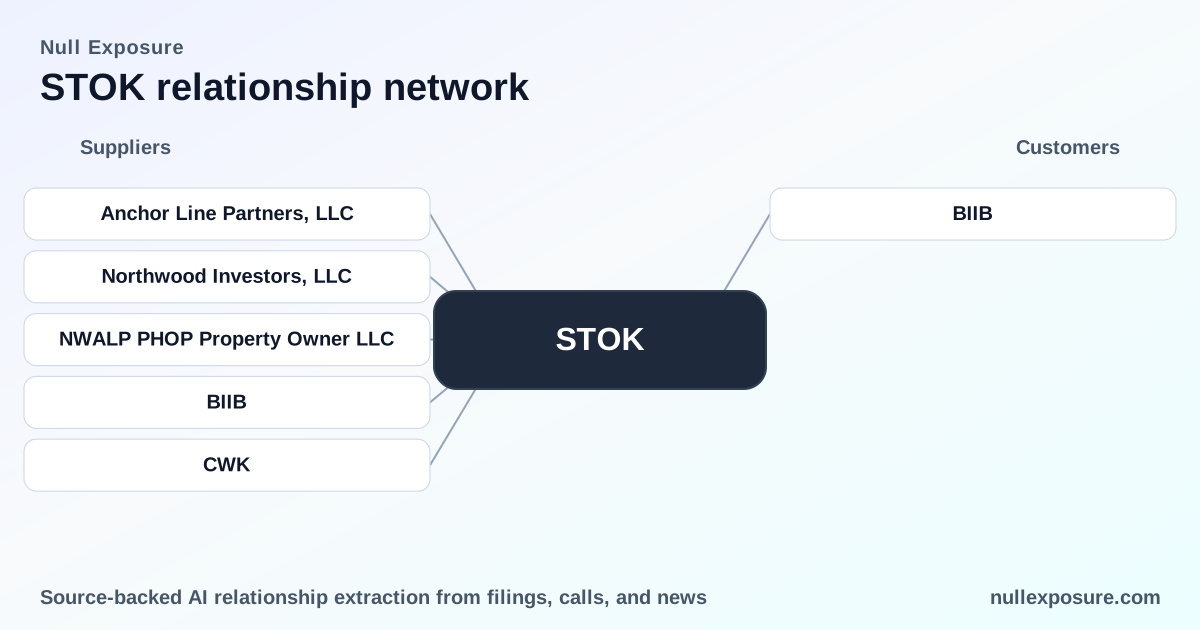
Anchor Line Partners, LLC — Anchor Line Partners, together with Northwood Investors, secured a long‑term lease with Stoke for space at 245 Fifth Avenue in Waltham, Massachusetts, supporting the company’s growth and lab footprint expansion. This was reported by Finviz on March 10, 2026 (link: https://finviz.com/news/288915/anchor-line-partners-supports-stoke-therapeutics-growth-by-securing-a-98500-square-foot-lease-in-waltham-ma). This lease signals expansion of physical capacity and longer‑term fixed operating costs.
-
Northwood Investors, LLC — Northwood jointly announced the same long‑term lease arrangement with Anchor Line Partners for Stoke’s facility at 245 Fifth Avenue, indicating a multi‑party landlord structure for the Waltham site. Finviz covered this announcement on March 10, 2026 (link: https://finviz.com/news/288915/anchor-line-partners-supports-stoke-therapeutics-growth-by-securing-a-98500-square-foot-lease-in-waltham-ma). A multi‑owner landlord can affect lease terms and amplification of tenant protections.
-
NWALP PHOP Property Owner LLC — Stoke entered into a new lease for its corporate headquarters and laboratory with NWALP PHOP Property Owner LLC, documenting a formal landlord‑tenant relationship for core HQ and lab space. Marketscreener reported the lease activity on March 10, 2026 (link: https://www.marketscreener.com/news/stoke-therapeutics-says-us-fda-seeks-additional-information-for-zorevunersen-in-dravet-syndrome-sha-ce7e58dad189f72d). This underscores that Stoke consolidates HQ and lab operations under formal leases rather than owning real estate—an important operational expense line.
-
Biogen Inc. (BIIB) — Stoke has a strategic collaboration with Biogen to develop and commercialize zorevunersen for Dravet syndrome, with recent results supporting the Phase 3 EMPEROR study. QuiverQuant reported on collaboration progress and promising clinical results on March 10, 2026 (link: https://www.quiverquant.com/news/Stoke+Therapeutics+and+Biogen+Announce+Promising+Results+for+Zorevunersen+in+Treating+Dravet+Syndrome,+Supporting+Phase+3+EMPEROR+Study). Biogen is the company’s most critical strategic partner for late‑stage development and future commercialization economics.
-
Cushman & Wakefield (CWK) — The commercial real estate firm Cushman & Wakefield represented Stoke in the Waltham lease transaction, with specific team members named in the coverage. Finviz documented the brokerage role on March 10, 2026 (link: https://finviz.com/news/288915/anchor-line-partners-supports-stoke-therapeutics-growth-by-securing-a-98500-square-foot-lease-in-waltham-ma). Using a major broker streamlines landlord negotiation and indicates professionalized real estate strategy.
What the supplier map tells investors about operating posture
-
Contracting posture: Stoke relies on external partners for real estate, clinical services, manufacturing, and commercialization. Company disclosures confirm agreements with contract manufacturers, CROs and other vendors for key functions, indicating a deliberate outsourcing model rather than vertical integration.
-
Concentration and criticality: The Biogen collaboration is a high‑impact, high‑criticality relationship that materially affects Stoke’s valuation trajectory for zorevunersen; losing or disrupting that relationship would materially change revenue and risk profiles. Real estate relationships are less value‑creating but operationally critical—lab capacity is rate‑limiting for R&D throughput.
-
Maturity: Stoke operates as an early‑stage biopharma transitioning to late‑stage development for its lead asset, so supplier relationships are evolving from transactional (short‑term leases, CRO engagements) to strategic (long leases, commercialization partnerships).
-
Company‑level operational constraints (from filings): Stoke’s regulatory filing explicitly warns that the company and its third‑party contractors face cybersecurity and business‑interruption risks that could result in material disruption to development programs and operations. The same filing documents reliance on contract manufacturers and CROs for manufacturing and clinical trials, positioning third‑party vendors as core operational nodes rather than ancillary suppliers. These are disclosed company signals in FY‑level filings.
Risk implications for investors and operators
-
Execution risk is concentrated in external partners. Clinical timelines and product supply depend on CROs/CMOs and on Biogen for commercialization; operational delays at those partners translate to timeline and cost risk for Stoke.
-
Lease commitments increase fixed cost leverage. Long‑term leases in Waltham expand lab capacity but also increase fixed operating expenses, which matters given Stoke’s R&D spending profile and revenue runway assumptions.
-
Cyber and continuity disclosures are material. The company explicitly notes that cyber incidents or infrastructure failures at third‑party vendors could cause a material disruption to development programs—this elevates vendor risk into a near‑term investment consideration.
-
Brokered transactions and reputable landlords reduce negotiation risk. Engagement with Cushman & Wakefield and institutional landlords like Anchor Line and Northwood suggests professional execution of real estate strategy, which reduces negotiation error but locks in lease economics.
If you want a deeper benchmarking of Stoke’s supplier concentration and vendor risk versus peers, review our monitoring tools at https://nullexposure.com/ which aggregate landlord, CRO/CMO, and strategic partner signals across the sector.
Actions for investors and operations teams
-
For investors: stress‑test valuation models for delays tied to third‑party manufacturing and the Biogen collaboration; apply scenario analysis for 3–6 month slippages in milestone timing and additional operating lease obligations.
-
For operators: formalize vendor SLAs and disaster recovery planning with CROs/CMOs and require cyber‑security attestations from critical suppliers; negotiate lease flexibility clauses where possible to protect R&D cadence.
-
For risk managers: include landlord and broker relationships in continuity planning—facility access, lab fit‑out timelines, and contingency lab capacity should be in the project plan for late‑stage trials.
For ongoing supplier surveillance and to see how Stoke’s partner map evolves through upcoming milestones, check https://nullexposure.com/ for real‑time relationship tracking and alerts.
Bottom line
Stoke’s supplier profile combines a commercially strategic partner (Biogen) with a set of operational suppliers—landlords, brokers, and contract manufacturers—that determine capacity, cost, and timeline execution. The single largest investment lever is the Biogen collaboration; the single largest operational vulnerability is third‑party manufacturing and vendor cyber/continuity risk, both of which are explicitly disclosed by the company. Investors should price in lease commitments and vendor concentration, and operators should prioritize vendor control measures. For continuous monitoring and deeper supplier analytics, visit https://nullexposure.com/.