Strategic Education (STRA): supplier relationships, commercial posture, and what investors should price in
Strategic Education, Inc. operates postsecondary and non-degree education programs and monetizes through tuition and program fees across its campus and online offerings, supported by a substantial marketing and technology stack that drives student acquisition. With trailing revenue of roughly $1.27 billion and EBITDA of $241.7 million, the company funds growth and operations through a combination of cash flow, a multi-year credit facility, and persistent marketing investment. For investors and procurement-focused operators, the critical questions are: how entrenched are Strategic Education’s supplier arrangements, how material is its vendor spend, and what contractual posture and operational constraints govern those relationships?
Discover deeper supplier intelligence at https://nullexposure.com/
How Strategic Education makes money and where suppliers fit in
Strategic Education’s core revenue engine is tuition-driven educational services, amplified by sustained investment in advertising and digital program delivery. Advertising expense alone ran roughly $181–$186 million annually from 2022–2024, showing that a large portion of revenue is allocated to customer acquisition and third‑party marketing vendors (advertising vendors, media buyers, and agencies). The company’s online delivery model also depends on external IT and cloud providers; corporate disclosures confirm structured vendor risk assessments and cybersecurity controls around those integrations. Financially, the enterprise trades at a mid‑teens trailing P/E with a forward P/E near 11 and an EV/EBITDA in the mid‑single digits, indicating investors price a degree of stability and cash generation into the stock.
Key operating drivers: large marketing/vendor spend, reliance on outsourced online program management and cloud infrastructure, and a credit profile supported by a multi‑year facility.
Explore supplier-focused coverage: https://nullexposure.com/
Why advertising and OPM vendors matter for valuation
Investors should treat marketing and online program management (OPM) vendors not as discretionary suppliers but as demand‑generation and delivery partners whose effectiveness directly influences enrollment, revenue growth, and margin sustainability. The visibility into multi-year financing and formal vendor risk processes suggests a deliberate and durable vendor strategy rather than short-term spot buying.
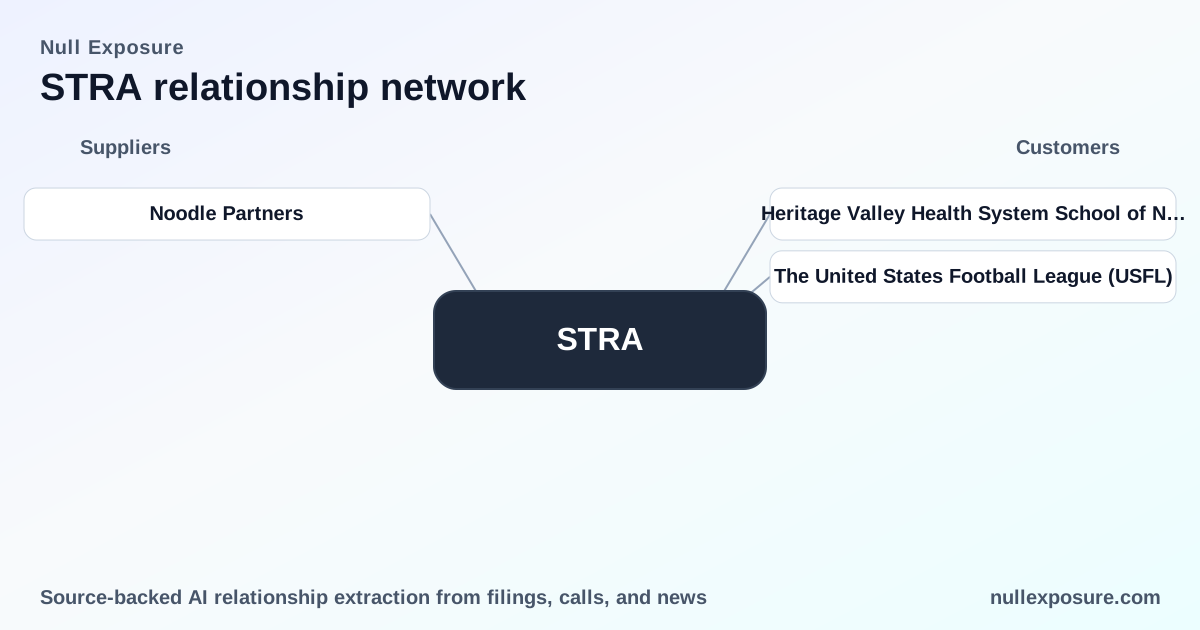
The public supplier relationship in the record: Noodle Partners
- Noodle Partners — Strategic Education announced a joint venture called WorkforceEdge in September (a collaboration between Strategic Education and Noodle Partners, an online program management firm serving not-for-profit universities). This arrangement positions Noodle Partners as an operational collaborator for online program development and delivery. A CNBC article covering investor interest in the company referenced the WorkforceEdge joint venture (CNBC, Dec 11, 2020: https://www.cnbc.com/2020/12/11/jeff-ubben-bets-on-underperforming-for-profit-education-stock.html).
This relationship illustrates Strategic Education’s strategy to partner with specialized OPMs to scale online offerings and access university clients, converting vendor capability into new product lines and revenue channels.
Company-level constraints that shape supplier strategy
Several disclosures function as operating constraints and should be read as company-level signals for supplier counterparties:
- Long-term contracting posture and financing maturity. The company discloses a credit facility with a maturity date of October 18, 2029, and references earlier multi‑party credit agreements, implying multi-year financial commitments that support stable supplier relationships and capital planning. These filings show creditor covenants and amortization of financing costs, signaling disciplined long-horizon planning.
- Service-provider role and vendor governance. Filings state that Strategic Education uses third‑party information infrastructure and cloud vendors and conducts risk assessments before integration and prior to contract renewals, indicating formal vendor governance, cybersecurity due diligence, and ongoing oversight. The company’s internal controls were audited by PricewaterhouseCoopers LLP, reflecting mature control environments tied to vendor operations.
- High and steady vendor spend on marketing. Advertising costs of $181.3M, $185.0M and $186.3M for 2022–2024 respectively show > $100 million annual spend directed to marketing suppliers, media, and agencies. That level of spend creates bargaining leverage but also concentrates operational risk on a small set of large vendors.
These constraints are company-level signals that define Strategic Education’s supplier bargaining landscape: long contract horizons, formalized vendor selection and oversight, and significant, concentrated spend.
What this implies for investors and procurement teams
- Supplier criticality is high. Given the scale of marketing spend and the strategic use of OPM partners, a small number of vendors are functionally critical to enrollment performance. That elevates operational risk and the importance of contractual protections (SLAs, performance-based fees, cybersecurity clauses).
- Negotiating posture favors disciplined contracting. The presence of long-term credit facilities and audited internal controls suggests management views supplier relationships as strategic, not transactional; expect multi-year agreements with governance milestones rather than short-term purchases.
- Execution risk sits in vendor performance and cyber resilience. Outsourced delivery and cloud reliance make vendor operational performance and security posture principal drivers of continuity and reputation risk.
Practical signals operators should watch
- Contract renewal dates and fee structures with major marketing and OPM partners, since a re-pricing or failed transition would show quickly in acquisition costs.
- Disclosure updates on the WorkforceEdge joint venture and similar collaborations, which convert supplier capability into revenue but raise integration risk.
- Any change to advertising spend patterns or to the terms of the credit facility that would pressure operating cash flow and supplier payments.
If you manage supplier risk or evaluate strategic partnerships, prioritize counterparties that can demonstrate performance alignment with enrollment and robust cybersecurity controls.
Learn more about supplier intelligence and strategic counterpart analysis at https://nullexposure.com/
Bottom line for investors
Strategic Education runs a capital-light content and delivery model that leverages large, long-term supplier relationships—notably in advertising, cloud services, and OPM partnerships—to drive student acquisition and online course delivery. Company disclosures indicate mature vendor governance, meaningful recurring spend, and a multi-year financing structure, all of which support operational continuity but concentrate risk in a small number of high-impact suppliers. Investors should price in both the upside from successful OPM collaborations and the vendor execution and cybersecurity risks implicit in an outsourced delivery model.