Sutro Biopharma (STRO): Supplier relationships that govern the manufacturing pivot
Sutro Biopharma is a clinical‑stage biotech that develops and supplies engineered therapeutic candidates while monetizing through collaborator agreements, supply contracts, and partner‑led development arrangements. The company provides materials, reagents and clinical materials to collaborators under contract, and is actively transitioning its manufacturing footprint from internal sites to third‑party contract manufacturing organizations (CMOs) to convert fixed infrastructure into outsourced, partner‑driven supply economics. For investors evaluating supplier risk, the critical facts are straightforward: revenue is generated through collaborator supply and services, and operational continuity now depends on a small set of CMOs and underwriter/PR relationships that shape capital access and market signaling. Learn more or run a full supplier risk report at https://nullexposure.com/.
Why the supplier picture matters for STRO shareholders
Sutro’s business model is built on two monetization levers: commercial supply to collaborators and milestone/licensing/partnered development economics. The company’s FY2024 disclosures confirm revenue recognition when performance obligations for supplied materials and services are met, so supplier performance directly governs near‑term cash conversion and the ability to service collaborators.
- Contracting posture: Sutro has made a deliberate shift from a hybrid in‑house model toward a primarily outsourced manufacturing model by completing technology transfers for reagents (substantially completed 2023) and cell‑free extract (substantially completed 2024) and planning to wind down its San Carlos facility by the end of 2025, per the FY2024 filing.
- Concentration and criticality: The company explicitly flags that loss of third‑party suppliers or inability to manufacture sufficient quantities would materially and adversely affect its business, making key CMOs critical counterparties to the commercial and clinical timelines.
- Maturity signal: Completion of technology transfers signals an operationally mature outsourcing strategy rather than an ad hoc dependence on ad hoc contractors.
These are company‑level signals drawn from Sutro’s FY2024 annual filing and accompanying disclosures.
If you evaluate counterparties for underwriting, manufacturing or PR impact, start your diligence at https://nullexposure.com/ for structured supplier intelligence.
The counterparty map — every relationship disclosed in the records
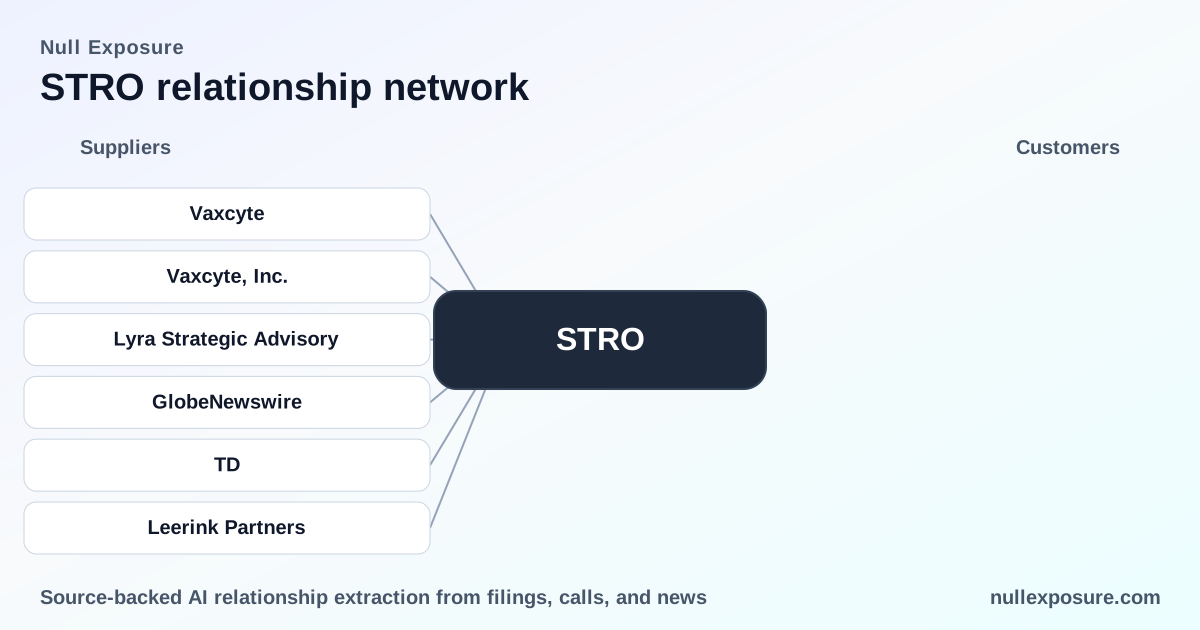
Below are the supplier and partner relationships identified in the available results, each summarized in plain English with source context.
Vaxcyte / Vaxcyte, Inc.
Sutro reports providing materials, reagents and clinical materials to collaborators under separate agreements and recognizes revenue as performance obligations are met; specifically, the company disclosed a Vaxcyte‑related accrual under a Vaxcyte Supply Agreement of $12,435 and $6,933 in its FY2024 filing. According to Sutro’s 10‑K (FY2024), supply arrangements with collaborators like Vaxcyte are a direct revenue source and accrue obligations tied to those agreements.
Lyra Strategic Advisory
Lyra Strategic Advisory is listed as the media contact for Sutro’s presentation at the 2026 J.P. Morgan Healthcare Conference, indicating Lyra handled investor/press communications for the event. This role was cited in the January 2026 conference press distribution as reported through news services in early 2026.
GlobeNewswire
Sutro’s JPM presentation was distributed via GlobeNewswire, and the published distribution included a disclaimer noting the press summary was produced with AI assistance; the distribution channel amplifies investor messaging and indicates Sutro uses established wire services to broadcast corporate events. The GlobeNewswire distribution and disclaimer are visible in the January 2026 press release trace.
TD Securities (USA)
TD Securities (USA) appears as one of the representatives of the underwriters in an underwriting agreement Sutro signed, showing TD acted as a placement agent for Sutro’s capital markets activity in early 2026. TradingView reported this underwriting agreement in March 2026, listing TD Securities (USA) as a counterparty.
Leerink Partners
Leerink Partners is named alongside TD Securities as a representative of the underwriters in Sutro’s underwriting agreement, indicating Leerink served as a capital markets intermediary for the offering. The TradingView notice of the underwriting agreement (March 2026) lists Leerink as a principal underwriting counterparty.
What these relationships reveal about operational risk and runway
These relationships collectively describe a company that generates revenue by fulfilling supply contracts to collaborators while outsourcing the heavy lifting of production. Key implications for investors:
- Supplier risk is first‑order: Sutro’s filing explicitly states that loss of third‑party suppliers or manufacturing shortfalls would materially and adversely impact the business; this makes supplier performance and CMO compliance primary due diligence items.
- Operational leverage is shifting off balance sheet: Completing technology transfers and outsourcing production reduces capital expenditure and transforms fixed manufacturing cost exposure into supplier performance exposure — a tradeoff that prioritizes financial flexibility but increases counterparty dependency.
- Capital markets support is active: Engagements with underwriting firms (Leerink, TD Securities) and active PR/distribution (Lyra, GlobeNewswire) show Sutro is maintaining capital access and investor visibility, which are necessary when a clinical‑stage company relies on external manufacturing and partner payments to fund operations.
Key takeaway: the company’s revenue engine is tied to contract supply performance and collaborator relationships, while its cash runway and market access are supported by active underwriter relationships and public communications.
Investment implications and next steps for operators and buyers
For investors and procurement managers assessing STRO supplier risk, actionable next steps are clear:
- Prioritize verification of CMO contracts, redundancy provisions, and quality/compliance track records given the material consequence of supplier failure (company filing, FY2024).
- Monitor accruals and disclosed counterparty exposures in ongoing filings to detect concentration changes — the Vaxcyte accrual illustrates how supply obligations show up in the balance sheet (10‑K, FY2024).
- Track underwriting activity and investor communications (Leerink, TD Securities; Lyra; GlobeNewswire) to anticipate capital raises that might alter supplier payment terms or working capital dynamics.
For operators or investors who want a structured supplier risk assessment or to benchmark Sutro against peer outsourcing strategies, start a tailored review at https://nullexposure.com/.
Final verdict
Sutro is executing a controlled transition from in‑house manufacturing to a CMO‑centric model, trading fixed asset exposure for concentrated supplier risk. That trade increases operational dependence on a small set of counterparties while preserving financial flexibility, and it places supplier diligence at the center of any investment or procurement decision. For detailed counterparty scoring and monitoring, see the supplier intelligence hub at https://nullexposure.com/.