Star Equity Holdings (STRR): what a sparse supplier map tells investors
Star Equity Holdings operates and monetizes as a small-cap healthcare solutions company that books revenue from its healthcare offerings in the United States and internationally, and supports capital markets engagement through outsourced investor-relations services. The company’s public footprint shows limited supplier disclosure — the most visible external relationship is an investor-relations engagement — which shifts the supplier-risk conversation from operations to capital-markets execution. For more supplier intelligence on small-cap healthcare suppliers, visit https://nullexposure.com/.
Quick operational thesis: revenue-driven healthcare business, capital-markets dependent
Star Equity’s business model is straightforward: generate revenue from healthcare solutions and maintain market access through investor communications. The latest public financials through September 30, 2025 show material top-line scale (Revenue TTM $149 million) paired with negative profitability (Diluted EPS TTM -1.59 and EBITDA negative), indicating that investor perception and capital access are strategic priorities as the company stabilizes margins and returns. The company’s small market capitalization ($36.9 million) and relatively low valuation multiples underscore that external stakeholder management shapes value as much as operational execution.
What the disclosed supplier relationships look like — very limited, IR-centric
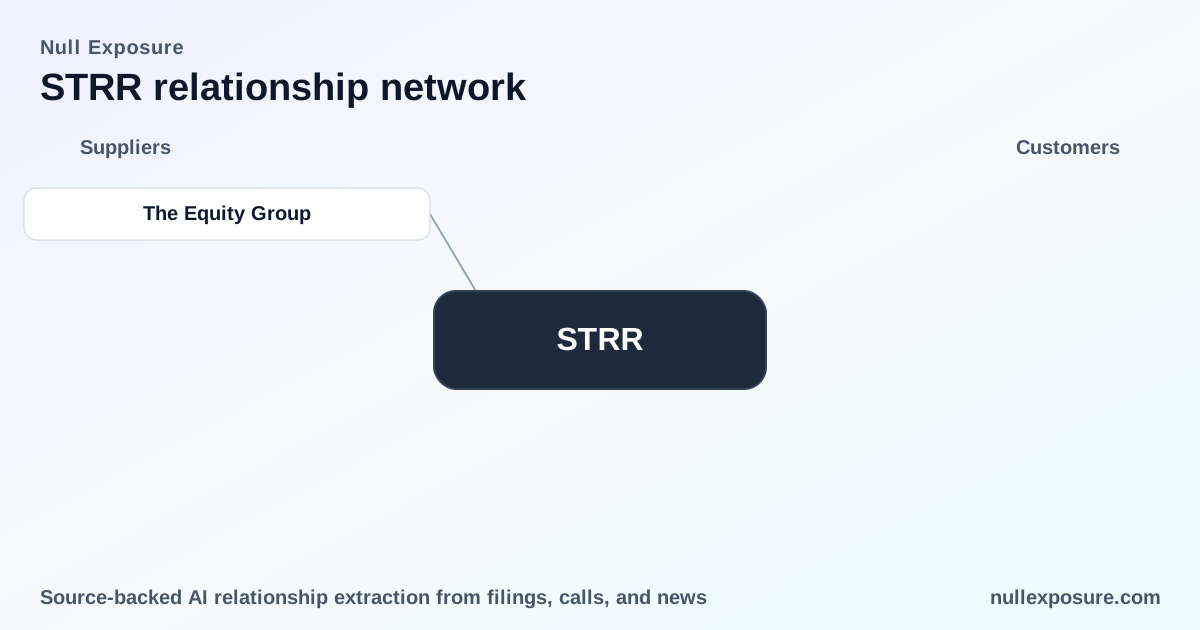
The universe of captured supplier relationships for Star Equity is minimal. The single, documented external partner is an investor-relations firm rather than an operating supplier.
The Equity Group — investor relations contact
Star Equity lists The Equity Group as its investor-relations partner, with Lena Cati named as the contact. This engagement is disclosed in a GlobeNewswire press release dated October 14, 2025 which announced the company presentation at an LD Micro conference and provided the IR contact details. According to that release, investor-relations services are an explicit external engagement for Star Equity (GlobeNewswire, Oct 14, 2025).
Why an IR supplier matters for valuation and risk
When a small-cap company’s only visible external relationship is an investor-relations provider, that fact carries several practical implications for investors:
- Market access and messaging are critical to near-term valuation. With negative profitability and modest market capitalization, maintaining liquidity and investor interest depends on professional IR execution.
- Operational supplier concentration risk is not visible. The absence of public supplier disclosures for manufacturing, IT, or clinical partners in the captured results points to either decentralized operational contracting or limited public reporting of those relationships.
- Contractual constraints were not captured. There are no extracted supplier constraints in the available record; at the company level, this is a signal that public filings or press activity did not surface supplier-level contractual encumbrances for the period covered.
For investors who prioritize governance of supply chains and vendor risk, that silence is itself informative: Star Equity’s public supplier footprint is light and oriented toward investor relations rather than operational input sourcing.
Company-level signals investors should weigh
Interpreting supplier relationships demands context from the financials and ownership structure:
- Valuation and scale: The company reports Revenue TTM of approximately $148.97 million and a market capitalization near $36.86 million, giving a low Price-to-Sales ratio (0.247). That spread between revenue scale and market value elevates the importance of investor communications and liquidity management.
- Profitability and leverage: Negative EBITDA and EPS place emphasis on the ability to refinance or access capital; an IR partner is a direct tool to influence those outcomes. According to the latest quarter (2025-09-30), operating margins are negative and management must prioritize capital markets engagement to fund operations.
- Ownership concentration: Insiders hold a substantial portion (~35.2%) and institutions ~32.1% of the float, which means supplier disclosures and corporate messaging will be scrutinized by relatively concentrated stakeholders when assessing governance and supplier risk.
These company-level traits shape supplier strategy: outsourcing investor relations is consistent with a company that must optimize external perception while keeping operational complexity off the disclosed supplier ledger.
Concentration, criticality and contracting posture — what investors should infer
With no supplier constraints captured, treat the following as company-level inferences rather than relationship-specific facts:
- Concentration: Publicly disclosed supplier concentration is low; the only named supplier is an IR firm. This suggests operational suppliers are either managed internally, dispersed across many small vendors, or simply not disclosed in the materials captured.
- Criticality: Investor-relations services are critical to Star Equity’s near-term financing and valuation outcomes. Operational suppliers could be equally critical, but their absence from the public record elevates the IR relationship in terms of observable importance.
- Contracting posture and maturity: A small-cap firm with negative profitability typically uses standard, short-term vendor engagements for non-core services and retains flexibility in operational contracts. The lack of recorded contractual constraints reinforces a contracting posture that is likely transactional and focused on flexibility rather than long-term lock-ins.
Practical implications for due diligence
For investors and operator partners evaluating Star Equity as a counterparty or portfolio holding, the priorities change because the visible supplier universe centers on capital markets:
- Verify operational supplier lists during diligence to uncover potential undisclosed dependencies (manufacturing, clinical services, IT providers).
- Assess the IR engagement’s scope and cadence; an effective IR program can materially compress financing costs for a small-cap company with negative earnings.
- Monitor upcoming investor events and communications; the GlobeNewswire notice of an LD Micro presentation (Oct 14, 2025) illustrates how STAR uses third-party venues to reach investors.
If you need a deeper supplier mapping or documentary review for small-cap healthcare firms, explore our research portal at https://nullexposure.com/ for bespoke supplier intelligence.
Final verdict — supplier intelligence is thin but meaningful
Star Equity’s public supplier disclosures are currently limited and dominated by investor-relations engagement, which is materially consequential given the company’s negative profits and small market capitalization. The absence of captured supplier constraints should be treated as a company-level signal of limited public supplier disclosure rather than definitive evidence of low supplier risk. Investors must supplement public-sourced supplier intelligence with direct diligence on operational counterparties to fully assess concentration and counterparty risk.
For a targeted review of supplier relationships and contractual constraints for small-cap healthcare issuers, visit https://nullexposure.com/ — our platform aggregates and highlights the relationships that influence valuation and operational resiliency.