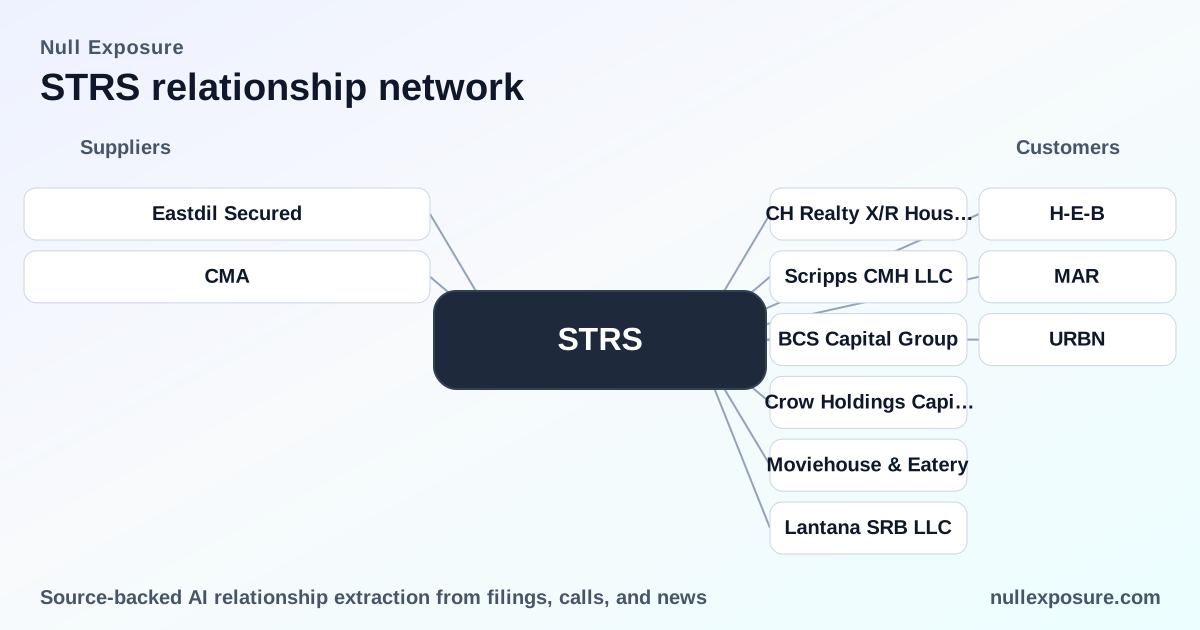
Stratus Properties (STRS): Strategic refocus, banked liquidity, and an adviser in play
Thesis: Stratus Properties monetizes a Texas-focused real estate platform through property acquisition, development, and the recycling of capital via asset sales and licensing; revenue derives from leasing and disposition activity while corporate returns remain pressured by negative margins and episodic project cycles. Recent actions — a high-profile asset sale announcement, engagement of a capital-marketing adviser, and an amended secured credit facility — reframe Stratus from a purely operational developer to a company executing a liquidity-driven strategic pivot.
If you are evaluating supplier relationships and counterparty risk around STRS, note that the company is actively reshaping its capital stack and advisory relationships to prioritize liquidity and portfolio rotation, not long-term reliance on new external development partners alone. For a concise briefing on counterparties and implications, visit https://nullexposure.com/.
Business model and how money flows Stratus operates as a diversified real estate owner-operator focused on multi-family and single-family residential assets in Texas. The company earns cash through leasing operations and by monetizing projects — development execution followed by asset sales or licensing to recycle capital. Financial indicators show constrained operating performance: trailing revenue of roughly $31.9 million with negative EBITDA (-$12.8 million) and negative net income metrics in the latest reported periods. The balance of property-level cash flow and access to secured borrowing capacity defines Stratus’s near-term runway.
What the market actions tell investors Three coordinated moves over the past quarter highlight a single priority: liquidity and strategic optionality. First, Stratus announced a sale of a portfolio asset and publicly disclosed the engagement of an adviser to explore alternatives. Second, the company extended and amended its secured revolving credit facility with Comerica Bank to shore up borrowing capacity into 2028. Together, these actions reflect an operating posture prioritizing capital recycling and near-term balance-sheet flexibility rather than aggressive new-build scale.
Key relationships and what they mean for counterparty risk
Eastdil Secured Stratus engaged Eastdil Secured to explore strategic alternatives concurrent with its asset sale announcement, signaling that the company is actively soliciting market M&A and capital-marketing advice. According to a December 22, 2025 market report, Eastdil’s engagement is tied to the Kingwood Place sale announcement and the company’s strategic pivot.
Comerica Bank Stratus amended its secured revolving credit facility with Comerica Bank, extending maturity to March 27, 2028; the facility carried a $27.4 million borrowing base with $17.4 million available net of outstanding letters of credit, strengthening near-term liquidity. This amendment was disclosed in a January 30, 2026 company announcement published on The Globe and Mail and covered by TradingView news in early 2026.
(These two counterparties encompass all supplier-scope relationships captured in recent reporting for STRS.)
Operating-model constraints and supplier posture Stratus’s procurement and project-delivery model relies on third-party general contractors and specialist consultants on largely fixed-price contracts, with in-house staff overseeing site selection, entitlements, architecture, engineering, landscaping, design, sustainability, and marketing. This contracting posture limits unit-level cost variability for the company but transfers construction execution risk to suppliers; it also requires a mature supply chain and disciplined project oversight. The company-level signal here is clear: Stratus is not vertically integrating construction but is contractually structured to hold suppliers accountable for delivery within negotiated fixed-price terms.
Financial and operational characteristics investors should track
- Concentration of strategy on capital recycling. The engagement of a sell-side adviser and an asset sale announcement indicate that STRS is prioritizing disposals to improve liquidity rather than funding large new developments from operating cash flow.
- Liquidity backed by a modest secured facility. A $27.4 million borrowing base with $17.4 million availability is material for a company of STRS’s size (market cap ~ $151.2 million) but is not a long-term growth engine; the extended maturity to 2028 buys time for asset disposition.
- Performance metrics show constrained profitability. Revenue of $31.9 million with negative EBITDA and negative EPS indicates the company is in a repair or transition phase; investors must assess whether asset sales and refinancing produce sustainable positive operating leverage.
- Valuation signals mixed maturity. Price-to-sales of 8.05 and EV/EBITDA above 200 reflect a market pricing sensitive to thin earnings and the potential upside attached to asset monetization outcomes.
Why the listed supplier relationships matter to investors and operators
- Eastdil Secured (adviser) matters for exit strategy execution. Engaging a top-tier capital markets adviser changes both the probability and speed of an asset or corporate sale; for counterparties, this raises the likelihood of rapid transaction-driven changes in counterparty exposure and contract novations.
- Comerica Bank (lender) underpins short-term funding and covenant oversight. The amended facility extends the company’s runway but also embeds a borrowing-base governance model that will influence permissible asset dispositions and require ongoing compliance with lender covenants.
Middle read CTA If you want a focused supplier-risk briefing or counterparty monitoring on STRS, see practical intelligence at https://nullexposure.com/ — designed for investors and operators who need actionable signals.
Practical implications and risk checklist for due diligence
- Counterparty concentration: Comerica is the primary secured lender disclosed; any lender or mezzanine provider added during strategic alternatives could change leverage dynamics. Monitor future filings for new pledge or intercreditor arrangements.
- Supplier execution risk: Fixed-price contracting reduces cost upside for Stratus but could escalate dispute risk if projects encounter delays or scope changes — operators should review contract dispute history and retention practices where possible.
- Liquidity event probability: The presence of an adviser and an announced sale increases the chance of further disposition activity or a strategic transaction that could materially reconfigure asset ownership and supplier obligations.
- Market timing and macro sensitivity: Given negative operating margins and a real estate market that is rate-sensitive, asset-sale pricing will reflect current cap-rate and demand dynamics; transaction outcomes will directly affect lender availability and supplier payment cadence.
Conclusion and recommended next steps Stratus is executing a clear liquidity-first agenda: asset sale plus adviser engagement and a renewed, extended borrowing facility. For investors and vendor managers, the immediate priority is monitoring transaction process updates, lender covenant status, and any shifting obligations to construction and service providers. If you need ongoing monitoring or a tailored counterparty risk memo on STRS, start with an overview at https://nullexposure.com/ and request a supplier-focused briefing tailored to your exposure profile.
Sources: FinancialContent and WRAL market reports (Dec 22, 2025) reporting Eastdil engagement; a January 30, 2026 press release published on The Globe and Mail and TradingView coverage confirming the Comerica amendment and facility details.