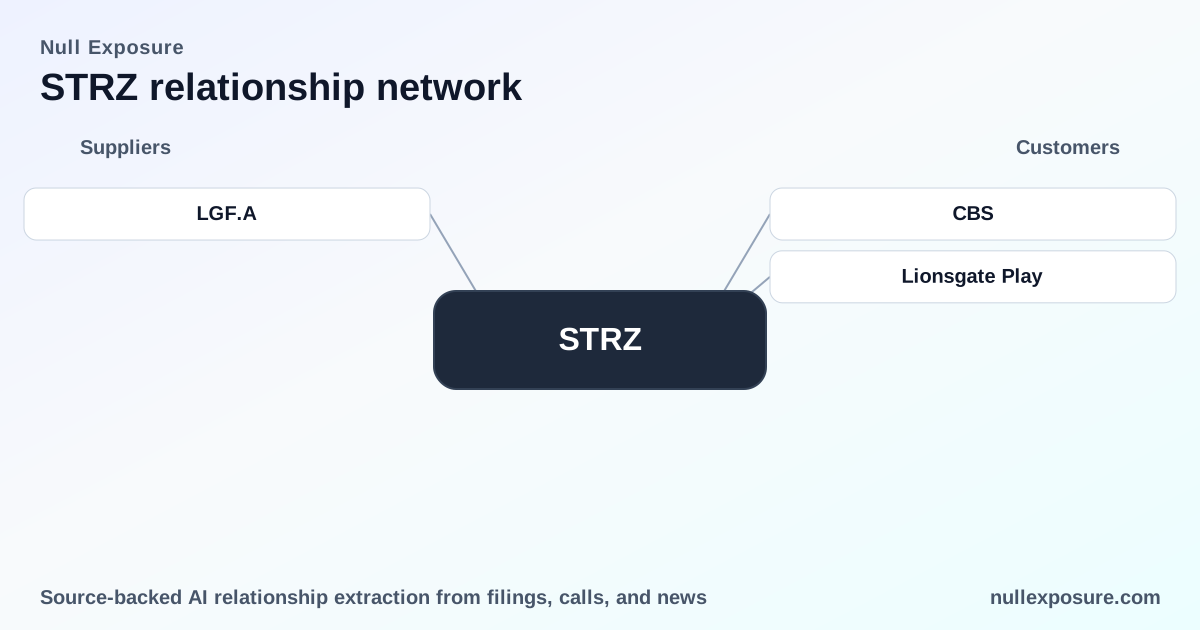
Starz Entertainment (STRZ): Supplier relationships, contracts, and what Lionsgate linkage means for investors
Starz operates as a niche premium content network and streamer that monetizes through subscription revenue, licensed pay-TV carriage fees and output licensing arrangements with major studios. The business blends steady recurring revenue from subscribers with timing-dependent licensing economics for theatrical films and series; its profitability profile depends on controlling content costs while extracting long-lived value from exclusive output deals. For investors evaluating supplier risk and opportunity, the dominant supplier relationship in recent public reporting is with Lionsgate—a relationship that shapes Starz’s content pipeline, cash outflows and strategic optionality. Learn more about relationship exposures and contract posture at https://nullexposure.com/.
Quick orientation: the business context that matters
Starz reports roughly $1.284 billion in trailing revenue and $131 million in EBITDA, with negative net margins driven by content and operating investments. The company’s operating model is content-first and contract-heavy: multi-year output licensing, programming notes tied to film deliveries, and shared services allocations that create predictable but material recurring spend. These dynamics create both downside concentration risk (content supplier concentration) and upside optionality when exclusive film windows drive subscriber retention.
All reported supplier signals: the Lionsgate thread (every item)
Below I cover every relationship entry surfaced in the aggregated results. Each item is a plain-English summary tied to the original reporting.
-
Broadcast & International (Broadcastnow) — FY2025: The outlet reported that Starz and Lionsgate extended an output deal, giving Starz pay-TV and SVOD rights to Lionsgate’s movie output; the piece also referenced a long-awaited corporate split between the companies. According to Broadcastnow (March 10, 2026), this extension preserves Starz’s access to first-tier Lionsgate theatrical titles.
Source: Broadcastnow article (reported March 10, 2026). -
Yahoo Finance Singapore — FY2026: A Yahoo piece described Starz as being backed by an exclusive output deal with Lionsgate through 2028, positioning Lionsgate films as a core content moat supporting the Starz proposition into the 2028 window.
Source: Yahoo Finance Singapore article (reported March 10, 2026). -
Finviz news roundup — FY2026: A Finviz market commentary reiterated that Starz’s bull case relies on an exclusive output deal with Lionsgate extending through 2028, highlighting the strategic value of guaranteed studio supply for programming and marketing planning.
Source: Finviz news (reported March 10, 2026). -
InsiderMonkey analysis — FY2026: Investor-oriented analysis emphasized Starz’s niche audience focus (notably content for women and underrepresented groups) and credited the exclusive Lionsgate output deal through 2028 as an underpinning of the content slate despite recent subscriber softness.
Source: InsiderMonkey blog post (reported March 10, 2026).
What the constraints reveal about Starz’s operating posture
The compiled constraint signals provide direct visibility into contract types, payment schedules and cost allocation practices that define Starz’s supplier risk profile.
-
Licensing is a primary contract form and specifically names Lionsgate: filings and disclosures describe an exclusive multiyear output licensing agreement with (New) Lionsgate covering U.S. theatrical titles beginning January 1, 2022, with Summit-label films added afterward. This is an explicit, material content commitment that locks Starz into programming fees tied to theatrical performance and title volumes. This contract structure makes Lionsgate a critical upstream supplier for Starz’s content inventory.
-
Service relationship with legacy Lionsgate functions: Old Lionsgate historically provided corporate G&A and other shared services to the Starz business under transitional arrangements. That contractual posture created a predictable allocation of corporate costs that Starz continued to absorb after the studio separation. The evidence names Lionsgate as a service-provider counterparty, making administrative continuity a supplier dimension beyond raw content licenses.
-
Spend concentration at a notable scale: Disclosures show a $10.0 million annual allocation under a Shared Services Agreement charged to Starz to reflect corporate G&A support sourced from the legacy studio—this is a material, recurring cost line in the $10–100 million spend band and a visible line item for budgeting and free cash flow modeling.
-
Short-term program financing exists alongside multi-year deals: Company disclosures also reflect programming notes with short-term repayment profiles (for example, $90.7 million outstanding with April 2025 contractual repayment dates and SOFR-based rates). These unsecured program-specific obligations create near-term cash flow timing risks even while multi-year output licenses provide supply visibility.
-
Long-term infrastructure commitments are present at company level: Starz leases satellite transponders under multi-year agreements, indicating infrastructural contract maturity that is separate from content suppliers but important to distribution resilience.
Collectively, these constraints show a company that mixes long-term exclusive content commitments (which secure programming windows) with short-term financing tied to film deliveries and reallocated corporate costs that increase fixed spend. That blend shapes Starz’s cash flow volatility profile and the value of its Lionsgate relationship.
Investor implications: concentration, criticality, and leverage
-
Concentration: The Lionsgate output agreement is a material concentration of content supply through 2028; loss or dilution of that deal would materially raise content acquisition costs or force programming substitutions. Investors should treat Lionsgate as a top-tier supplier risk.
-
Criticality: The relationship is critical for Starz’s historical positioning—exclusive film rights drive marketing cycles and retention metrics more than episodic third-party acquisitions. The Shared Services Agreement also creates an administrative dependency during transition periods.
-
Contract maturity and flexibility: Multi-year licensing provides scheduling certainty but locks in programming fees that are frequently tied to theatrical receipts—this structure creates asymmetric upside (if titles overperform) and downside (if theatrical results deteriorate). Short-term programming notes introduce refinancing and interest-rate sensitivity that can compress free cash flow.
-
Financial modeling impact: Use the disclosed revenue ($1.284B TTM) and EBITDA ($131M) as baselines, then stress-test scenarios where Lionsgate fees rise or short-term program financing requires rollover at higher rates.
Explore more supplier risk signals and contract analytics at https://nullexposure.com/ for deeper diligence.
Bottom line and recommended actions
Starz’s supplier profile is dominated by a confirmed, exclusive multiyear Lionsgate output licensing arrangement that both stabilizes content supply and concentrates counterparty risk. The company balances that long-term commitment with short-term programming financing and legacy shared-service charges—an operating mix that produces predictable content flows but requires active liquidity management.
- For operators and investors: prioritize monitoring the Lionsgate output windows, the $10M shared-services allocation, and the near-term programming note maturities.
- For analysts building models: incorporate scenario ramps for content fee inflation and refinancing risk into free cash flow and valuation runs.
For a full supplier-risk snapshot and to track emerging contract signals, visit https://nullexposure.com/ — the platform centralizes the disclosures and news that move supplier-exposed equities.
Final thought: Starz’s strategic value lies in exclusive, studio-backed film supply, but that same exclusivity concentrates supplier risk—understanding the contract mechanics with Lionsgate is essential to any investment thesis on STRZ.