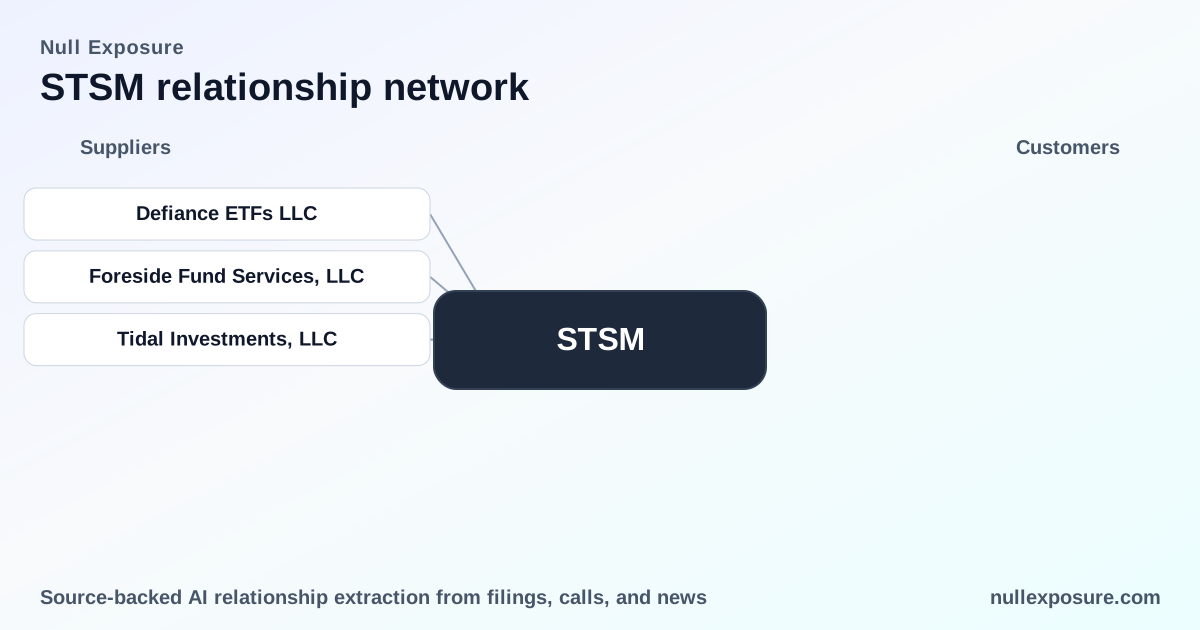
STSM supplier map: who runs the 2x short for TSMC and what investors should know
Thesis: STSM is an exchange-traded product structured as a 2x short ETF against Taiwan Semiconductor Manufacturing Company Limited (TSMC). The economics are traditional ETF economics — sponsor and adviser capture management and operational fees, distributors enable market access, and product viability depends on asset flows, liquidity and regulatory posture. The launch partners behind STSM determine distribution reach, operational resilience and go-to-market execution; they are therefore material to any investor or operator assessing counterparty risk and commercial upside. Learn more about supplier relationships and diligence at https://nullexposure.com/.
How STSM is put together and who earns what
STSM is not a standalone operating company; it is an investment vehicle created and brought to market by a sponsor with delegated service providers. Revenue accrues through product fees, creation/redemption mechanics and aftermarket trading liquidity that reinforces assets under management. Operational responsibilities — portfolio construction, trading, compliance, and distribution — are split among the sponsor, the adviser and the distributor, and each role carries different commercial leverage and operational risk for investors and counterparties.
The three named supplier relationships and their roles
Defiance ETFs LLC — the sponsor and brand owner
Defiance ETFs LLC is identified as the ETF sponsor for STSM in the launch announcement, which positions Defiance as the entity responsible for product creation, regulatory filing and overall commercial ownership of the fund. According to the company press release on November 18, 2025, Defiance publicly launched STSM as the first 2x short ETF for Taiwan Semiconductor Manufacturing Company Limited (GlobeNewswire, Nov 18, 2025: https://www.globenewswire.com/news-release/2025/11/18/3190031/0/en/Defiance-Launches-STSM-The-First-2X-Short-ETF-for-Taiwan-Semiconductor-Manufacturing-Company-Limited.html).
Tidal Investments, LLC — the investment adviser
Tidal Investments, LLC is named as the Fund’s investment adviser and is responsible for portfolio implementation, daily leverage management and counterparties used to achieve the 2x short exposure. The launch announcement explicitly lists Tidal as the adviser in the same November 18, 2025 press release (GlobeNewswire, Nov 18, 2025: https://www.globenewswire.com/news-release/2025/11/18/3190031/0/en/Defiance-Launches-STSM-The-First-2X-Short-ETF-for-Taiwan-Semiconductor-Manufacturing-Company-Limited.html).
Foreside Fund Services, LLC — distribution and regulatory support
Foreside Fund Services, LLC is referenced as the distributor for STSM and is the entity that will handle intermediary relationships and certain regulatory filings associated with product distribution. The distributor role is confirmed in Defiance’s launch communication dated November 18, 2025 (GlobeNewswire, Nov 18, 2025: https://www.globenewswire.com/news-release/2025/11/18/3190031/0/en/Defiance-Launches-STSM-The-First-2X-Short-ETF-for-Taiwan-Semiconductor-Manufacturing-Company-Limited.html).
What these relationships tell investors about the operating model
- Contracting posture and delegation. The sponsor/adviser/distributor split reflects a common ETF operating model: the sponsor holds strategic control, the adviser executes investment strategy and the distributor provides market access. This structure creates clear division of liability and commercial upside between brand-owner and service providers.
- Concentration and criticality. With three named counterparties, counterparty concentration is limited but meaningful: loss or underperformance at any single service partner — especially the adviser — would materially affect fund execution. The data shows no further third-party custodians, authorized participants, or prime brokers in the disclosed relationships, which means investors should request additional operational detail when assessing counterparty concentration.
- Maturity and standardization. The relationship map is standard for ETF launches, implying mature operational templates and established vendor roles rather than bespoke or experimental arrangements. This supports faster onboarding and predictable regulatory compliance paths.
- Company-level signal: no disclosed supplier constraints. The available records include no explicit contractual constraints or caveats about supplier obligations; the absence of disclosed supplier constraints is itself a signal that the product launch relied on conventional contractual constructs rather than constrained or contingent service arrangements.
Explore deeper counterparty mapping and operational checks at https://nullexposure.com/.
Risks that follow from the supplier map
- Execution risk via the adviser. For a leveraged inverse product, investment adviser performance and risk controls are the single biggest operational exposure — mispricing or failed hedge execution causes NAV divergence and reputational risk.
- Distribution concentration and retail flows. Distributor reach affects initial asset gathering and liquidity; reliance on a single distribution partner can slow scaling if market appetite is limited.
- Regulatory and product-type risk. Leveraged inverse ETFs face periodic regulatory scrutiny and suitability debate; sponsor and distributor reputations directly affect product survivability under regulatory and market stress.
- Opaque counterparty details. The launch announcement does not list trading counterparties, authorized participants, custodians or prime brokers; investors should require disclosure of those counterparties and their credit profiles before committing significant capital.
Practical diligence checklist for operators and investors
- Request the adviser’s trading and hedging playbook: margining, counterparties and stress scenarios.
- Confirm the list of authorized participants, custodian and prime brokers and review counterparty credit limits.
- Validate distribution agreements and placement channels to assess asset-gathering potential.
- Monitor fund-level flows and expense disclosures post-launch for early performance signals.
Bottom line and recommended next steps
STSM is a classic ETF stack: Defiance as sponsor, Tidal as adviser and Foreside as distributor — a configuration that supports rapid market access but concentrates operational risk in the adviser role. For investors and operators, the commercial thesis is straightforward: product success depends on asset flows and flawless daily execution of a 2x short strategy. The immediate diligence priority is hedging counterparties and the adviser’s operational controls.
For a deeper supplier risk profile and ongoing monitoring solutions, start your diligence at https://nullexposure.com/. If you require a bespoke counterparty map or a rapid operational due diligence pack, visit https://nullexposure.com/ to request support and reporting tailored to ETF launches.