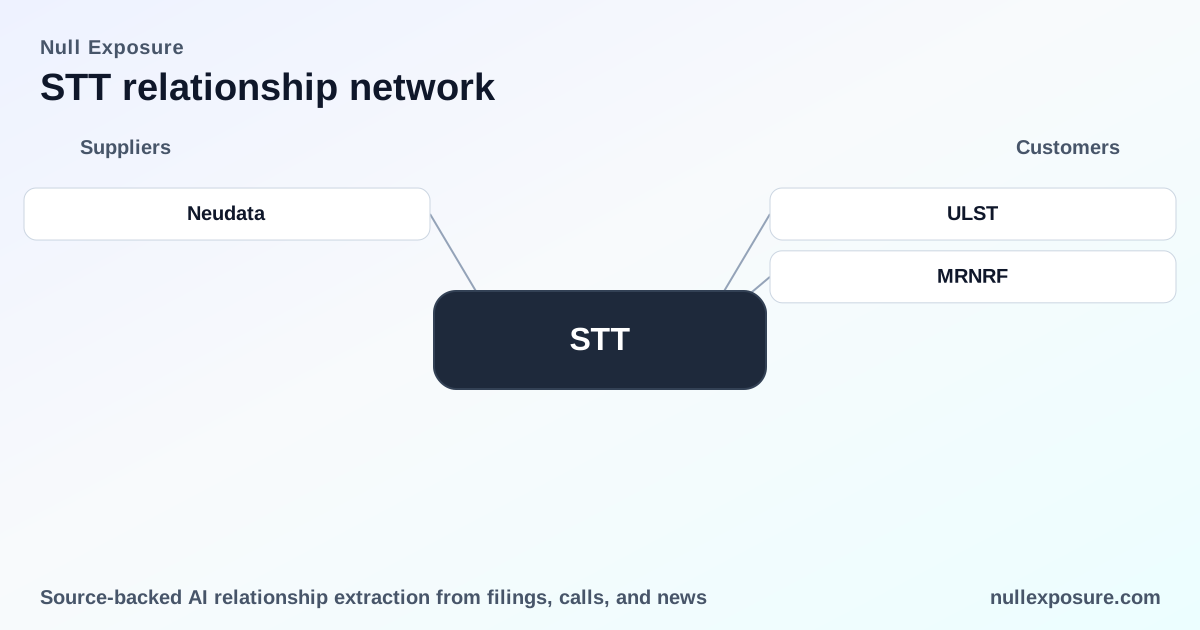
State Street (STT) — supplier relationships, strategic signal, and investor checklist
State Street Corporation operates as a global custodian and asset servicer that monetizes through fee-based client servicing: custody and fund administration fees tied to assets under custody and administration, investment management fees, and growing revenue from analytics and data-intelligence services. The firm captures predictable recurring revenue from large institutional clients and incrementally monetizes proprietary and partner-enabled data capabilities to sell higher‑margin advisory and analytics offerings. For investors evaluating supplier relationships, the recent Neudata alliance is a visible example of how State Street is converting market intelligence partnerships into commercial products and client engagement channels. Read more about State Street supplier intelligence at https://nullexposure.com/.
What the Neudata engagement actually does for the business
State Street has announced a focused partnership with Neudata to expand its Data Intelligence capabilities and to promote institutional use of alternative data across practical investment workflows. This is an extension of State Street’s strategy to embed research and analytics into client workflows, converting custody and servicing relationships into higher‑value advisory touchpoints. According to Simply Wall St (March 10, 2026), the alliance targets macroeconomic and market insights derived from non‑traditional inputs and will be featured at Neudata’s 2026 global data summits in London, New York, Hong Kong, and San Francisco.
Every relationship captured in the public reporting
- State Street announced a partnership with Neudata to expand its Data Intelligence capabilities, positioning the firm to use alternative data to generate macroeconomic and market insights; this was reported by Simply Wall St on March 10, 2026.
- As a sponsor of Neudata’s 2026 global data summits, State Street will engage directly with data‑literate institutional investors to showcase practical applications of alternative data in investment workflows, according to Markets Media (March 2026).
- Reporting consolidated by Simply Wall St reiterated the March 2026 announcement and emphasized the cross‑market summit presence (London, New York, Hong Kong, San Francisco) as a distribution mechanism for the new capability.
Each of these items references the same commercial relationship—State Street partnering with Neudata—documented in March 2026 by industry press and investment research outlets (Simply Wall St; Markets Media).
Why this relationship matters to investors
- Revenue uplift through client engagement: The Neudata partnership is oriented toward content and workflow integration rather than large one‑time technology sales, increasing the probability of recurring advisory or analytics fees tied to client asset flows.
- Distribution leverage: State Street will leverage Neudata’s summit platform to market capabilities directly to institutional buy‑side teams, accelerating commercial adoption without proportional increases in sales spend.
- Adjacency to core custody business: This initiative is additive to core fee streams—analytics and decision support enhance stickiness of custody and administration clients and improve cross‑sell of higher‑margin services.
Operating model signals and company-level constraints
Public evidence presents State Street as a mature service provider with formal control and oversight frameworks. The firm’s 2024 audit disclosures note Ernst & Young LLP audited the effectiveness of internal control over financial reporting as of December 31, 2024, which is a signal of governance maturity and regulatory compliance posture. Separately, State Street acknowledges operational exposures from the use of unaffiliated subcustodians, which introduces operational and reputational concentration risk when servicing cross‑border mandates. These constraints indicate:
- Contracting posture: State Street operates primarily as a service provider to institutional clients, signing long‑term custody and administration agreements that create durable revenue but require high operational compliance.
- Concentration and criticality: Reliance on unaffiliated subcustodians is a structural concentration that raises execution risk in specific markets; this is a firm‑level vulnerability rather than an attribute of the Neudata partnership.
- Maturity and control: Formal external audit of internal controls demonstrates an advanced control environment appropriate for a systemically important servicer.
Risk checklist for supplier diligence
Investors and operators evaluating this supplier dynamic should prioritize these questions before extrapolating durable revenue upside:
- Contract economics: Are Neudata‑sourced products sold on a revenue‑share, license, or referral basis, and how does State Street capture margin?
- Integration depth: Will Neudata content be embedded into State Street’s client‑facing platforms or distributed as a standalone advisory product? Deeper integration increases stickiness but also operational burden.
- Regulatory and compliance allocation: Which party retains responsibility for data provenance, recordkeeping, and model governance when alternative inputs are used for client advice?
- Counterparty concentration: How does the Neudata relationship interact with existing subcustodian and third‑party vendor dependencies identified in State Street filings?
These diligence items directly map to commercial upside, execution risk, and regulatory exposure that determine whether the partnership shifts State Street’s growth profile or simply augments marketing channels.
Read more supplier intelligence and comparative diligence frameworks at https://nullexposure.com/.
Investment implications and a short roadmap for monitoring
State Street’s financial profile supports cautious optimism: healthy profit margins, a durable fee base, and a balance sheet that supports growth through strategic partnerships. Key metrics from the company summary—earnings per share, return on equity, and a visible dividend—reinforce the view of a cash‑generative incumbent positioning its product stack for higher‑margin analytics. For an investor or operator, the practical monitoring plan is:
- Track announcements for commercial terms and client wins tied to Neudata offerings; adoption signals are leading indicators of revenue capture.
- Monitor regulatory filings and client disclosures for any reallocation of compliance responsibilities or material reliance on third‑party inputs.
- Reassess operational risk tied to subcustodians and vendor ecosystems when State Street scales analytic services internationally.
If Neudata‑enabled solutions convert into measurable fee streams and client retention uplift, the partnership will have moved from marketing to monetization—investors should look for that inflection in quarterly disclosures.
Final actionable step: review the relationship summaries and control‑framework signals, then prioritize outreach to State Street management or client references to validate commercial traction. For a centralized view of supplier relationships and their investor implications, visit https://nullexposure.com/.
State Street’s Neudata engagement is a clear strategic move to convert institutional distribution into an analytics revenue stream; the partnership is material from a product and client‑engagement perspective, while company‑level disclosures on subcustodians and audited controls remain the primary execution and regulatory guardrails investors must watch.