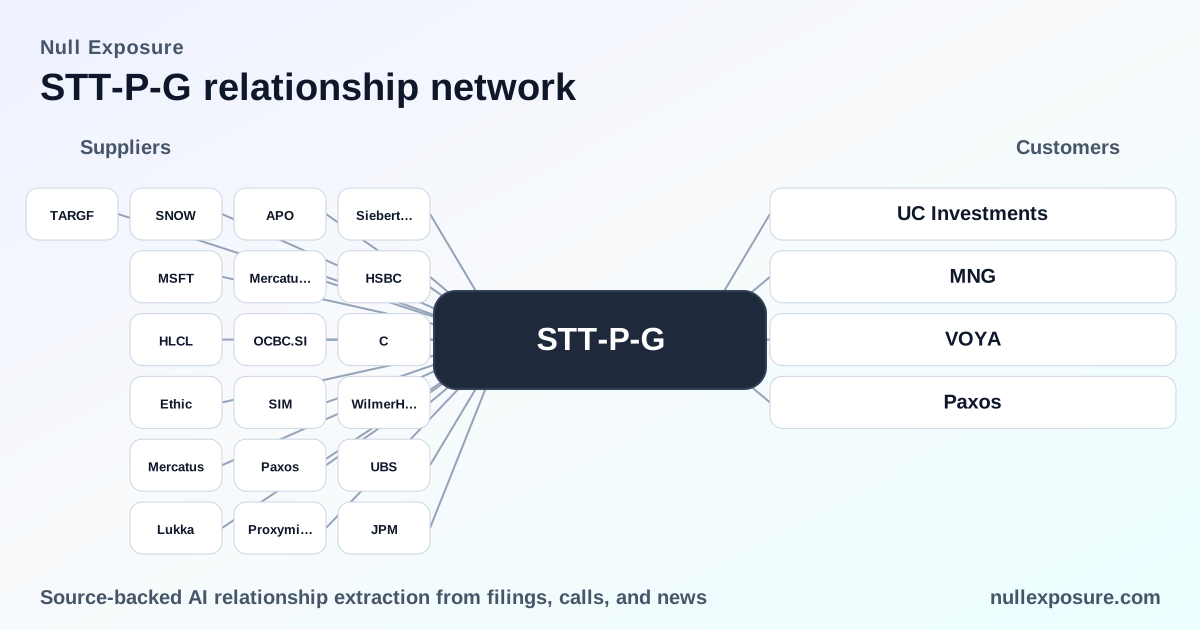
State Street (STT-P-G): supplier map and strategic implications for investors
State Street is a global custodian, asset manager and financial services holding company that monetizes through custody and administration fees, investment management, securities servicing, and capital markets issuance; the STT-P-G depositary shares are one form of its capital structure supporting these operating businesses. This briefing maps the supplier and partner relationships that shape State Street’s product delivery, capital access and technology stack — and highlights the commercial signals investors should price into valuation and counterparty risk assessments. For an interactive view of these links and primary source references, visit https://nullexposure.com/.
What this relationship map tells investors in plain terms
State Street runs a hybrid operating model: entrenched banking and capital markets relationships underwrite balance-sheet funding and product distribution, while a layered technology and fintech ecosystem underpins product innovation (tokenization, data platforms, settlement). The company funds growth and liquidity through public capital markets transactions supported by global investment banks, and simultaneously invests in technology and partnerships to defend custody and asset-servicing franchises.
Key takeaways:
- Capital markets access is core — large underwriter syndicates handle debt issuance.
- Custody and settlement are strategic and increasingly digital — blockchain pilots and tokenized custody extend custody economics.
- Third-party tech and data partners reduce build time but create operational dependencies.
Explore how these relationships affect risk and opportunity at https://nullexposure.com/.
Supplier and partner relationships — what each connection means
Below are the relationships surfaced in public coverage; each entry is a concise investor-oriented summary with an explicit source reference.
-
Siebert Williams Shank & Co., LLC — acted as a representative of the underwriters on State Street’s $1.5 billion fixed-to-floating senior and subordinated notes offering that priced November 16, 2023 and closed November 21, 2023, signaling broad underwriting distribution for debt issuance (WilmerHale advisory, Nov 2023).
Source: WilmerHale insight on the offering (FY2023). -
HSBC Securities (USA) Inc. — served as an underwriter representative on the same $1.5 billion registered notes transaction, reflecting reliance on global bank syndicates for capital markets execution (WilmerHale advisory, Nov 2023).
Source: WilmerHale insight (FY2023). -
Citigroup Global Markets Inc. — one of the lead underwriters for the November 2023 fixed-to-floating notes, underscoring State Street’s use of premier global dealers to access wholesale funding (WilmerHale advisory, Nov 2023).
Source: WilmerHale insight (FY2023). -
UBS Securities LLC — acted as a representative of the underwriters on the 2023 note issuance, part of a diversified underwriting group supporting State Street’s wholesale debt program (WilmerHale advisory, Nov 2023).
Source: WilmerHale insight (FY2023). -
WilmerHale — advised State Street on the capital markets transaction, confirming legal and regulatory counsel engagement for complex registered note offerings (WilmerHale announcement, Nov 2023).
Source: WilmerHale client advisory (FY2023). -
J.P. Morgan — State Street joined JPMorgan’s blockchain platform as the first third‑party custodian for tokenized assets, a strategic step into tokenized custody and a signal of institutional adoption of ledger-based settlement rails (Coindesk, Aug 2025).
Source: Coindesk coverage of the JPM blockchain partnership (FY2025). -
J.P. Morgan Securities — acted as the placement agent on the same tokenization initiative transaction, aligning placement expertise with custody execution on the new platform (Coindesk, Aug 2025).
Source: Coindesk (FY2025). -
Taurus — selected as a tokenization partner, providing tokenization infrastructure in conjunction with State Street’s custody role on JPM’s platform, indicating a multi-vendor approach to token infrastructure (Coindesk, Aug 2025).
Source: Coindesk (FY2025). -
Oversea‑Chinese Banking Corporation (OCBC) — anchored the first $100 million tokenized commercial paper issuance with State Street Investment Management purchasing the debt, demonstrating early market transactions for tokenized short-term paper (Coindesk, Aug 2025).
Source: Coindesk reporting on the OCBC tokenized CP (FY2025). -
Apollo — partnered with State Street on a target-date platform, supplying private markets exposure via a pooled vehicle while State Street manages indexed public allocations, showing a product-level tie-up between manager and platform provider (401kSpecialist, FY2025).
Source: 401kSpecialist coverage (FY2025). -
Mercatus / Mercatus, Inc. — acquired by State Street to enhance front- and middle-office private markets capabilities, enabling a whole‑portfolio view and private markets data/operations integration for institutional clients (Citybiz and Pensions & Investments coverage, FY2021–FY2022).
Sources: Citybiz (FY2022) and Pensions & Investments / PIONLINE (FY2021). -
SimCorp — entered a front‑to‑back partnership with State Street in EMEA, integrating SimCorp Dimension into State Street’s Alpha Platform to deliver outsourced investment operations for insurers, signaling reliance on established portfolio administration systems (GlobeNewswire, Oct 2020).
Source: GlobeNewswire announcement (FY2020). -
Paxos — served as an institutional settlement service in a pilot, enabling State Street to route settlement instructions to Paxos for cost‑effective, faster settlement while maintaining legacy messaging interfaces, indicating experimental adoption of alternative settlement rails (Paxos press release, FY2022).
Source: Paxos newsroom (FY2022). -
Proxymity — rolled out global shareholder disclosure with State Street, improving investor communications and regulatory compliance across markets and signaling investment in digital proxy and disclosure workflows (Newswire, FY2025).
Source: Newswire (FY2025). -
Snowflake — selected as a data platform partner for State Street’s Alpha platform, with Snowflake powering data plumbing and analytics in an Azure-hosted architecture to support open connectivity to vendor data (eFinancialCareers coverage, FY2021).
Source: eFinancialCareers (FY2021). -
Microsoft — partnered around Azure infrastructure and Kafka pipelines for State Street’s open-architecture platform, providing cloud and streaming backbone for scale and data governance (eFinancialCareers, FY2021).
Source: eFinancialCareers (FY2021). -
Helical Plc — developer of State Street’s new London headquarters at 100 New Bridge Street, with delivery scheduled April 2026, reflecting corporate real estate commitments that affect occupancy and lease economics in the UK (VoxMarkets, FY2025).
Source: VoxMarkets report (FY2025). -
Ethic — entered a technology partnership with State Street Global Advisors (SSGA) to scale delivery of customized investments across SMA, model and unified managed accounts, demonstrating SSGA’s use of fintech partners to expand product distribution (WealthManagement, FY2025).
Source: WealthManagement.com (FY2025). -
Lukka — received investment from State Street Partners (reported activity), reflecting interest in crypto data and valuation services that can feed new asset servicing lines for digital-asset clients (Coindesk, Dec 2020).
Source: Coindesk report (FY2020).
Operating model constraints and commercial signals investors should price
There are no supplier-specific constraint excerpts reported in the public results set; however, the relationship map surfaces company-level operational signals investors should treat as constraints in modeling:
-
Contracting posture: State Street consistently engages large global banks and specialized fintechs — a mix of long‑term bilateral contracts with incumbent banks for capital markets and modular commercial terms with technology vendors for platform capabilities. That posture trades off time-to-market for dependence on external platforms.
-
Concentration and diversification: Underwriting and custody partners are diversified across major global dealers and fintechs, reducing single‑party counterparty concentration for issuance and product execution; however, core custody economics remain concentrated in institutional client flows.
-
Criticality and integration: Technology partners (Snowflake, Microsoft, SimCorp) and custody/settlement partners (J.P. Morgan, Paxos, Taurus) are critical to product delivery; operational or contractual disruption at these nodes would have outsized impact on new product rollouts and tokenized custody services.
-
Maturity and runway: Relationships span incumbent financial institutions (Citi, UBS, HSBC, J.P. Morgan) and younger fintechs (Paxos, Proxymity, Taurus, Lukka), suggesting State Street is both defending legacy franchises and investing in nascent markets that have longer monetization horizons.
For deeper vendor maps and trending exposure analytics, see https://nullexposure.com/.
Bottom line for investors
State Street’s supplier footprint is strategically coherent: global banks underwrite and distribute capital, while tech and fintech partners extend custody and product capabilities into tokenization, data, and private markets. Primary investment risks are execution of new product monetization and operational dependencies on third‑party platforms; primary upside is capture of new custody flows and fee-bearing private markets services. Review counterparties in your risk models, and update liquidity and operational scenarios to reflect the multi-vendor structure that now sits at the heart of State Street’s service delivery.
For source-level links and an interactive supplier visualization, visit https://nullexposure.com/.