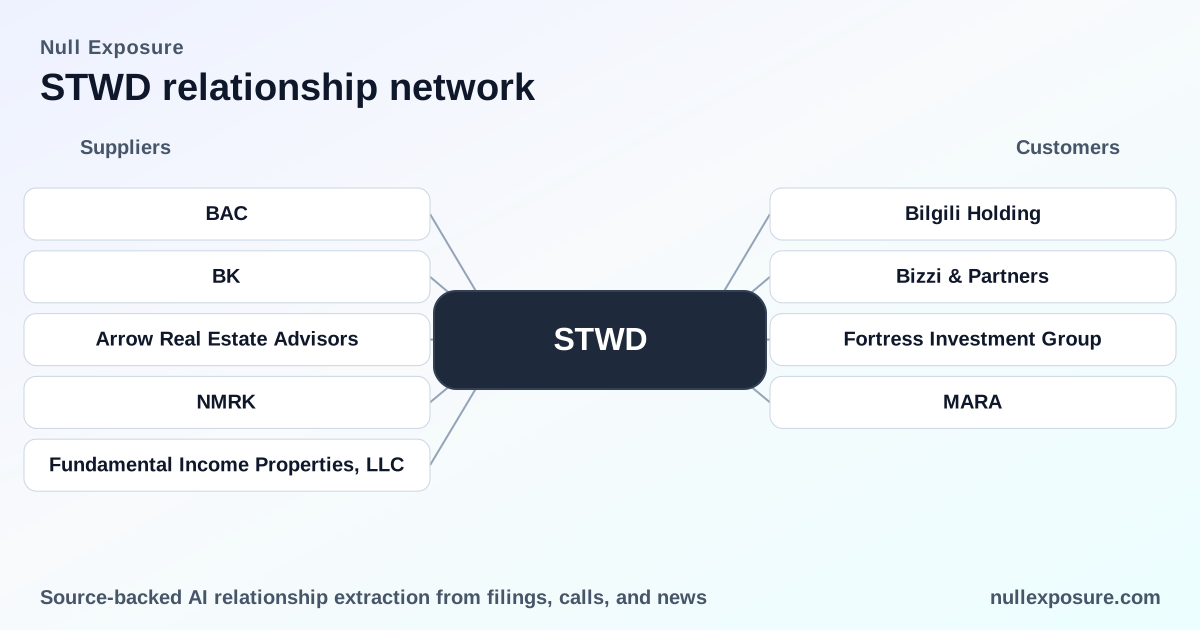
Starwood Property Trust (STWD): Supplier Relationships, Strategic Footprint, and What Investors Should Watch
Starwood Property Trust is an externally managed mortgage REIT that earns returns from interest on loans and securities, explicit management and incentive fees paid to its manager, and selective equity investments in real estate. The company leverages external capital markets to fund originations and development financing while relying on third‑party advisors, trustees, and asset managers to structure deals and execute portfolio expansion. For investors, the economics are driven by net interest margins, fee income from asset management, and the company’s ability to access financing at scale.
Explore deeper supply‑chain intelligence and counterparty signals at https://nullexposure.com/.
Quick operating snapshot: how Starwood’s back‑office maps to investment returns
Starwood is externally managed by SPT Management, LLC and benefits from Starwood Capital Group’s global platform; that governance model concentrates operational control in a third‑party manager while leaving asset ownership with the REIT. The business monetizes through three core levers: (1) interest and yield capture on mortgage and real‑estate related loans and securities; (2) fee income tied to management and incentive agreements; and (3) opportunistic equity and development financings. Key financial context: market capitalization in the low billions, a yield‑oriented dividend profile, and a price‑to‑book near parity, which together position STWD as a yield play with active balance‑sheet management.
Learn how these supplier relationships impact capital and execution risk at https://nullexposure.com/.
The supplier and partner relationships that matter (one by one)
BofA Securities — BofA is serving as sole financial advisor to Starwood in its acquisition of a net‑lease platform, placing the bank at the center of strategic M&A execution and valuation negotiation. According to a ConnectMoney report (March 2026), BofA’s advisory role gives it direct influence over transaction structuring and timing.
The Bank of New York Mellon — BNY Mellon acts as trustee for a $550 million private note issuance under an indenture dated October 14, 2025, establishing BNY Mellon as the formal trustee and document custodian for the offering. MarketScreener reported the indenture role (reported March 2026) and highlights BNY Mellon’s operational centrality to STWD’s debt logistics and investor servicing.
Arrow Real Estate Advisors — Arrow, alongside Newmark, advised on a $350 million construction/loan financing for The Greenwich project in Manhattan that Starwood financed, underscoring Arrow’s role in underwriting and structuring complex development loans. A Fortress press release (April 15, 2025) describing the financing credits Newmark and Arrow as advisors on the loan.
Newmark Group, Inc. — Newmark participated as an advisory firm in the same Manhattan financing, providing loan advisory and market diligence on The Greenwich development; the Fortress release (April 2025) names Newmark as an advisor and positions it as a marketing and capital markets intermediary for the transaction.
Fundamental Income Properties, LLC — Through a merger, STWD’s Property Segment acquired 468 properties across 44 states and 59 industries, materially expanding the REIT’s footprint and tenant diversity. TradingView’s SEC 10‑Q summary (reported March 2026) documents the portfolio expansion stemming from the Fundamental Income Properties merger and indicates how M&A alters operating scale and geographic risk dispersion.
What the company‑level constraints signal about supplier exposure
Starwood’s public filings and disclosures reveal structural supplier characteristics that shape counterparty risk:
- Contracting posture — short‑term renewal cadence. Management and advisory agreements renew annually and the manager can terminate on 180 days’ notice, which gives the manager flexibility and leaves the REIT with limited long‑duration contractual insulation.
- Global operating reach but moderate concentration. The manager deploys personnel across 17 cities in eight countries, signaling global sourcing and execution capability while centralizing decision authority in the manager’s executive team.
- Role and function — service provider dependency. STWD is externally managed, and the manager provides staff, due diligence, legal support and delegates trade execution for specialized products (for example, third‑party RMBS managers), demonstrating consistent reliance on external service providers for day‑to‑day operations.
- Active relationship posture and service orientation. The manager relationship is active and fee‑based; management fees and incentive compensation are integral to how the company is run and how external partners are paid.
These constraints are company‑level signals that shape how suppliers are engaged and the speed at which relationships can change.
How these relationships translate into investor risks and opportunities
- Execution risk is concentrated around key intermediaries. BofA’s advisory role and BNY Mellon’s trustee function are critical for M&A and capital markets execution; a disruption in either relationship would directly affect deal timing and debt servicing.
- Development and construction exposure requires active underwriting. The Greenwich financing illustrates Starwood’s willingness to participate in high‑profile development loans; loan advisors like Newmark and Arrow are essential in pricing, market comparables, and exit assumptions. Their input materially affects credit outcomes for development‑stage exposures.
- Scale through M&A increases diversification but raises integration risk. The Fundamental Income Properties merger expanded STWD’s property count and industry spread, improving geographic diversification while adding operational complexity and a short‑term need for asset integration.
- Contracting flexibility increases counterparty churn risk. Annual renewals and short notice termination create an environment where service providers can rotate, making vendor continuity a governance item to watch.
Investor takeaway: monitor trustee and advisor continuity, underwriting diligence on development loans, and the manager’s contractual position — all are the operational levers that will drive realized returns and downside protection.
Explore more counterparty and supplier intelligence to inform portfolio decisions at https://nullexposure.com/.
Actionable checklist for investors and operators
- Track debt documentation and trustee arrangements for each issuance; trustees such as BNY Mellon are operationally critical.
- Review engagement letters and termination clauses for the manager relationship; short renewal cycles increase strategic optionality but raise turnover risk.
- For development finance exposure, verify third‑party advisor roles and reputations—advisors like BofA, Newmark, and Arrow materially affect pricing and execution.
- Post‑M&A, demand detailed integration and asset management plans for the acquired portfolio to assess timing of synergies and potential writedown risk.
Bottom line and recommendation
Starwood Property Trust operates as a manager‑centric, yield‑oriented mortgage REIT that depends on a small set of high‑impact suppliers (advisors, trustees, and specialty asset managers) to execute financing and expand assets. Investors should weight the company’s active external management model, short renewal contracts, and recent portfolio expansion when assessing downside scenarios and liquidity planning. For buy‑side and operations teams focused on counterparty exposure, prioritize monitoring trustee agreements, advisor mandates, and integration outcomes from mergers.
For deeper, transaction‑level supplier profiles and time‑series counterparty alerts, visit https://nullexposure.com/.