Stereotaxis (STXS) — supplier relationships, manufacturing posture, and operational risk for investors
Stereotaxis designs and sells robotic magnetic navigation systems for interventional cardiology and monetizes through a combination of capital equipment sales, disposables/consumables, and contracted maintenance services. The company offsets capital intensity by subcontracting a large portion of manufacturing, generating recurring service revenue through maintenance contracts and disposables tied to installed systems, and pursuing targeted acquisitions to internalize critical device components. If you evaluate supplier and partner exposure for STXS, focus on the company’s contracting posture, recent strategic partnerships, and how those tie to product production and aftermarket revenue. For an integrated view of supplier relationships and operational constraints, visit https://nullexposure.com/ for more supplier intelligence and relationship mapping.
How Stereotaxis makes money and why supplier relationships matter
Stereotaxis sells high-value robotic navigation systems to hospitals and clinics, then captures recurring cash flow from maintenance services and consumable devices. Capital equipment sales drive near-term revenue volatility, while installed base service and disposables drive longer-term margin stability. Given the company’s sub-scale revenue base relative to peers—approximately $32.4 million in trailing twelve-month revenue and negative EBITDA—supplier arrangements directly influence product availability and gross margins.
Two structural features determine supplier risk and strategic upside:
- Contracting posture is short-term and purchase-order driven, which keeps fixed costs low but increases exposure to supply disruption and price swings. According to the company’s filings, Stereotaxis purchases most components through purchase orders rather than long-term supply agreements and maintains limited finished-goods inventory.
- Manufacturing is largely subcontracted: the firm deliberately outsources major subassemblies to preserve flexibility and reduce fixed manufacturing overhead, while retaining assembly/integration and aftermarket services in-house.
These characteristics make supplier and partner relationships both a potential constraint and a lever for rapid scaling when executed well.
Company-level operating constraints you should track
Several explicit operating signals emerge from the company disclosures and filings that shape supplier strategy and investor risk calculus:
- Short-term procurement posture: The company purchases most parts via purchase orders, not long-term agreements, and does not hold large finished-goods inventories. This reduces capital tied up in inventory but increases exposure to single-sourcing and price volatility, particularly for specialized medical components.
- Subcontract manufacturing strategy: Stereotaxis subcontracts many major subassemblies to third-party manufacturers to maximize flexibility and lower fixed costs. This reduces capital intensity but increases reliance on partner quality and delivery performance.
- Service-provider role and outsourcing: Stereotaxis provides maintenance and support directly in some regions and through outsourced representatives in others; it also uses third-party services for certain international administrative functions such as payment of patent annuities. This model supports global reach with modest direct headcount but creates dependency on external service providers for customer experience and compliance tasks.
Taken together, these signals describe a company that prioritizes operational flexibility over vertical integration, which suits a small-cap medical device supplier but concentrates counterparty and logistics risk. Investors should monitor supplier concentration, contractual terms, and inventory trends to detect stress early.
The partnerships and suppliers you need to know
Below are the supplier and partner relationships surfaced in recent public materials; each entry includes a concise investor-focused takeaway and the source.
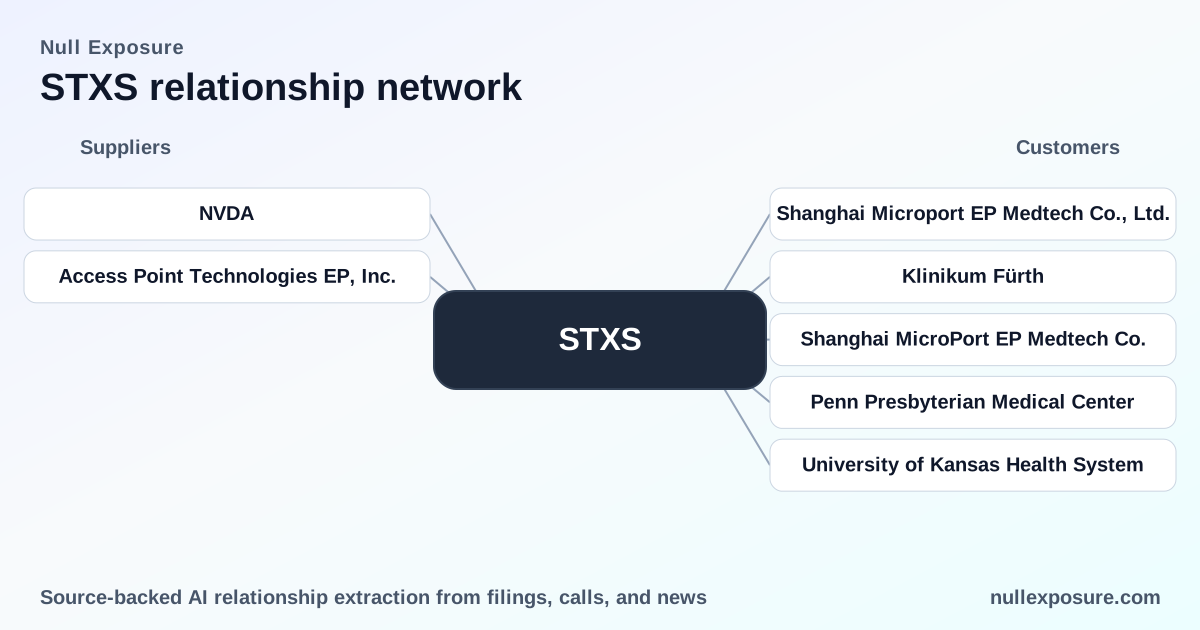
NVIDIA — strategic software and AI support
Stereotaxis was accepted into NVIDIA’s NVIDIA Connect program, which provides member companies access to NVIDIA’s software development resources, frameworks, and SDKs. This relationship accelerates Stereotaxis’ software and AI capabilities for image-guided navigation and systems optimization, enhancing product differentiation without heavy internal R&D spending. According to a company news release distributed on GlobeNewswire in March 2025, NVIDIA highlighted Stereotaxis at its GTC conference and confirmed the company’s participation in the Connect program. (GlobeNewswire, March 2025)
Access Point Technologies EP, Inc. (APT) — acquisition to internalize catheter development
Stereotaxis acquired Access Point Technologies EP, Inc., integrating in-house catheter development and manufacturing expertise to increase production capacity and support innovation in interventional devices. This acquisition shifts Stereotaxis slightly toward vertical integration for consumables and reduces reliance on external catheter suppliers, improving control over a key consumable that drives recurring revenue. TradingView’s coverage of the company’s FY2025 SEC 10‑Q highlighted the APT integration and its expected impact on production and innovation. (TradingView summary of SEC 10‑Q, FY2025)
What these relationships imply for investors
- NVIDIA connection is a high-upside non-equity partnership: Access to NVIDIA’s software stack reduces time-to-market for advanced algorithms and gives Stereotaxis a path to embed AI-enabled workflow improvements in its systems without significant incremental hardware investment. This is a strategic enabler, not a guaranteed revenue source, but it materially strengthens the company’s technology roadmap and competitive positioning.
- APT acquisition is tactically de‑risking production: By bringing catheter development in-house, Stereotaxis captures more margin on disposables and reduces supplier substitution risk for a component that is central to recurring revenue. For a company that outsources many subassemblies, this acquisition represents a selective push toward control where consumables drive lifetime customer economics.
- Operational model amplifies counterparty risk: Short-term purchasing and heavy subcontracting reduce fixed costs but increase the impact of supplier failure or price spikes; investors should prioritize monitoring supplier concentration, lead times, and inventory days. The company’s use of outsourced service representatives and third-party international payment services expands operational reach but introduces vendor management and compliance risk.
If you are modeling STXS, stress-test scenarios for component supply interruptions and incremental service opportunities from the APT integration. For a deeper supplier relationship map and scenario planning, visit https://nullexposure.com/ to explore how these partners interact across the Stereotaxis value chain.
Investment checklist: what to watch next
- Quarterly updates on installed base growth and consumable attach rates (after APT integration).
- Disclosure of any long-term supplier contracts or changes to purchasing terms—look for movement away from purchase-order reliance.
- Product development milestones tied to NVIDIA-enabled software features and evidence of clinical adoption.
- Inventory and accounts payable trends that would flag supplier strain or working-capital shifts.
Final takeaway and action
Stereotaxis operates a lean, subcontract-heavy manufacturing model while using targeted acquisitions and strategic software partnerships to shore up critical components and capabilities. That combination supports capital efficiency and a faster product roadmap but increases exposure to supplier execution risk—precisely the relationships investors should monitor.
For more supplier intelligence, detailed relationship mapping, and scenario-driven risk assessments, visit https://nullexposure.com/ and explore how supplier posture shapes small-cap medical device performance. For tailored research or portfolio-level supplier analysis, start at https://nullexposure.com/ and connect with our analyst team.