SU Group Holdings (SUGP): Supplier relationships, operating posture, and what investors should track
SU Group Holdings Limited operates as an investment holding company that sources special situations and distressed assets, restructures or repositions them, and monetizes through strategic disposals and operational improvements. The firm’s revenue base reflects operating businesses it controls, while shareholder returns will be driven by successful asset turnarounds or capital events such as share consolidations and disposals. Investors should treat SUGP as a small-cap, opportunistic consolidator with operational exposure and an elevated execution risk profile. For primary research and deeper supplier relationship mapping, visit https://nullexposure.com/.
How SUGP makes money and why supplier links matter
SU Group monetizes through active management of portfolio companies and transactional events. Revenue of $192.4 million (TTM) with a gross profit of $30.7 million shows operating scale, but the company is loss-making at the operating level (EBITDA -$16.27 million and EPS -$1.71 TTM), indicating that near-term value creation depends on restructurings, cost control, and capital transactions rather than stable margin expansion. The business structure puts supplier and service-provider relationships — including transfer agents, corporate registrars, and capital markets advisors — at the center of execution for recapitalizations and share-alteration events.
If you want an ongoing map of who services these events, check the supplier coverage at https://nullexposure.com/.
What the headline financials imply for operating posture and contracting
The company’s public metrics drive direct, practical signals about contracting posture, concentration, criticality and maturity:
- Contracting posture: opportunistic and transactional. SUGP’s core activity—special situations investing and restructurings—requires short-term, event-driven contracts (advisors, transfer agents, turnaround consultants) rather than long-term supply agreements.
- Concentration and governance signals. With insiders holding roughly 9.25% and institutions around 0.09% of the float, supplier and vendor selection likely reflects concentrated decision-making and can favor trusted or familiar service providers over broad competitive tenders.
- Criticality: event-dependent but operationally material. Suppliers that execute corporate actions (e.g., transfer agents) are critical during share consolidations or capital changes even if they do not drive ongoing revenue.
- Maturity: small-cap, high execution risk. Market cap (~$12.1 million), negative EBITDA, and high beta (2.758) indicate an immature equity profile where single transactions materially shift investor outcomes.
These company-level signals imply suppliers are appointed for precision and speed rather than as interchangeable partners; due diligence on counterparties is therefore a material part of counterparty risk assessment.
The supplier relationships in the public record
Below is the complete list of supplier relations captured in the provided results and the practical implications of each.
Transhare Corporation — transfer agent and exchange role
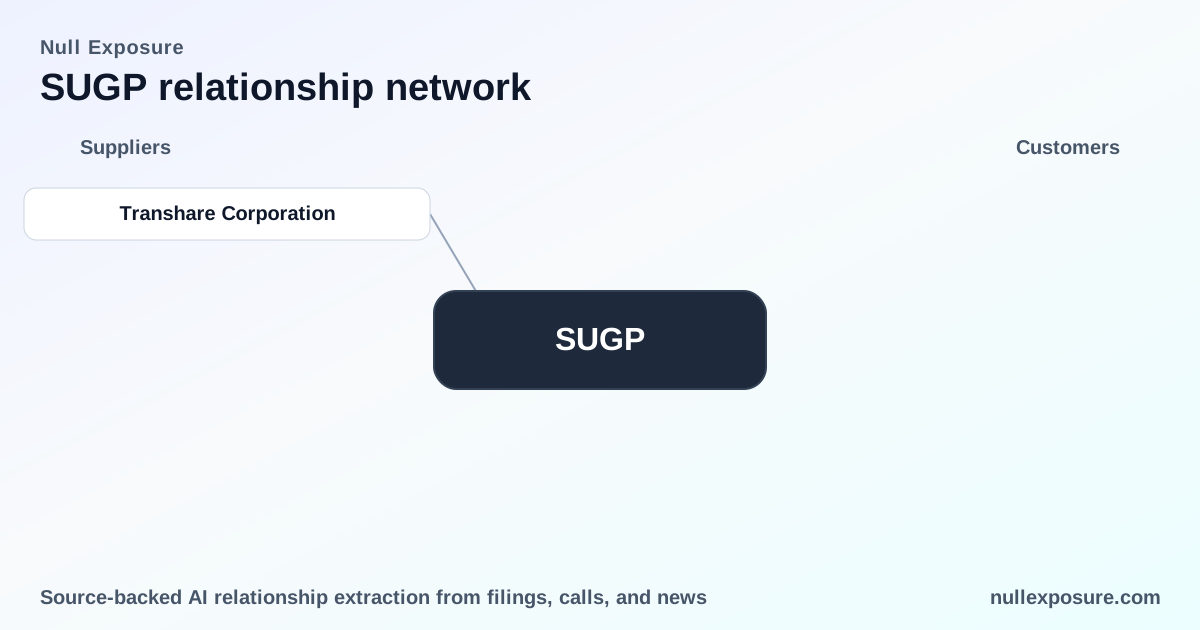
Transhare Corporation will serve as the company’s transfer agent and act as the exchange for SU Group’s share consolidation. According to a PR Newswire release dated March 10, 2026, Transhare is explicitly designated to handle the mechanics of the reverse stock split and related exchange functions (PR Newswire, March 10, 2026). This is an administrative, execution-critical relationship: for a company executing a share consolidation, the transfer agent’s role is essential to completing the corporate action cleanly and avoiding shareholder record disputes.
Operational risk and dependency analysis
The single supplier flagged in public results is a transactional, execution-critical provider, not an ongoing operational vendor delivering revenue support. That pattern is consistent with a holding-company model that relies on partners for discrete capital market events.
Key risk considerations:
- Execution risk on corporate actions. Designating a transfer agent for a share consolidation is routine, but any operational error can delay trading and amplify market illiquidity for a small-cap name.
- Concentration of authority. Low institutional ownership and a meaningful insider stake increase the chance that suppliers are appointed through tight internal channels, which reduces transparency for outside investors.
- Financial fragility. Negative profitability and a small market capitalization increase the probability that SUGP will undertake further corporate actions (consolidations, capital raises, disposals), elevating the importance of reliable supplier relationships.
For a closer look at supplier assignments over time and to monitor any new supplier disclosures, visit https://nullexposure.com/.
Practical takeaways for investors and operators
- Monitor transfer-agent disclosures ahead of any corporate actions. For small-cap companies, the identity and performance history of firms like Transhare matter during consolidations and capital rearrangements.
- Assess governance and appointment processes. The combination of insider concentration and minimal institutional ownership suggests investors should demand clarity on how critical suppliers are selected and audited.
- Prioritize execution risk in valuation. SU Group’s valuation and near-term upside are event-driven; therefore, supplier operational reliability is a direct input to execution probability and timing.
Next steps and how to track changes
Investors evaluating SUGP should track filings and press releases for new supplier appointments and changes in corporate action plans. For an organized view of supplier-level disclosures and ongoing monitoring tools, use the resources at https://nullexposure.com/.
In summary, SUGP runs an opportunistic, event-driven operating model where supplier relationships are transactional but execution-critical; the publicly documented Transhare engagement illustrates that dynamic. Investors must combine financial reading with supplier diligence to properly size event risk and execution probability.