Sun Communities (SUI): Supplier relationships and operating constraints investors should price in
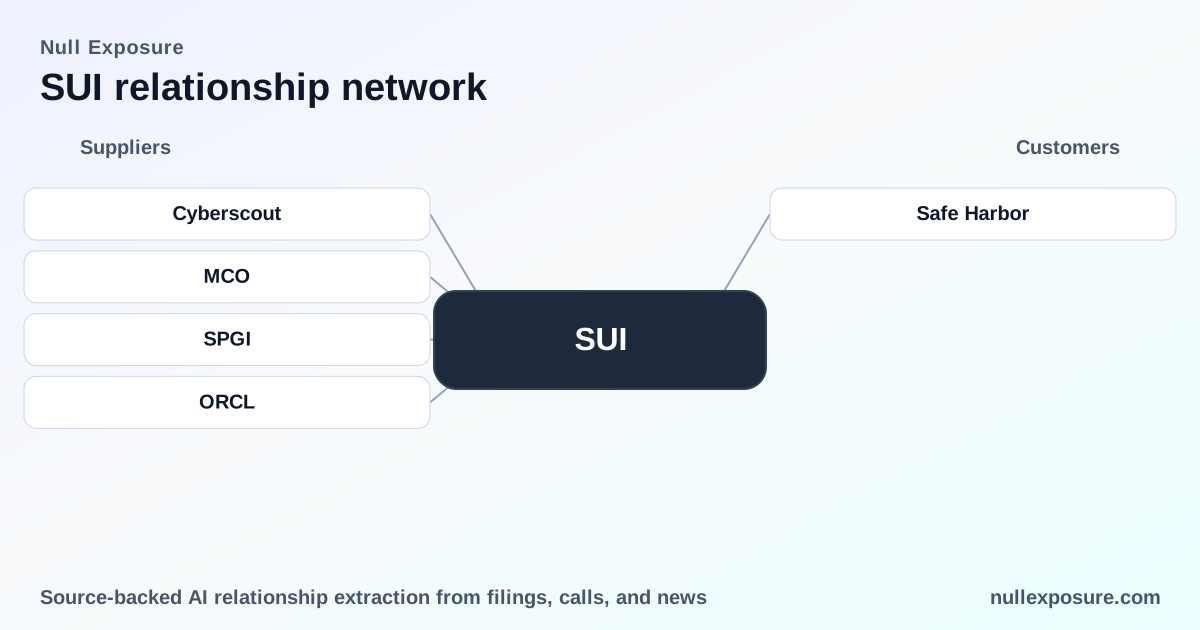
Sun Communities is a publicly traded REIT that owns, operates and develops manufactured housing and RV communities across the U.S. and Ontario, monetizing primarily through recurring rental income, ancillary community fees and selective development and acquisition activity. For investors and counterparties, the firm's supplier mix reflects three strategic priorities: credit profile management (rating agencies), enterprise systems modernization (NetSuite) and incident/consumer protection services (cybersecurity partners) — each influencing cost of capital, operating leverage and reputational exposure. Learn more about supplier risk and counterparty diligence at https://nullexposure.com/.
Why supplier relationships matter for a REIT like Sun Communities
Sun’s business model depends on predictable cash flows from long-lived real estate and a relatively small set of critical external providers. Credit ratings determine borrowing costs for acquisitions and refinancings, enterprise systems determine scale and reporting quality, and consumer-protection vendors govern remediation and legal exposure in the event of incidents. Investors should treat suppliers not as peripheral vendors but as levers of capital efficiency and operational continuity.
Cyberscout — a consumer protection partner on breach response
Sun offered affected residents complimentary credit monitoring, identity theft protection and a $1 million identity theft insurance policy through Cyberscout, part of TransUnion, as part of its response to a reported incident. This is a classic remediation engagement intended to limit downstream liability and reputational damage. According to a March 2026 notice on ClaimDepot, Sun contracted Cyberscout to provide these services to impacted parties (ClaimDepot, March 2026).
Moody’s — a driver of borrowing economics
Moody’s upgraded Sun Communities to Baa2 in 2025, a move that directly reduces Sun’s marginal cost of capital and improves financing optionality for acquisitions and development. The upgrade was cited in the company’s Q4 2025 earnings discussion, where management tied improved ratings to a stronger balance sheet and credit profile (Q4 2025 earnings transcript posted on The Globe and Mail, March 2026).
S&P — another credit-rating lift that changes the financing equation
Standard & Poor’s raised Sun Communities to BBB+ in 2025, reinforcing the same credit-strength narrative and supporting lower spread financing and potential refinancing windows. Management referenced this upgrade during the Q4 2025 earnings call as evidence of improved credit metrics (Q4 2025 earnings transcript posted on The Globe and Mail, March 2026).
NetSuite — the backbone of the digital transformation
Management has described the NetSuite implementation completed a few years ago as the foundation of its digital journey; that enterprise platform is now the basis for scaling operations, consolidating reporting and rolling out analytics. The Q4 2025 discussion highlights NetSuite as a strategic enabler of operational efficiency and future automation initiatives (Q4 2025 earnings transcript posted on The Globe and Mail, March 2026).
What the supplier mix signals about Sun’s operating posture
- Contracting posture and maturity: Long-term lease arrangements at the portfolio level create a business that is asset-backed and contractually sticky; long lease terms imply predictable revenue lanes but also create embedded landlord obligations and limited short-term flexibility. Company-level disclosures referencing long-term ground leases reflect this posture.
- Counterparty concentration and criticality: A small number of suppliers — major rating agencies and a single enterprise software provider — carry outsized influence over financing and back-office scale. That concentration is a positive for consistency and integration, and a single point of vulnerability if relationships degrade.
- Operational maturity: The NetSuite implementation and subsequent references to a “digital journey” show the company is in the post-implementation optimization stage, where the upside is process automation and margin improvement rather than basic systems rollout.
These constraints are visible in company-level signals such as the prevalence of long-term contracts and the presence of government-controlled land under certain assets, which affect lease terms and rights of use across parts of the portfolio (company filings and management commentary, FY2025–FY2026).
Financial backdrop that amplifies supplier effects
Sun reports revenue TTM of $2.2985 billion and EBITDA of approximately $1.009 billion through the latest quarter (2025-12-31), with a market capitalization near $17.3 billion. Credit rating upgrades therefore translate directly into cheaper capital for an active acquirer, and improved systems reduce the incremental cost of scaling operations. Conversely, the need to deploy consumer-protection services after an incident demonstrates the immediate cost and reputational risk of operational failures.
Explore supplier risk profiles and tailored diligence at https://nullexposure.com/ to see how these relationships affect valuation and counterparty exposure.
Practical diligence checklist for investors and operators
- Validate credit rating trajectories and the analytical rationale behind upgrades to forecast refinancing windows and spread compression.
- Review contract length and key lease terms for any portfolio segments tied to government-controlled land or long-term ground leases; those clauses change relocation and redevelopment economics.
- Confirm enterprise systems integration (ERP, property management interfaces) and vendor SLAs to assess the ability to scale acquisitions without operational drag.
- Verify incident response coverages and vendor responsibilities (cyber insurance, remediation providers) to quantify contingent liabilities and potential legal exposures.
Bottom line: integrate supplier signals into valuation and operations
Sun Communities’ supplier landscape is compact but consequential. Credit rating agencies materially affect financing costs, NetSuite underpins operational scalability, and cyber remediation vendors limit immediate reputational and monetary fallout from incidents. For investors, the interplay of these relationships with long-term lease structures and government-controlled land exposures is a decisive part of underwriting cash-flow durability and downside risk.
For a deeper review of how supplier relationships affect counterparty risk and portfolio valuation, visit https://nullexposure.com/. If you are performing diligence on Sun or similar REITs, prioritize contract terms with long-duration counterparties and verify remedial service arrangements as part of transaction-level risk modeling.