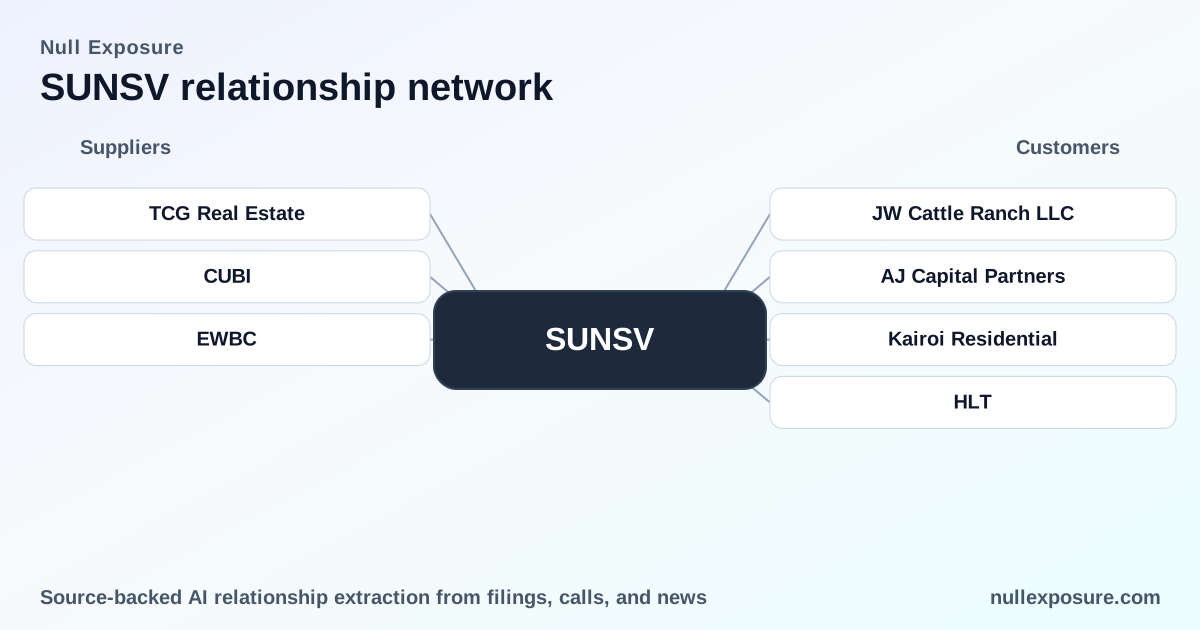
SUNSV supplier relationships: credit backbone and partner map investors need to know
Sunrise Realty Trust (tracked here under SUNSV for supplier analysis) operates as a real-estate lending and financing counterparty that monetizes through structured credit relationships and committed lending facilities; the company’s working capital and transaction execution are driven by a small number of institutional lenders that provide bridge loans and revolving credit capacity. Cash flow and growth hinge on these lender partnerships—their size, tenure, and willingness to expand facilities determine Sunrise’s effective leverage and deal cadence. For readers evaluating supplier risk and counterparty exposure, this note maps every public lender relationship in the record and draws operational implications. For an at-a-glance view of our supplier analytics, visit the Nillexposure homepage: https://nullexposure.com/
One-line framing: what investors should watch
Sunrise’s commercial posture is that of a borrower dependent on committed institutional credit lines and ad hoc bridge financing, rather than a broad syndicate of retail or public investors—this creates concentration risk but also simplifies counterparty monitoring and negotiation leverage.
The lender roster, relationship-by-relationship
TCG Real Estate — bridge-loan originations for property refinancing
Sunrise committed $30.0 million to a $45.0 million senior bridge loan originated by Tannenbaum Capital Group’s TCG Real Estate platform to refinance a Class-A retail property in Houston’s Galleria sector. According to a March 10, 2026 market release, Sunrise’s $30 million participation represents a large-ticket exposure to a single Project-level bridge loan (source: Yahoo Finance, Mar 10, 2026 — https://finance.yahoo.com/news/sunrise-realty-trust-commits-30-120000337.html).
Key takeaway: Sunrise is an active participant in transaction-level bridge financings through third-party originators, which creates short-term asset-liability timing risk around refinancing or exit events.
Customers Bank (CUBI) — incremental committed capital to the revolving credit facility
Customers Bank committed $25.0 million to expand Sunrise’s revolving credit facility, bringing total committed capacity to $165.0 million. GlobeNewswire and MarketScreener reported the addition and commitment on March 5–10, 2026, noting Customers Bank as a new participant in the facility (sources: GlobeNewswire, Mar 5, 2026; MarketScreener, Mar 10, 2026 — https://www.globenewswire.com/news-release/2026/03/05/3250704/0/en/sunrise-realty-trust-expands-revolving-credit-facility-to-165-million-with-addition-of-customers-bank.html).
Key takeaway: The addition of Customers Bank increases committed liquidity and reduces near-term refinancing pressure, but it also concentrates incremental capital into a single revolving structure.
East West Bancorp (EWBC) — original anchor lender and expandable lead arranger
East West Bancorp is the lead bank that originally established the revolving Credit Facility in November 2024 and continues as a core participant; the facility remains expandable to $200 million subject to lender participation and conditions. Multiple releases in March 2026 reiterate East West’s anchoring role and the facility’s expandability (sources: GlobeNewswire, Mar 5, 2026; MarketScreener, Mar 10, 2026 — https://www.globenewswire.com/news-release/2026/03/05/3250704/0/en/sunrise-realty-trust-expands-revolving-credit-facility-to-165-million-with-addition-of-customers-bank.html).
Key takeaway: East West’s position as original arranger and the expandable facility structure create optionality for growth, but reliance on lead-bank willingness to syndicate remains critical.
What the relationships imply for Sunrise’s operating model and risk profile
- Contracting posture: Sunrise relies on committed bilateral and syndicated credit rather than unsecured public funding; the company negotiates facility terms with anchor banks and supplements capacity through ad hoc bridge participations. This contracting posture favors speed of deployment but requires constant lender engagement and covenant compliance.
- Concentration: The public record shows a small number of meaningful lender relationships—East West Bancorp as anchor, Customers Bank as a meaningful incremental participant, and TCG Real Estate as a source of deal-specific bridge originations. That concentration simplifies counterparty management but raises counterparty concentration risk if one lender withdraws or tightens terms.
- Criticality: The revolving credit facility is operationally critical—it underwrites day-to-day liquidity and transaction execution. The documented expandability to $200 million implies runway for growth, yet the company’s ability to access that uplift is conditional on lender participation and covenants.
- Maturity and dynamism: The Credit Facility’s origination in November 2024 and the March 2026 expansion demonstrate a young but actively managed financing relationship, signaling that Sunrise is in a phase of capital reconfiguration and liability optimization rather than static reliance on legacy funding.
Because the public record contains no separate constraint excerpts tied to specific contracts or covenants, the absence itself functions as a company-level signal: public constraint disclosures are limited, which increases the importance of direct due diligence and lender dialogue for anyone evaluating counterparty risk.
Risk summary and what underwriters and operators should watch
- Liquidity concentration risk: A large share of committed financing sits with a few institutional lenders; monitor lender appetite and renewal cadence.
- Refinancing timing risk: Participation in short-term bridge loans (TCG-originated) requires successful exits or refinancing; these events are the immediate operational pivot points.
- Syndication dependency: The expandable facility is conditional—growth depends on the company’s ability to attract additional lenders into the syndicate or on East West’s continued appetite to lead.
For active investors or operators evaluating SUNSV supplier exposure, these relationships make clear that credit underwriting and covenant performance are primary drivers of supplier reliability.
If you want deeper counterparty scoring or a bespoke exposure report, start at the Nillexposure homepage and request supplier-level work: https://nullexposure.com/
Practical actions for investors and operators
- Request current covenant schedules and facility utilization reports from Sunrise to validate the runway provided by the $165 million facility and the $200 million expandability cap.
- Monitor deal-level outcomes for TCG-originated bridge loans to assess exit risk and the incidence of loan extensions or workouts.
- Engage East West and Customers Bank dialogue threads through sponsor channels; lender sentiment is the leading indicator of future capacity.
For a concise supplier-risk dashboard and ongoing monitoring of Sunrise’s lender relationships, see our tools and reports at https://nullexposure.com/
Final take
Sunrise’s supplier map is straightforward: a compact set of institutional lenders anchors liquidity and a smaller set of originators supplies transaction-level financing. That structure gives Sunrise operational agility and negotiating simplicity, but it also concentrates counterparty risk and ties growth to the continued willingness of lead banks and bridge originators to provide capital. Investors and operators should treat lender engagement and covenant health as primary monitoring metrics rather than secondary details.