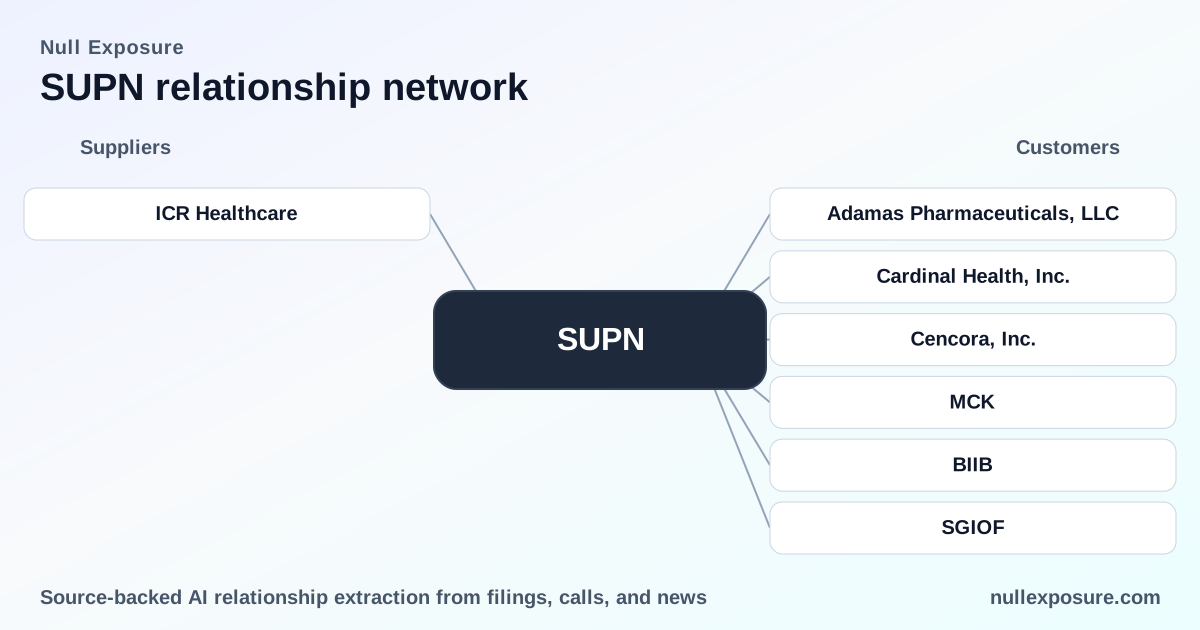
SUPN supplier intelligence: what investors should know about Supernus’s vendor posture
Supernus Pharmaceuticals operates as a specialty CNS-focused drug developer and commercializer that outsources virtually all manufacturing and investor-relations communications. The company monetizes through prescription drug sales in the United States, supported by third‑party contract manufacturing organizations (CMOs) for active pharmaceutical ingredients and finished products, and by maintaining a centralized investor-relations function handled by an external firm. Revenue is generated from marketed CNS products while operating leverage and margin volatility are driven by supplier contracts, geographic sourcing, and minimum purchase obligations. For a deeper view of supplier exposure and relationship intelligence, visit https://nullexposure.com/.
Quick commercial snapshot investors use to set context
Supernus reported roughly $719 million in trailing twelve‑month revenue with a market capitalization near $2.9 billion and negative net margin over the latest period. The firm’s operating model is highly outsourced: gross profit remains strong but operating margin compression and negative EPS reflect elevated operating and supplier-related costs. Supplier relationships are therefore a direct determinant of near-term profitability and supply continuity.
Who handles Supernus’s investor communications — and what that implies
- ICR Healthcare is listed as the investor contact in multiple Supernus press releases, indicating an ongoing retained relationship for investor communications and conference coordination. A GlobeNewswire release announcing fourth-quarter and full‑year 2025 results (filed February 12, 2026) lists Peter Vozzo of ICR Healthcare as the investor contact.
- A separate GlobeNewswire release (December 3, 2025) for the Bank of America CNS Therapeutics virtual conference also identifies Peter Vozzo at ICR Healthcare as the investor contact.
These two press releases confirm a consistent, active engagement with ICR Healthcare for IR and conference support, which standardizes market messaging and reduces disclosure risk. According to the GlobeNewswire announcement dated February 12, 2026, ICR Healthcare is the named contact for investor inquiries tied to Supernus’s earnings call; the December 3, 2025 notice to the Bank of America conference repeats the same contact details.
Every supplier-related relationship disclosed in the results
- ICR Healthcare (press-release / investor relations): Supernus uses ICR Healthcare as its investor relations and communications agent; press releases for FY2025 and FY2026 list Peter Vozzo of ICR Healthcare as the contact for investor inquiries (GlobeNewswire, Dec 2025; Feb 2026).
- ICR Healthcare (conference participation): ICR Healthcare coordinates Supernus’s participation in investor conferences, as shown in the company’s Bank of America CNS Therapeutics conference announcement (GlobeNewswire, Dec 2025).
Both items reflect the same retained IR/communications relationship across consecutive reporting periods and events, underlining an ongoing externalized approach to investor engagement rather than in‑house coverage.
Supplier constraints and what they reveal about operating risk
The consolidated constraint signals describe a supplier posture that is long‑term, geographically concentrated in APAC/EMEA for manufacturing inputs, materially important to revenue, and dominated by CMOs rather than in‑house plants.
- Long-term contracting posture: Contract language cited includes a clause where “Britannia may terminate its obligation to supply APOKYN for cause, or at any time, by giving at least twenty‑four months' written notice,” and references to commercial supply agreements dated in 2021. This indicates Supernus accepts multi-year commitments and built-in notice periods for key supply lines, creating predictability but also fixed obligations where minimum purchase or dedicated facility economics can lock in cost exposure. (Excerpted contractual language.)
- Geographic sourcing concentration: Supernus relies on third‑party CMOs in Asia for bulk drug substance and on European CMOs for certain raw materials and manufacturing; this APAC/EMEA split concentrates supply chain risk along established CMO corridors and exposes the company to regional regulatory, logistics, and lead‑time dynamics. (Company disclosure on supply locations.)
- Materiality and criticality: Management discloses that failure to obtain required commercial quantities on time and at reasonable prices would prevent meeting demand or profitably selling products. This frames suppliers as material to revenue delivery, not discretionary vendors. (Company risk disclosure.)
- Manufacturer role and outsourcing: The firm explicitly depends on CMOs for all manufacturing, API supply agreements, and finished product purchases; some contracts include minimum annual purchase obligations tied to dedicated manufacturing economics (for example, MYOBLOC purchase terms). This establishes suppliers as manufacturer partners and implies contractual embedded leases or in‑substance fixed commitments. (Multiple supply and API agreement excerpts.)
- Active relationships and segment focus: The relationship stage signals are “active,” and the operating segment tied to these suppliers is manufacturing of commercial CNS products such as Qelbree, Trokendi XR, GOCOVRI, and Oxtellar XR.
Collectively, these constraints describe a mature, outsourced manufacturing model with material commercial exposure and multi‑year contractual commitments. This structure delivers scale and focus for Supernus but concentrates operational risk in a small set of manufacturing partners located primarily in APAC and EMEA.
For a vendor‑level risk analysis and supplier scorecards, see https://nullexposure.com/ for tailored reports.
What investors should watch in the next 12 months
- Contractual minimums and fixed-cost exposure. Minimum purchase obligations (embedded lease economics) create downside if demand softens; revise unit economics accordingly.
- Geopolitical/logistics risk in APAC/EMEA. Any disruption in Asia or Europe will directly affect drug availability and could force costly secondary sourcing.
- Supplier concentration and qualification timelines. Replacement CMOs require long qualification and regulatory approval paths; downtime translates into lost revenue.
- Communications continuity. Retained IR firms like ICR Healthcare standardize messaging but also centralize disclosure — track any changes in retained agency as a signal of strategic shifts.
Investment implications and actionable takeaways
- Operational leverage cuts both ways. Outsourcing keeps capital expenditures low but transfers execution risk to suppliers; model sensitivity to COGS and lead times should be increased in forecasts.
- Supply contracts are strategic assets. Contracts with long notice periods and minimum purchase commitments reduce volatility in supply but increase downside in demand weakness; investors should adjust valuation scenarios for embedded fixed commitments.
- Monitor supplier geography and diversification. Any incremental disclosure on alternative sourcing or capacity expansion in North America reduces tail risk and should be treated as positive operational de‑risking.
For a deeper supplier risk brief and to download relationship-level evidence, visit https://nullexposure.com/.
Final thoughts and next steps
Supernus’s business model depends on successful commercialization of CNS products while relying heavily on third‑party CMOs and outsourced investor communications. The combination of material supply dependence, APAC/EMEA manufacturing concentration, and long‑term contractual commitments is the primary operational risk vector to monitor. Investors should stress‑test revenue scenarios against supply interruption and minimum purchase obligations and track any changes in supplier footprint or contract terms.
Ready to convert supplier intelligence into portfolio actions? Start with supplier risk scoring at https://nullexposure.com/ — the quickest route to integrating vendor exposure into your investment thesis.