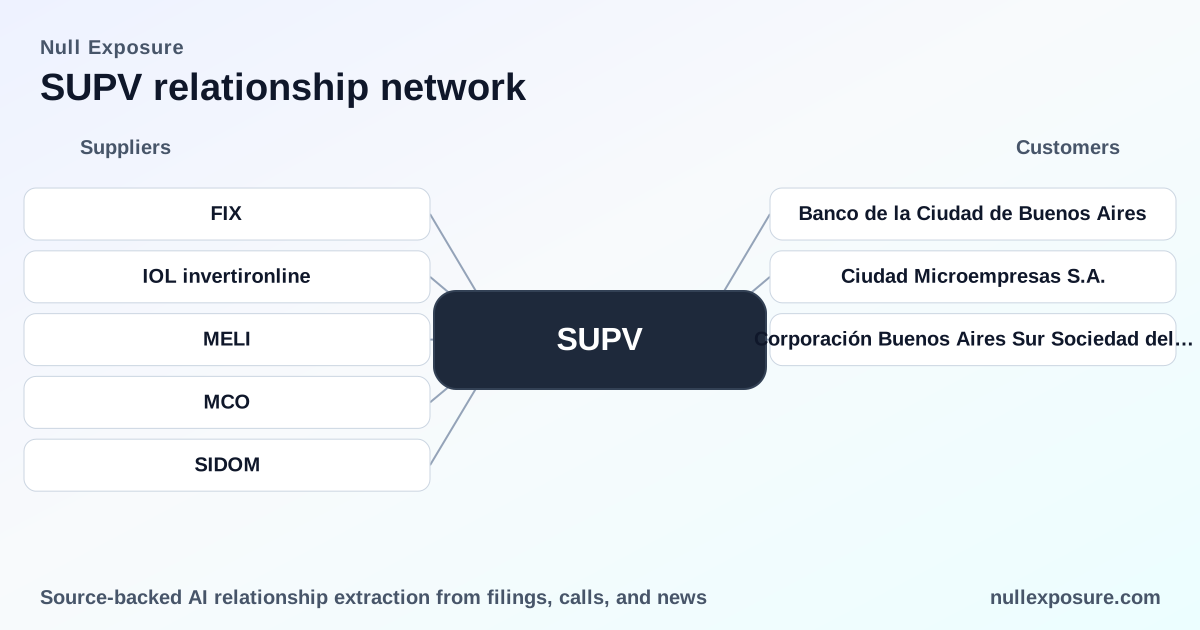
Grupo Supervielle (SUPV): Strategic supplier ties that reshape distribution and digital reach
Grupo Supervielle operates as a diversified regional bank headquartered in Buenos Aires, monetizing through traditional deposit-taking and lending, merchant and corporate services, and increasingly through digital distribution partnerships and brokerage integrations that expand fee income and customer touchpoints. The bank’s move to embed third‑party platforms and marketplaces into its app and commerce flows represents a deliberate shift from pure banking spread to a platform-driven revenue mix built on alliances and distribution partnerships. For a focused read on supplier exposure and partner risk, visit https://nullexposure.com/.
How Supervielle makes money and why partners matter
Grupo Supervielle is a listed NYSE regional bank with a balance of retail deposits, lending, and non-interest income. Primary monetization channels are lending spreads, fees from payment and merchant services, and growing digital brokerage distribution, as evidenced by recent partner announcements. Recent financials show revenue concentration in core banking but negative profit margins and weak quarterly growth signal pressure on traditional spread earnings; partner-driven fee revenue is therefore strategic for profitability recovery.
Operating model signals:
- Contracting posture: The bank is executing partnership agreements and integrations rather than pure acquisitions — a supplier posture favoring embedded services and white‑label relationships rather than ownership.
- Concentration: Partnerships focus on a handful of large digital platforms and local service providers, indicating targeted concentration on high‑reach distribution channels.
- Criticality: Digital and marketplace integrations are critical to retail customer acquisition and non‑interest revenue; these relationships are operationally important rather than ancillary.
- Maturity: Supervielle is an established regional bank transitioning toward platform partnerships; relationships are in rollout/scale phase rather than pilot-only.
For investor diligence on partner exposure and contractual risk, start here: https://nullexposure.com/.
What each supplier relationship reveals about strategy and risk
FIX — credit rating and market narrative
The credit rater FIX projects improvement in the bank’s profitability driven by asset quality and diversification toward digital and corporate services, positioning FIX as a source of third‑party validation of Supervielle’s strategic pivot. Source: Invertironline coverage of FIX’s view (Nov 22, 2024) — https://www.invertironline.com/posts/obligaciones-negociables-recomendadas-suscripcion-supervielle-22-11-2024.
IOL invertironline — brokerage integration to amplify investment flows
Supervielle integrated IOL invertironline into its mobile app to offer an in‑app investment experience to an investor base of more than 1.7 million accounts, converting the bank’s customer base into a distribution channel for brokerage transactions and advisory fees. Source: Cronista report on the IOL integration (FY2025) — https://www.cronista.com/brand-strategy/supervielle-integra-a-iol-invertironline-para-crear-una-experiencia-unica-de-inversion-desde-su-app/.
Mercado Libre — marketplace storefront and in‑app commerce button (Cronista Brand Strategy)
Supervielle’s “Tienda Supervielle” integration into Mercado Libre uses the marketplace to create exclusive benefits for the bank’s customers, converting marketplace traffic into banking product leads and merchant fee opportunities. This taps Mercado Libre’s commerce scale for customer acquisition and card/credit usage. Source: Cronista brand piece on the Mercado Libre tie (FY2025) — https://www.cronista.com/brand-strategy/supervielle-integra-a-iol-invertironline-para-crear-una-experiencia-unica-de-inversion-desde-su-app/.
Mercado Libre — in‑app button and operational tie (Cronista Apertura)
Separate coverage confirms a functional integration: the bank placed a Mercado Libre button inside its app interface to streamline customer access to marketplace services, reinforcing the bank’s strategy to partner with high‑traffic platforms for engagement and transactional volume. Source: Cronista Apertura report on the app partnership (FY2025) — https://www.cronista.com/apertura/empresas/con-nuevo-ceo-supervielle-confirma-que-no-se-vende-y-apuesta-a-sorprender/.
SIDOM — payments utility integration for customs fees
Supervielle’s alliance with SIDOM implements a payment button for customs and port-related fees, enabling clients to manage ad valorem and administrative charges electronically and embedding the bank into trade finance operational flows. This relationship expands corporate and SME payment volumes and supports fee generation from transactional services. Source: Los Andes article on the SIDOM alliance (FY2024) — https://www.losandes.com.ar/economia/patricio-supervielle-somos-el-principal-banco-privado-de-la-provincia-de-mendoza.
What these relationships imply for revenue, risk, and contract posture
The partner set demonstrates a coherent strategy: convert customer flows into fee and interchange revenue by embedding third‑party services in Supervielle’s digital channels. Broker integration (IOL) directly targets investment fee income; marketplace integration (Mercado Libre) targets card spend and merchant interchange; SIDOM embeds transactional payment fees into trade flows.
Key commercial characteristics:
- Shallow capital commitment, high distribution leverage. Partnerships are integration-first, not acquisition-first, keeping capital deployment light while allowing rapid scaling of fee revenue.
- Concentration risk is real but deliberate. Ties to a few large partners amplify growth if execution succeeds; they also create single-partner operational exposure for distribution.
- Operational criticality. The bank’s app becomes a hub; outages or contract shifts with Mercado Libre or IOL would erode acquisition and fee channels.
- Maturity stage: scaling commercial integrations. Announcements indicate moving from pilot to productization, which accelerates revenue potential while increasing service-level and compliance obligations.
Financial context that intensifies partner importance: Supervielle’s recent figures show negative profit margins and sequential revenue declines, underscoring the need for non‑interest revenue growth to restore profitability. Partnerships therefore function as both revenue accelerants and tactical cost‑efficient distribution.
Mid‑analysis action: For a systematic view of how supplier exposures affect bank economics and contract risk, explore https://nullexposure.com/.
Investor takeaways and due diligence checklist
- Partnerships are strategic and revenue‑oriented. IOL and Mercado Libre integrations are explicit efforts to convert customer engagement into fee income; monitor adoption metrics closely.
- Operational dependency on digital distribution is increasing. Ensure contracts contain protections on data sharing, service levels, and termination provisions.
- Concentration tradeoff. The partner set is high-impact but limited in number; scenarios where a single partner changes commercial terms deserve priority stress tests.
- Credit validation exists but watch execution. FIX and Moody’s Local Argentina commentary provide external perspectives on credit and instruments, but credit improvement is contingent on successful monetization of these integrations.
Final recommendations:
- Review partner SLAs, revenue-sharing mechanics, and termination clauses as part of counterparty risk work.
- Monitor customer activation rates from the IOL and Mercado Libre integrations and merchant volumes linked to SIDOM.
- Reassess earnings sensitivity to non‑interest income growth given recent negative margins and quarterly revenue declines.
For further supplier-level intelligence and to map partner risk against financial outcomes, visit https://nullexposure.com/ — the portal for supplier exposure analysis and actionable signals.
Bold closing: Supervielle’s supplier strategy converts distribution into a primary lever for restoring margins; investors should treat these integrations as strategic growth drivers and focal points of operational risk.