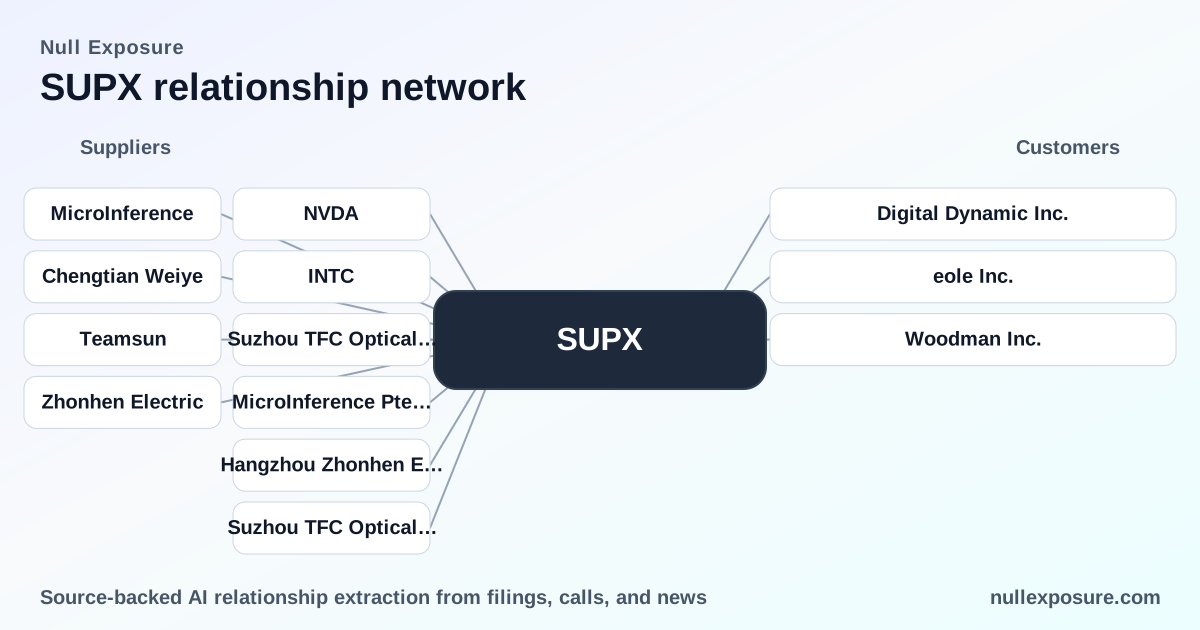
SuperX (SUPX) supplier map: how partnerships power an AI-infrastructure SKU
SuperX AI Technology Limited builds and sells rack-scale AI servers, integrated data‑center power and cooling solutions, and professional services for high-performance AI deployments. Revenue is generated from hardware sales, joint-venture product lines, and services delivered through newly formed service and ODM partnerships; strategic equity stakes extend control over critical reseller and solution‑provider channels. This piece unpacks the supplier and partner relationships that underpin SuperX’s product roadmap and go‑to‑market footprint — and what that implies for investors assessing concentration, supply risk, and scaling potential. For an interactive supplier index and ongoing updates, visit https://nullexposure.com/.
Why supplier relationships are the strategic lever for SuperX
SuperX positions itself as a systems integrator and appliance vendor at the intersection of advanced GPUs, server CPUs, networking, and specialized power and cooling. The company monetizes by packaging compute platforms (XN9160 families), selling engineered subsystems, and offering managed deployment and maintenance through joint ventures. Ownership stakes in channel partners increase margin control and secure preferred access to constrained components. The supplier list here reveals a deliberate vertical and horizontal strategy: buy the best compute silicon, own the channel, and build supporting infrastructure components through JVs and ODM deals.
The supplier and partner roster — what each relationship delivers
NVIDIA (NVDA)
SuperX builds multiple rack‑scale platforms and AI servers powered by NVIDIA Blackwell GPUs (B200/B300), making NVIDIA the core silicon supplier for training and HPC performance. According to SuperX press releases in March 2026, the XN9160-B300 and B200 variants emphasize Blackwell architecture as the primary accelerator for SuperX’s high-performance SKUs (PR Newswire, March 2026). NVIDIA is a critical, high‑leverage supplier for SuperX’s flagship offerings.
Intel (INTC)
SuperX’s servers incorporate Intel Xeon 6th Gen processors as system controllers and CPU compute alongside the NVIDIA GPUs, a specification highlighted in SuperX product announcements in March 2026 (PR Newswire, March 2026). Intel supplies the CPU platform that makes the high-density chassis viable and is therefore essential to system balance and performance.
Suzhou TFC Optical Communication Co., Ltd. (TFC)
SuperX has formed a partnership and Singapore joint venture with TFC to provide ODM support for optical connectivity components aimed at global AI data centers, enabling end‑to‑end optical solutions to ease data transmission bottlenecks (Finviz and The Globe and Mail coverage; Sahm Capital commentary, February–March 2026). TFC strengthens SuperX’s optical supply chain and reduces reliance on third‑party module sourcing.
MicroInference Pte. Ltd.
SuperX acquired a majority stake in MicroInference, an NVIDIA Partner Network solution provider, to secure specialized systems integration and access to the NVIDIA ecosystem for regional deployments, according to SuperX filings and press releases in March 2026 (PR Newswire, March 2026). The equity investment converts a channel dependency into an owned capability for sales, integration, and after‑sales support.
Hangzhou Zhonhen Electric Co., Ltd. (Zhonhen Electric)
SuperX formed a joint venture with Zhonhen Electric to develop High‑Voltage Direct Current (HVDC) power infrastructure for AI data centers, combining Zhonhen’s HVDC technology with SuperX’s AI deployment expertise (PR Newswire, March 2026). This JV targets a high‑value, engineering‑intensive segment that complements compute offerings with integrated power solutions.
Chengtian Weiye
SuperX established the “SuperX Cooltech” joint venture with Chengtian Weiye to produce advanced liquid cooling solutions — CDUs, micro‑channel liquid cold plates, and integrated thermal systems — to service high‑density AI racks (FY2025 results disclosed via PR Newswire, March 2026). Cooling JV activity aligns product design with thermal management needs of Blackwell‑class systems.
Teamsun
SuperX set up “SuperX Global Service,” a JV with Teamsun to deliver global professional services: deployment, maintenance, and managed services for multi‑channel access and global customers (FY2025 results, PR Newswire, March 2026). The Teamsun JV is a direct mechanism to scale service revenue and capture recurring contract value.
What the relationship set reveals about operating model and constraints
No explicit operational constraints were published in the referenced releases; however, the supplier map provides strong company‑level signals about SuperX’s operating model:
- Contracting posture: SuperX combines first‑party equity stakes and JVs with OEM dependency for foundational silicon. The company both purchases high‑end components (NVIDIA, Intel) and invests in channel and component providers (MicroInference, TFC), reflecting a hybrid contracting posture that reduces go‑to‑market risk while preserving supplier exposure for critical silicon.
- Concentration and criticality: GPU supply (NVIDIA Blackwell) and Intel CPUs are strategically critical — any disruption in access or price escalation will materially affect product availability and margins. JVs target other critical subsystems (power, cooling, optical connectivity) to reduce third‑party single‑source risk.
- Maturity and integration: The pattern of acquisitions and JVs (MicroInference, Zhonhen, Chengtian, Teamsun) signals an aggressive mid‑stage scaling play: move from box‑selling to full‑stack, integrated system sales and recurring service contracts.
- Geography and scale implications: Partnerships in Singapore and China position SuperX for APAC regional expansion while serving global data‑center customers with localized services and ODM support.
For investors prioritizing supplier exposure and margin resilience, these signals prioritize monitoring GPU and CPU supply dynamics, JV execution, and channel integration progress.
For more context on supplier concentration and how it affects valuation, see actionable coverage at https://nullexposure.com/.
Investment implications and a short risk checklist
- Upside: Owning channel partners and JVs improves gross margin capture and supports recurring service revenue, which can convert hardware sales into higher lifetime value per customer.
- Downside: Heavy reliance on NVIDIA Blackwell GPUs and Intel CPUs creates a single‑technology risk vector; supply constraints or pricing changes will directly pressure revenue growth and fulfilment.
- Execution risk: Multiple concurrent JVs increase integration and execution complexity; success depends on commercialization speed and delivery quality for power, cooling, and optical components.
- Revenue mix: Current public financials show low revenue base and negative EBITDA; scaling integrated solutions and services is required to justify current market capitalization multiples.
Key monitoring items over the next 12 months: NVDA supply commitments, MicroInference integration progress, deployment wins for XN9160-B200/B300 platforms, and commercialization of SuperX Cooltech and SuperX Digital Power JVs.
What to watch next and how to act
SuperX’s supplier strategy converts high‑end component access into proprietary systems and service channels. Investors should watch NVDA and INTC supply terms, JV commercialization metrics, and install base growth for recurring service revenue. To track these supplier linkages, model outcomes for both a constrained‑supply scenario and an accelerated‑JV monetization scenario.
For an ongoing supplier map and more supplier‑risk analytics, visit https://nullexposure.com/.
If you want a tailored supplier risk brief for SUPX — including scenario P&L impacts from GPU price or availability shocks — check the resources at https://nullexposure.com/ and contact our research desk.