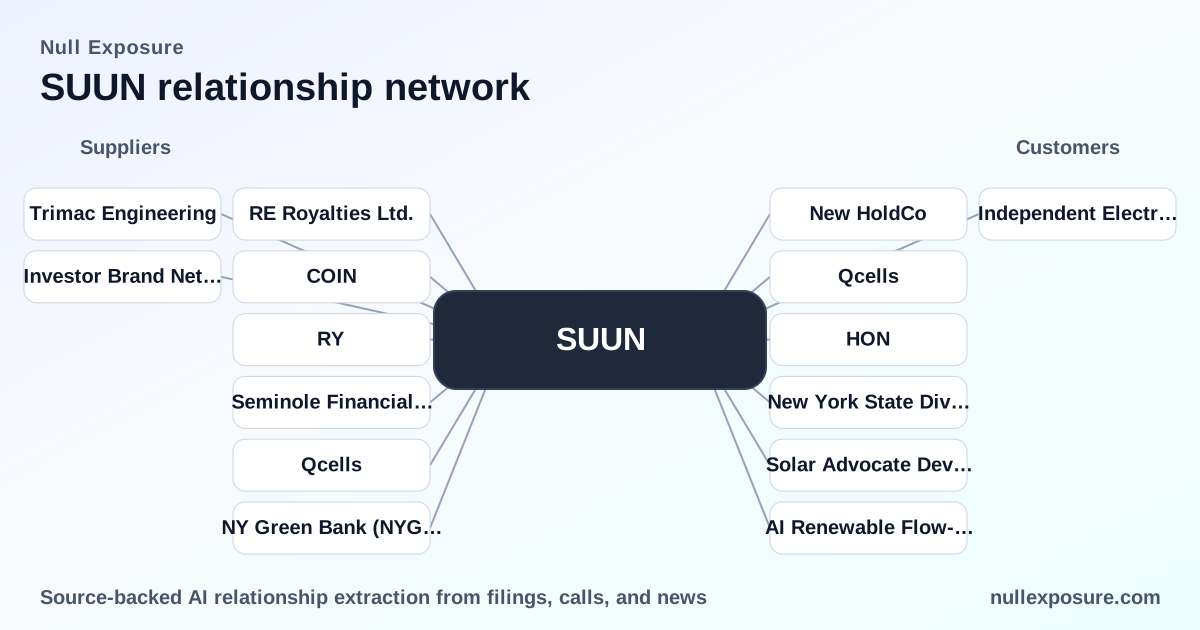
SolarBank (SUUN) — supplier and financing map for investors evaluating counterparty risk
SolarBank (recently rebranded as PowerBank Corporation) develops, constructs and operates distributed solar and battery energy storage systems (BESS) across North America. The company monetizes through project development fees, construction-to‑mini‑perm project loans that convert to longer-term financing, and asset-level power sales once projects reach operation. SolarBank’s operating model is capital‑intensive and finance‑driven: lenders and module suppliers are effectively co‑builders of the company’s growth pipeline. For a concise supplier risk dashboard and ongoing monitoring, visit https://nullexposure.com/.
Business model in one line: develop low‑carbon generation and storage projects, use short‑term construction finance and partner contracts to reach commercial operation, and convert projects into long‑dated cash flows or repeat development fees.
Why counterparty selection defines SUUN’s runway
SolarBank is not a utility‑scale EPC with deep balance‑sheet reserves; it is a project developer that converts pipeline into operating assets through external capital and supplier commitments. Key drivers of valuation and execution risk are the quality of project finance partners, module supply agreements, and local engineering/installation firms capable of meeting interconnection timelines. The company’s public financials show revenue traction (USD 44.6M TTM) but negative operating leverage (negative EBITDA and EPS), which places outsized importance on supplier and lender relationships to sustain growth without diluting equity.
If you are modeling downside scenarios, stress the availability and cost of project finance and the reliability of module supply; both directly affect time to COD (commercial operation date) and IRR. Learn more about relationship profiles and monitoring at https://nullexposure.com/.
Relationship roll call — every source observed in coverage
-
RE Royalties Ltd. — SolarBank accepted a loan from RE Royalties to advance its BESS program, supporting construction activity for battery projects. Source: CarbonCredits coverage on SolarBank’s USD 3M boost (Mar 2026).
-
Coinbase Prime (Coinbase) — SolarBank filed to open an institutional Coinbase Prime account to custody Bitcoin and USDC and to use self‑custodial wallet services as part of a treasury strategy. Source: Bitcoin Magazine coverage of SolarBank’s Bitcoin treasury moves (Mar 2026).
-
Royal Bank of Canada (Forbes India report) — The company secured approximately USD 25.8M of debt financing from RBC to construct two Ontario BESS projects, providing project‑level liquidity to move those assets into construction. Source: Forbes India report on SolarBank’s project finance from RBC (FY2025).
-
Seminole Financial Services, LLC — SolarBank entered into a US$2.6M construction-to-mini‑perm loan with Seminole to complete the Geddes Project in Upstate New York, reflecting the company’s use of smaller specialty lenders for individual site finance. Source: PR Newswire announcement of the Seminole loan (Mar 2026).
-
Royal Bank of Canada (PR Newswire announcement) — SolarBank’s subsidiary closed a combined project loan in the principal amount of USD 25.8M with RBC as Lender, Administrative and Collateral Agent and Green Loan Structuring Agent, indicating RBC’s role in both cash and green‑structure advisory. Source: PR Newswire financial closing announcement (FY2024).
-
Qcells (PR Newswire: USD 49.5M transaction) — SolarBank announced a USD 49.5M agreement to deploy U.S.-manufactured Qcells solar modules across projects, signaling a firm supply commitment for module procurement at scale. Source: PR Newswire on the Qcells transaction (FY2025).
-
NY Green Bank (NYGB) — SolarBank secured an USD 8M revolving credit facility with NYGB to fund interconnection deposits for an initial 50 MW portfolio in New York State, demonstrating active use of specialty green financing to de‑risk early‑stage capex. Source: SahmCapital summary of PowerBank highlights (Feb 2026).
-
Royal Bank of Canada (Entrepreneur coverage) — Entrepreneur reported the USD 25.8M RBC facility for Ontario BESS construction, reinforcing multiple press sources on the same project‑finance relationship. Source: Entrepreneur piece referencing the RBC financing (FY2025).
-
RBC (Bitcoin Magazine mention) — Bitcoin Magazine noted a USD 25M credit facility from RBC to expand SolarBank’s BESS portfolio, an alternate framing of RBC’s commitment that underscores size and reuse across the company’s pipeline. Source: Bitcoin Magazine item referencing RBC credit (FY2025).
-
Qcells (CarbonCredits / editorial) — CarbonCredits and other outlets describe SolarBank’s collaboration with Qcells and the use of U.S.-manufactured modules as part of resiliency and supply‑chain strategy. This reinforces the supplier relationship already reported in PR Newswire. Source: CarbonCredits article on SolarBank’s strategic use of Qcells modules (FY2025).
-
Trimac Engineering — SolarBank partnered with Nova Scotia engineering firm Trimac Engineering to deliver its 2.4 MW Sydney project, showing reliance on local engineering contractors for regional builds. Source: PR Newswire on the Nova Scotia project (FY2025).
-
Investor Brand Network — Investor Brand Network distributed a SolarBank press release (rebrand messaging and corporate updates), indicating use of syndicated investor PR channels for corporate disclosure. Source: Investor Brand Network press distribution via The Globe and Mail (Jul 2025).
Market implications and operating constraints (company‑level signals)
No explicit third‑party constraints were returned for SUUN in the data payload, so the following are company‑level operational signals drawn from public disclosures and the relationship map:
- Contracting posture: SolarBank relies on a mix of construction-to-mini‑perm loans, revolving facilities for interconnection deposits, and project finance with large banks. That structure implies rolling counterparty negotiations and the need to convert short‑term construction obligations to long‑dated finance.
- Concentration and criticality: A small set of lenders and a major module supplier (Qcells) are central to near‑term execution; disruptions to those relationships would materially delay COD timelines.
- Financial maturity: Reported negative EBITDA and EPS with modest market cap indicate an early‑growth, capital‑intensive profile where access to project and green financing is a gating factor for scale.
- Investor base and governance signal: High insider ownership (21.5%) and low institutional holdings (1.2%) suggest concentrated insider influence and limited institutional oversight, which increases execution risk if management conflicts with minority holders.
Key takeaway: SolarBank’s growth is finance‑dependent — lender and supplier continuity is more consequential than single operating metrics in the near term.
Tactical considerations for investors and operators
- Prioritize real‑time monitoring of project finance closings, module deliveries from Qcells, and the status of the NYGB revolving facility; funding timing and module lead times will drive short‑term cash burn and milestone achievement.
- Stress test models for longer conversion from construction to long‑term finance and for potential increases in module or freight costs.
- Track treasury posture given the Coinbase Prime filing; any material Bitcoin holdings change liquidity dynamics and regulatory attention.
For updated counterparty risk dashboards and deeper supplier due‑diligence, visit https://nullexposure.com/.
Closing assessment
SolarBank’s network of lenders, a major module supplier and a roster of local engineering partners outlines a pragmatic growth play: execute projects with external capital and scale through repeated project finance cycles. Execution risk is concentrated in financing continuity and supplier delivery; those are the levers that determine whether development converts into permanent cash flows or recurring capital raises. Investors should watch RBC, Qcells, NYGB and the suite of smaller project lenders closely for covenant terms, roll‑over behavior, and supplier performance.
For ongoing monitoring and to subscribe to relationship alerts for SUUN, go to https://nullexposure.com/.