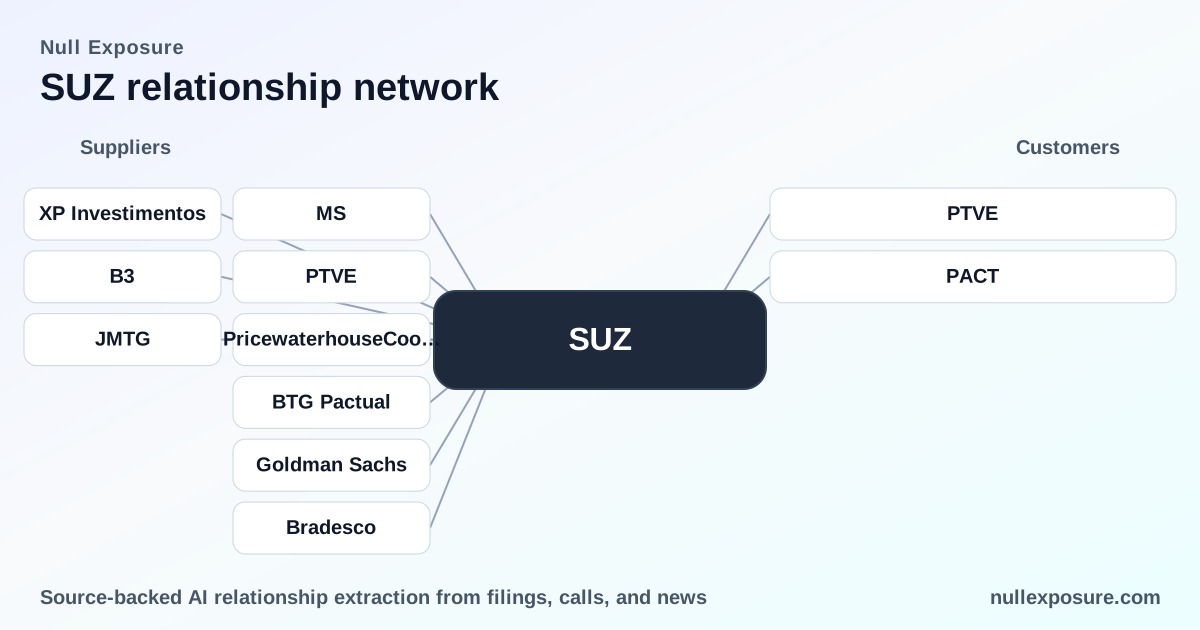
Suzano (SUZ) — supplier profile and counterparty map investors should own
Suzano is a vertically integrated pulp and paper supplier that monetizes through large-scale production and long-term commercial contracts for eucalyptus pulp and paper products, selling both into domestic Brazilian markets and global converters; margins are driven by commodity pulp pricing, scale efficiencies and selective downstream sales into packaging grades. Investors should view Suzano as a capital-intensive, cash-generative basic materials supplier with active capital-allocation (dividends and buybacks) and a diversified set of financial and commercial counterparties that support market execution and long-term supply relationships. For deeper supplier and counterparty analytics, visit https://nullexposure.com/.
Business model at a glance
- Suzano produces eucalyptus pulp and paper and sells into converters, packaging producers and commodity markets; the company converts forestry and mill scale into cash flow that funds operations, dividends and buybacks. The FY2025 financials show Revenue of ~$50.1bn and EBITDA of ~$21.0bn, supporting the company’s compact valuation multiple (Trailing P/E ~4.9) and heavy free-cash-generation profile reported through FY2025.
- Capital allocation is active. Recent communications indicate buybacks funded from profits and capital reserves, executed through a roster of broker-intermediaries and domestic market trading on B3.
- Contracting posture is mixed: Suzano combines spot commodity sales with at least some long-term supply arrangements for specialty grades, which anchors revenue visibility for downstream customers while preserving upside to pulp price cycles.
Commercial and financial relationships investors need to track Below I list every relationship surfaced in the recent feed, with a concise plain-English description and the contemporaneous source context.
-
Morgan Stanley — Suzano named Morgan Stanley as one of the broker-intermediaries to execute its announced buyback, with funding coming from profits and capital reserves. This positions Morgan Stanley as a transactional partner in Suzano’s capital allocation program (TS2.Tech report, March 10, 2026).
-
BTG Pactual — Included among the brokers appointed to manage buyback execution, BTG Pactual is a domestic execution partner for Suzano’s share repurchase activity on Brazilian markets (TS2.Tech report, March 10, 2026).
-
Goldman Sachs — Listed with the broker group supporting Suzano’s buyback plan, Goldman Sachs plays an international execution and placement role in the company’s repurchase program (TS2.Tech report, March 10, 2026).
-
J.P. Morgan — Identified as a broker intermediary for the buyback program, J.P. Morgan provides global market access to support Suzano’s capital-return mechanics (TS2.Tech report, March 10, 2026).
-
Bradesco — As a named intermediary on Suzano’s buyback list, Bradesco supplies local execution and settlement capability for purchases executed on Brazilian venues (TS2.Tech report, March 10, 2026).
-
XP Investimentos — Cited alongside other brokers for the buyback, XP Investimentos is a domestic distribution and execution partner that connects Suzano with Brazilian liquidity for repurchases (TS2.Tech report, March 10, 2026).
-
B3 — Purchases under the buyback plan are executed on Brazil’s B3 exchange at market prices, making B3 the primary trading venue for the program and a critical enabler of Suzano’s capital returns (TS2.Tech report, March 10, 2026).
-
PricewaterhouseCoopers (PwC) — PwC issued an unqualified audit opinion on Suzano’s consolidated financial statements for the year ended December 31, 2025; Suzano’s Fiscal Council reviewed management reports and financials in early February 2026 in connection with that audit sign-off (The Globe and Mail / TipRanks reporting on FY2026 filings, March 2026).
-
Pactiv Evergreen Inc. — Suzano committed to supply liquid packaging board to Pactiv Evergreen’s converting business under a long-term supply arrangement, embedding Suzano within a downstream packaging value chain and providing a stable revenue channel beyond spot pulp markets (armoneyandpolitics report, referenced in March 2026).
Operating-model constraints and business signals (company-level) The feed contains no explicit standalone constraint records, but the available relationship and filing signals deliver clear company-level constraints and operational characteristics investors should treat as part of risk assessment:
-
Contracting posture: Suzano combines long-term supply arrangements for specialty packaging grades with commodity market sales, evidenced by the long-term supply agreement with Pactiv Evergreen. This structure reduces revenue volatility for specific product lines while preserving cyclicality in commodity pulp sales.
-
Concentration and counterparties: Commercial and execution relationships are diversified across domestic and global banks (Morgan Stanley, Goldman, J.P. Morgan, BTG, Bradesco, XP) and a domestic exchange (B3), indicating deliberate counterparty diversification for capital-market operations rather than concentration risk in execution partners.
-
Criticality: Trade execution and capital returns are operationally dependent on the broker cohort and B3 trading infrastructure; interruptions in these channels would hamper share repurchase execution, though not core pulp production.
-
Maturity and governance: An unqualified FY2025 audit from PwC and fiscal council review in February 2026 are positive governance signals that support financial statement reliability and investor transparency.
Risk and strategic implications for investors and operators
-
Capital-allocation balance: The company is using profits and capital reserves to fund buybacks. Investors should monitor whether buybacks are prioritized over debt reduction or capex, and the extent to which buybacks are opportunistic versus structural.
-
Customer mix and margin resilience: Long-term supply contracts with converters like Pactiv Evergreen lock in volume and reduce downstream counterparty risk, but overall profitability remains exposed to pulp and paper market cycles reflected in trailing and forward P/E spreads.
-
Execution and governance dependencies: Broker networks and exchange access enable capital returns; an interruption in these execution partners would be an operational obstacle for buybacks but not for raw-material production. The unqualified PwC audit is a material governance positive.
Middle-of-article call to action If you manage counterparty exposure or supplier risk in portfolios, review Suzano’s counterparties and capital allocation trends in our full supplier dossiers at https://nullexposure.com/ to map exposure across financial and commercial partners.
What investors should monitor next
- Quarterly updates on buyback execution metrics and remaining authorization. Watch trading volumes on B3 and broker disclosures for pace and pricing of repurchases.
- Any expansion of long-term supply contracts beyond Pactiv Evergreen, which would signal strategic downstream verticalization.
- Subsequent audit commentary or governance disclosures that could alter perceived financial statement quality.
Closing thoughts and how to act Suzano combines scale, cash generation and active capital allocation with a mixed contracting posture that balances long-term specialty sales and commodity exposure. Key operational dependencies are financial intermediaries for buybacks and major conversion customers for volume stability, while governance is supported by an unqualified PwC audit. For practical due diligence on Suzano’s supplier map and counterparty concentration, consult the supplier research hub at https://nullexposure.com/. For portfolio managers evaluating exposure to commodity cyclicality and corporate capital allocation, our supplier-level profiles offer the counterparty detail required to make informed allocation decisions — start with https://nullexposure.com/.