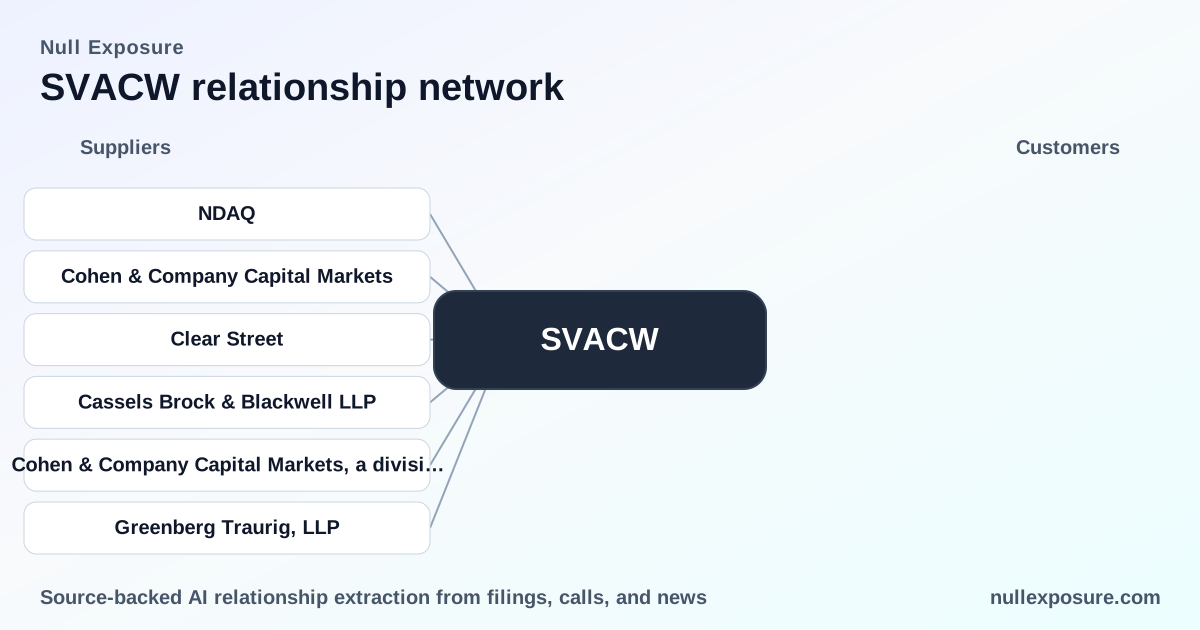
Starboard Value Acquisition Corp (SVACW): Who’s Lining Up Around This SPAC—and What That Means for Investors
Starboard Value Acquisition Corp is a purpose-built acquisition vehicle that raises capital through a public units offering, separates its Class A shares and warrants for trading (SVAC and SVACW), and captures sponsor economics and transaction fees when it completes a business combination. The company monetizes by underwriting sponsor economics, advisory and placement fees from capital markets activity, and by creating a tradable equity and warrant structure that transfers value into a post-combination public company. For investors and operators evaluating supplier relationships, the relevant signal is how a compact roster of capital markets, trading and legal partners reduces execution risk but concentrates counterparty exposure.
If you want a focused supplier-risk dossier and relationship map for SPAC counterparties, review our platform for structured supplier insights at https://nullexposure.com/.
Quick read: operating posture and commercial logic
Starboard operates with a transactional contracting posture typical of SPACs: short-duration mandates tied to a business combination, concentrated reliance on a handful of financial and legal providers, and high criticality on capital-markets execution. Concentration is a business feature here—fewer, more specialized partners reduce friction on deal execution but create single-point dependencies. The corporate maturity profile is pre-combination; commercial relationships are heavily event-driven and will reprice or terminate once the merger is consummated.
Partner-by-partner breakdown: who the company is working with
Below I cover every named relationship captured in the public reporting with plain-English summaries and source references.
-
Nasdaq Global Market (NDAQ)
Starboard intends to list its separated Class A shares and warrants on the Nasdaq Global Market under the symbols SVAC and SVACW once the units begin separate trading. This is the primary public venue for the company’s securities and the liquidity platform for investors. According to a Yahoo Finance announcement dated March 10, 2026, Nasdaq Global Market will host the separated listings. -
Cohen & Company Capital Markets (division of Cohen & Company Securities, LLC)
Cohen & Company Capital Markets is serving as lead book-running manager and is named as the exclusive financial advisor, lead capital markets advisor and private placement agent to Starboard. This places Cohen at the center of the SPAC’s capital-raising and placement activity, making them a key execution and distribution partner. This role is described in multiple press releases and announcements, including a GlobeNewswire release (January 22, 2026) and subsequent media reports in March 2026. -
Clear Street
Clear Street is engaged as a joint book-runner alongside Cohen & Company for the SPAC offering, which positions Clear Street as an important execution and trading counterparty for order flow and aftermarket liquidity support. The joint book-runner relationship is detailed in the March 10, 2026 Yahoo Finance announcement. -
Greenberg Traurig, LLP
Greenberg Traurig is acting as legal counsel to Starboard, providing transactional and securities advice essential to the SPAC registration, offering mechanics and the eventual business combination. This legal engagement is documented in the GlobeNewswire announcement dated January 22, 2026 and reiterated across syndicated press reports in March 2026. -
Cassels Brock & Blackwell LLP
Cassels Brock & Blackwell LLP is also serving as legal counsel to Starboard, supporting cross-border or jurisdictional elements of the transaction and reinforcing the deal team’s legal capacity. This counsel role is cited in the GlobeNewswire announcement (January 22, 2026) and in subsequent press reports.
Each relationship above is drawn from the public announcement cycle around the proposed business combination and secondary listings (see media reports in March 2026 and the January 22, 2026 press release for the underlying transaction rationale).
What the relationship map tells investors about operational risk
- Execution is concentrated but specialized. A small set of finance and legal partners—Cohen & Company and Clear Street on the capital markets side, and two corporate law firms—indicates a deliberate selection of providers who can move quickly on a time-sensitive SPAC timetable. Concentration speeds execution but creates vendor single points of failure.
- Counterparty criticality is high for a narrow window. These suppliers are mission-critical during registration, the public offering, and the business combination; after the deal closes, the supplier footprint usually changes materially.
- Contracting posture is transactional and short-term with high renewal optionality. Agreements are focused on discrete deliverables—underwriting, placement, book-running and transactional legal work—with commercial terms that are event-tied to the success of the SPAC close.
- Maturity is early-stage until combination closes. Starboard’s operating maturity is limited by its pre-combination status: relationship durability depends on whether the business combination is completed and the post-combination company’s strategy for capital markets and legal support.
Key takeaways for investors and operators
- Sponsor and advisor concentration is a deliberate design choice that favors speed and execution efficiency in SPAC transactions but increases counterparty risk if any single advisor cannot perform.
- Nasdaq listing mechanics matter because split-unit trading creates distinct liquidity and valuation dynamics between Class A shares and warrants (SVAC / SVACW). That distinction informs short-term market behavior and potential arbitrage strategies.
- Legal coverage is robust with dual counsel, which reduces legal execution risk across jurisdictions and complex deal conditions.
If you want deeper supplier diligence, our platform builds consolidated counterparty profiles and historical performance signals—start here: https://nullexposure.com/.
Risks and monitoring priorities
- Monitor the underwriting and placement performance of Cohen & Company and Clear Street during the offering window because underperformance on distribution or liquidity support will directly affect share economics and warrant pricing.
- Track legal deliverables and closing conditions managed by Greenberg Traurig and Cassels Brock; material legal delays or adverse opinions could delay or derail the combination.
- Watch for changes in counterparty composition post-announcement; replacement of major advisors before closing is an operational red flag.
For a companion supplier-risk report and ongoing alerts tied to these counterparties, visit our homepage and sign up for targeted coverage at https://nullexposure.com/.
Conclusion: actionable investor posture
Starboard Value Acquisition Corp has assembled a compact, market-facing team for its SPAC lifecycle: Nasdaq for listing mechanics, Cohen & Company and Clear Street for placement and book-running, and Greenberg Traurig plus Cassels Brock for legal coverage. The arrangement optimizes speed and execution but concentrates counterparty exposure and elevates event-driven execution risk until the combination is closed. Investors should prioritize monitoring underwriting performance, listing mechanics (split trading of units into Class A shares and warrants), and legal closing conditions as the primary operational signals that will determine value transfer from the SPAC vehicle to the public combined company.
Explore a structured supplier dossier and ongoing monitoring options at https://nullexposure.com/ to convert these relationship signals into portfolio actions.