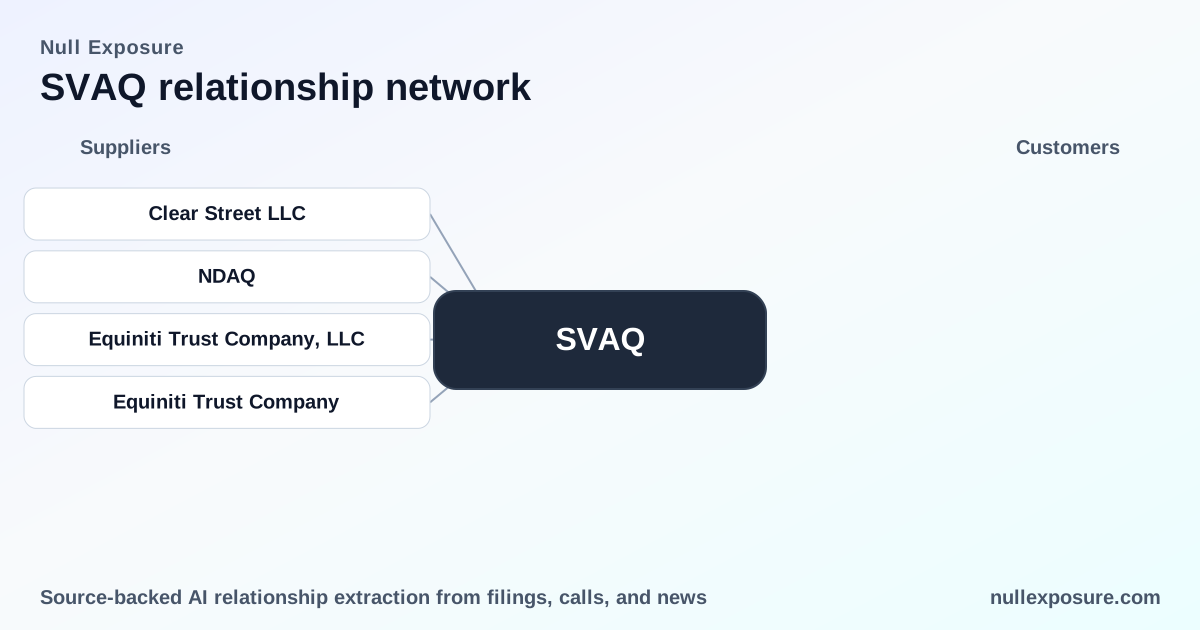
SVAQ Supplier Footprint: who underwrote, listed and operationalized this SPAC
Silicon Valley Acquisition Corp. (SVAQ) is a special purpose acquisition company that monetizes by raising public capital through an IPO, holding that capital in trust, and completing a business combination that converts public market financing into equity in an operating target. The SPAC’s commercial value derives from the sponsor’s ability to source and close a target, capture a promoter equity stake on close, and realize upside for public shareholders through the combined company’s growth. SVAQ currently shows no operating revenue and runs a capital-markets-first operating model — its supplier relationships reflect that focus.
Explore deeper supplier intelligence at NullExposure
Market snapshot and investor implications
- Capital-market vehicle, not an operating company. Reported market capitalization is approximately $294.63 million and reported trailing operating metrics are zero, consistent with a pre-merger SPAC.
- Liquidity and listing architecture are central to value realization. Units converted into Class A shares and warrants listed on Nasdaq; this listing is necessary for secondary-market value and for any merger consideration to trade post-combination.
- Underwriting and transfer-agent relationships are operationally critical. The choice of book-runner and transfer agent defines distribution execution, settlement mechanics and investor servicing during the IPO lifecycle.
These elements make the supplier posture: contractual and exchange-dependent, concentrated (a small number of specialized providers), and high criticality for capital markets operations. For continued diligence and monitoring, visit NullExposure for more SVAQ supplier detail.
What SVAQ’s supplier list tells investors and operators SVAQ’s publicly reported supplier interactions are short, transactional, and focused on three essential capital-markets functions: underwriting, listing, and transfer agency. Each relationship is narrow in scope but high in operational significance — any failure or friction with these suppliers would directly affect the SPAC’s ability to raise, list, or service securities.
H3: Clear Street LLC — sole book-running manager (GlobeNewswire, Jan 8, 2026)
Clear Street acted as the sole book-running manager for SVAQ’s initial public offering, underwriting the units and coordinating allocation and distribution to investors. This places Clear Street at the center of SVAQ’s capital formation execution and syndicate responsibilities, including the over-allotment execution noted in the IPO closing notice. Source: GlobeNewswire press release (Jan 8, 2026).
H3: Nasdaq — listing venue for SVAQ shares and warrants (GlobeNewswire, Jan 8, 2026)
Nasdaq is the designated exchange for SVAQ’s Class A ordinary shares and warrants once units separate for trading, establishing the public market venue and the regulatory framework for post-IPO liquidity. The exchange listing is a functional prerequisite for any merger target to access U.S. public markets under the SPAC structure. Source: GlobeNewswire press release (Jan 8, 2026).
H3: Equiniti Trust Company, LLC — transfer agent for unit separation (GlobeNewswire, Feb 11, 2026)
Equiniti Trust Company, LLC is identified as SVAQ’s transfer agent and is the operational gatekeeper for investors wishing to separate units into ordinary shares and warrants; brokers must coordinate with Equiniti to process separations and update registries. This relationship governs share recordkeeping and the mechanics of investor entitlements following the IPO. Source: GlobeNewswire press release (Feb 11, 2026).
H3: Equiniti Trust Company — broker interaction note (TradingView, Feb 11, 2026)
A market bulletin reiterated that separation of units requires broker contact with Equiniti Trust Company, underscoring the practical investor-servicing function Equiniti performs and the dependency on broker-transfer agent workflows for investor access to tradable instruments. Source: TradingView news item (Feb 11, 2026).
H3: Clear Street LLC — underwriting confirmation in secondary release (GlobeNewswire, Feb 11, 2026)
A secondary press release confirmed the units were offered in an underwritten offering with Clear Street LLC again identified as sole book-running manager, reinforcing the single-manager underwriting posture for SVAQ’s offering and the concentration of underwriting risk with Clear Street. Source: GlobeNewswire press release (Feb 11, 2026).
Operational constraints and business-model signals Absent explicit contractual constraints in the public record, the supplier footprint itself informs several company-level signals about SVAQ’s operating model:
- Contracting posture: Short-term, event-driven contracts typical of SPAC IPOs; underwriter and transfer-agent agreements are transactional and tied to IPO lifecycle events rather than long-term vendor frameworks.
- Concentration: The underwriting and transfer services are concentrated among a very small number of providers; Clear Street functions as sole book-runner, and Equiniti is the named transfer agent. Concentration increases single-party operational risk.
- Criticality: Each supplier is operationally critical. Clear Street’s distribution capability affects capital formation; Nasdaq listing affects liquidity and regulatory compliance; Equiniti’s operation affects investor entitlement and settlement.
- Maturity: The business is in a pre-combination phase with no operating revenue and limited vendor diversity; supplier relationships are mature only in the context of capital markets event execution, not in recurring operational services.
Investors should treat these signals as structural features of SPACs: value realignment will occur only when a combination is announced and executed, and supplier relationships listed are designed to enable that transaction rather than to operate an underlying business.
Risk checklist for investor diligence
- Underwriting concentration: Single book-runner can accelerate execution but concentrates counterparty and reputational risk.
- Transfer agent workflow: Errors or delays in unit separation can impair secondary-market trading and shareholder liquidity.
- Listing dependency: Any regulatory or listing delay on Nasdaq directly affects the tradability and investor exit options.
If your investment or operational strategy requires deeper teeth-on-the-ground monitoring of these service providers or benchmarking across SPAC sponsors, NullExposure maintains ongoing supplier mappings and event-tracking. Explore supplier monitoring at NullExposure
Bottom line and recommended next steps SVAQ’s supplier record is compact and functionally appropriate for a capital-formation vehicle: Clear Street for underwriting, Nasdaq for market access, and Equiniti for share servicing. These relationships are high-impact but narrow in scope — they are necessary enablers of the SPAC lifecycle rather than drivers of future operational revenue. For investors, focus diligence on the sponsor’s pipeline for a target, the terms of the underwriting/overallotment, and the mechanics of unit separation that Equiniti will administer. For operators, ensure counterparty SLAs and reconciliation processes are documented to avoid settlement friction.
For a focused supplier risk report or continuous monitoring of SVAQ and similar vehicles, visit NullExposure and request a tailored briefing.