SVAQW supplier relationships: what investors need to know
Silicon Valley Acquisition Corp. Warrants (SVAQW) is the warrant component of a SPAC that monetizes via the merger pathway: it raises capital through an IPO of units, separates warrants and shares for secondary-market trading, and realizes value when the sponsor executes a business combination with a target or when warrants are exercised or traded. The operating model is standard SPAC mechanics: underwritten capital formation, exchange listing, and transfer agency to enable investor liquidity, with upside tied entirely to post‑merger execution and market revaluation. For a concise supplier-risk snapshot and ongoing tracking, visit https://nullexposure.com/.
Overview and investment thesis Silicon Valley Acquisition Corp. structured its offering to provide investors access to technology-focused acquisitions while outsourcing key capital‑markets functions to established vendors. Value for warrant holders depends on the sponsor’s deal pipeline and the integrity of the capital‑markets plumbing provided by third parties such as the book‑runner, exchange, and transfer agent. This piece breaks down each supplier relationship observed in public coverage and draws operational implications for investors and operators.
Why these suppliers matter A SPAC’s external partners define its capacity to complete a clean IPO, list securities that trade normally, and allow investors to separate and settle units. Concentration in a single book‑runner, a recognized exchange listing, and an established transfer agent all point to a conventional, market‑ready SPAC structure, but they also introduce points of single‑vendor dependence that investors must price into scenario analyses.
Key takeaways at a glance
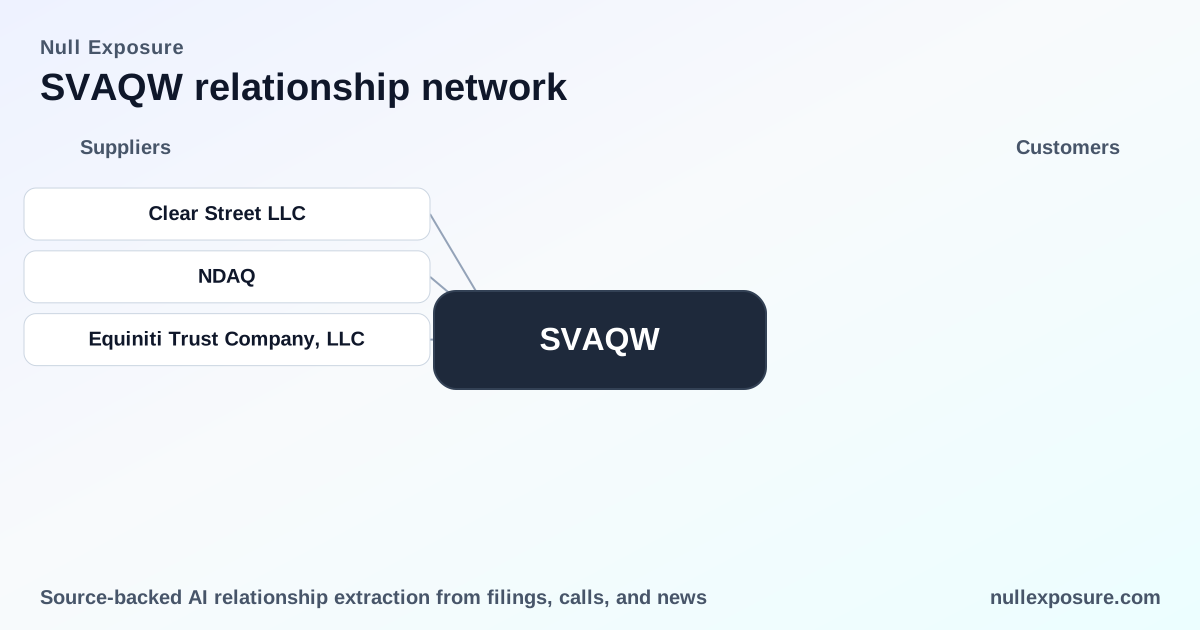
- Clear Street LLC functioned as the book‑running manager for the IPO process, a critical role that centralized underwriting and distribution.
- Nasdaq is the exchange listing the Class A shares and warrants (SVAQ / SVAQW), ensuring mainstream venue liquidity and regulatory visibility.
- Equiniti Trust Company, LLC is the transfer agent, enabling unit separation and shareholder recordkeeping procedures. For more supplier intelligence and deeper due diligence tools, go to https://nullexposure.com/.
Supplier relationships and source-by-source summaries
Clear Street LLC — underwriting and book‑running
Clear Street LLC acted as the lead or sole book‑running manager for Silicon Valley Acquisition Corp.’s initial public offering and related overallotment option, which is the core mechanism by which the SPAC raised its founding capital. According to a GlobeNewswire release carried by The Manila Times on January 8, 2026, Clear Street executed the over‑allotment closing in connection with the IPO, and Quiver Quantitative’s coverage of the IPO (FY2025/FY2026 reporting) confirms Clear Street’s role as lead book‑running manager. (Sources: GlobeNewswire/The Manila Times, Jan 8, 2026; Quiver Quantitative IPO reports, FY2025–FY2026.)
Nasdaq — exchange listing for shares and warrants
Nasdaq is the exchange designated for trading the separated securities; the Class A ordinary shares and warrants are expected to trade under the tickers “SVAQ” and “SVAQW,” respectively. Quiver Quantitative’s announcement describing trading options for the securities specifically noted the Nasdaq listing and the separate ticker assignments that enable liquidity for both equity and warrant holders. (Source: Quiver Quantitative trading notice, FY2025.)
Equiniti Trust Company, LLC — transfer agent and unit separation
Equiniti Trust Company, LLC is the transfer agent responsible for facilitating the separation of IPO units into Class A ordinary shares and warrants and for handling related shareholder recordkeeping through broker requests. Quiver Quantitative’s trading-options release outlines the process by which holders must instruct brokers to contact Equiniti to complete unit separation. (Source: Quiver Quantitative trading notice, FY2026.)
How these relationships shape operational risk and deal execution The observed supplier set reflects a standard SPAC operating posture: centralized underwriting, an established public exchange, and a professional transfer agent. From an investor and operator standpoint, that implies:
- Contracting posture: Externalized capital‑markets functions reduce internal execution burden but increase reliance on named vendors (underwriter and transfer agent) to perform against offering timelines.
- Concentration: Clear Street serving as sole book‑runner concentrates underwriting risk in one counterparty; underwriting performance and syndicate distribution capacity are material to deal success.
- Criticality: Nasdaq listing is critical to liquidity and investor convertibility; any listing or trading disruption would materially affect warrant valuation.
- Maturity: All three counterparties are recognized market participants, so operational maturity is high, limiting idiosyncratic operational failure risk but not removing market execution risk.
No supplier constraints were identified in the coverage provided, which is a company‑level signal: public sources included announcement and distribution reporting but did not surface contractual limitations, vendor disputes, or operational constraints tied to these providers. That absence is a positive governance signal but does not reduce the need for legal and commercial diligence before any merger or capital event.
Risk factors that investors and operators must weigh
- Single‑book‑runner concentration increases exposure to the underwriter’s execution capability and market reach during follow‑on transactions.
- Exchange dependency makes the SPAC sensitive to market‑wide trading halts and listing rule enforcement.
- Operational handoffs (broker → transfer agent → issuer) create settlement and separation timing risk that can temporarily suppress liquidity in early trading days.
Actionable next steps for diligence
- Verify underwriting agreements and any lock‑up or indemnity terms with Clear Street to quantify underwriter obligations and risk sharing.
- Confirm Nasdaq listing confirmations and any ongoing compliance milestones that could affect tradability.
- Validate transfer‑agent processes and timelines with Equiniti to model when warrants and shares become separately tradable and how that affects market supply.
If you want continuous monitoring of these supplier relationships and their evolving signals, start with our homepage for tailored supplier reports: https://nullexposure.com/.
Conclusion and investor guidance SVAQW’s supplier footprint—Clear Street (underwriter), Nasdaq (exchange), and Equiniti (transfer agent)—is consistent with a conventional SPAC that outsourced critical capital‑markets functions to recognized providers. That structure provides operational readiness and liquidity channels but concentrates some execution risk in named vendors. Investors evaluating SVAQW should prioritize verification of underwriting terms, listing confirmations, and transfer‑agent mechanics ahead of any exposure to the warrant class.
For a deeper supplier-risk profile and ongoing alerts tied to these counterparties, review our platform at https://nullexposure.com/.