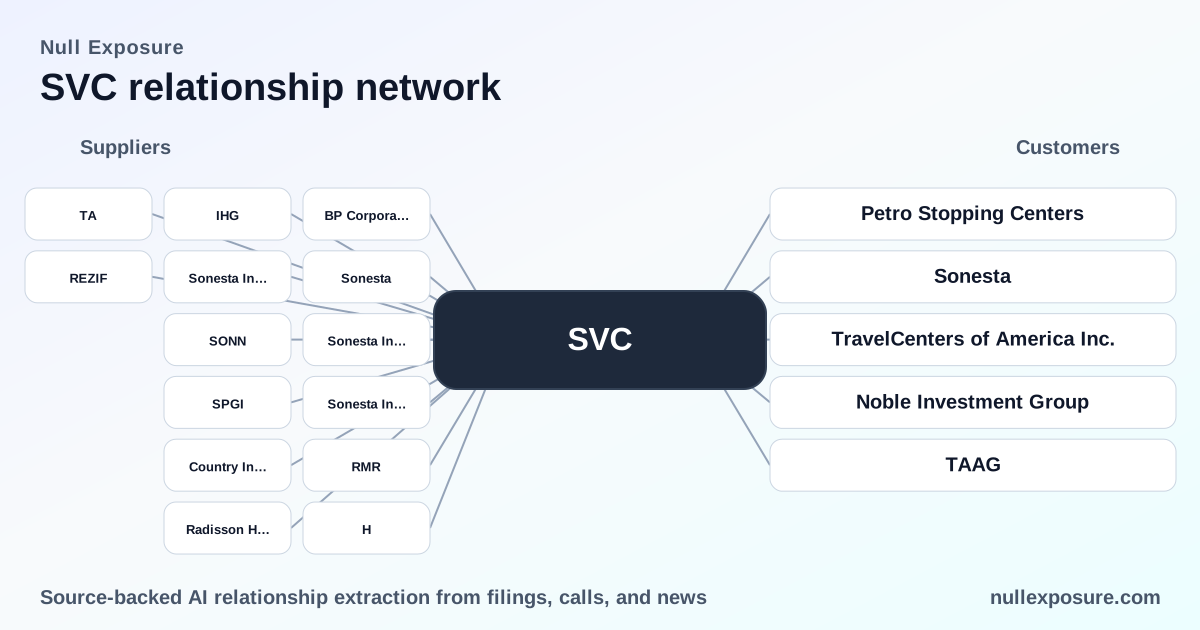
Service Properties Trust (SVC): Supplier map, contractual posture, and what investors should price in
Service Properties Trust (SVC) is a hotel- and net-lease-focused REIT that monetizes real estate through long-term leases, third-party management agreements and selective asset sales — collecting rents, owner-priority returns and fee income while outsourcing hotel operations to branded managers. Investors should evaluate SVC as an owner/operator hybrid where property-level cash flows depend heavily on a handful of service providers and long-duration finance instruments. For a concise supplier-risk briefing and commercial due diligence, start here: https://nullexposure.com/
What you need to know in one line
SVC is asset-heavy, concentrated on North American hospitality and travel centers, and runs with long-term financing and management contracts that create both predictable income and single-counterparty concentration risk.
Who runs SVC’s hotels and travel centers — relationship roll call
Below are the supplier relationships surfaced in SVC materials and market coverage, each distilled to one or two sentences with source attribution.
-
BP Corporation North America Inc.
BP provides a payment guarantee for the TA travel‑center leases up to an aggregate cap, giving SVC a partial credit support mechanism on those leased assets. This is disclosed in SVC’s 2024 Form 10‑K. -
Sonesta / Sonesta International / Sonesta International Hotels Corp. / Sonesta International Hotels
Sonesta is SVC’s dominant hotel operator: the 2024 10‑K shows Sonesta historically operated 181 of SVC’s hotels and the companies have negotiated long-term management and franchising arrangements, including a 15‑year management agreement for 59 hotels and an arrangement for Sonesta to franchise or manage 114 hotels being sold — with SVC retaining a minority stake in Sonesta per March 2026 press coverage. (SVC 2024 10‑K; HotelInvestmentToday, AsianHospitality, HotelManagement, March 2026.) -
The RMR Group / The RMR Group LLC
SVC is externally managed by RMR, which originates transactions and provides management services; the two parties amended their business management agreement on January 1, 2026 to change the incentive‑fee benchmark and termination assessment. (The RMR news releases and SVC filings; The Globe and Mail; SVC 2024–2025 press coverage.) -
Hyatt (including Hyatt Place)
Hyatt subsidiaries manage a tranche of SVC hotels (17 Hyatt-branded properties at the 2024 report date), giving SVC exposure to Hyatt’s systems and franchise economics. (SVC 2024 10‑K; TradingView reporting, TheRealDeal coverage on portfolio composition.) -
IHG / Crowne Plaza
IHG manages at least one SVC property in the portfolio (Crowne Plaza referenced among hotel-brand line items), representing a small but branded operating relationship. (Portfolio summary in market coverage, TheRealDeal; TradingView summarizing 2025 filing.) -
Radisson / Country Inns & Suites by Radisson / Radisson Hotels & Resorts
Radisson family brands operated several SVC hotels (seven Radisson properties noted), reflecting SVC’s multi‑brand operating mix across full‑ and select‑service hotels. (TheRealDeal portfolio summary; SVC 2024–2025 filings and coverage.) -
TA (TravelCenters of America)
TA operates travel centers SVC leases; SVC leased 175 travel centers to TA historically, representing roughly 28.7% of historical real estate investments and creating significant cash‑flow concentration in travel‑center rents. (SVC 2024 10‑K disclosure.) -
S&P (credit ratings referenced for securitizations)
In connection with ABS issuance tied to net‑lease assets, S&P ratings were applied to tranches (Class A AAA, Class B AA, Class M BBB) as reported in transaction summaries of SVC’s 2026 securitization activity. (TradingView transaction summary, March 2026.) -
Other brand mentions (Hyatt Place, Crowne Plaza, Country Inns & Suites by Radisson)
These brand mentions in filings and press coverage reflect the granular composition of SVC’s hotel portfolio and the mix of franchise versus management agreements across brands. (TheRealDeal and related press coverage summarizing SVC portfolio composition, 2025–2026.)
Contracting posture, concentration and maturity — how SVC’s operating model reads
SVC’s relationship profile is shaped by long‑dated contracts, geographic concentration in North America, and a reliance on a few large service providers.
-
Long-term contracts dominate. SVC discloses numerous long‑dated debt instruments and a weighted average hotel agreement term of roughly 11.9 years (not counting manager renewal options), and Sonesta’s agreement itself runs to 2037 with additional renewal options, which produces predictable near‑term cash flow and lender comfort. (10‑K debt table and contract term disclosures.)
-
Concentration is material and critical. Sonesta historically operated half of SVC’s historical REI and TA-related travel centers accounted for nearly 29% of historical investments, creating single‑counterparty concentration that is operationally critical to run‑rate cash flows. (10‑K operational concentration disclosures.)
-
Relationships are service‑provider focused and active. Management, reservation, marketing and system fees with Sonesta and management agreements with RMR dominate the services segment; these are active commercial relationships rather than passive licensing arrangements. (10‑K fees and management agreement descriptions.)
-
Finance maturity is staggered but significant. SVC’s capital structure includes senior unsecured and secured notes out to the early 2030s, and securitizations with multi‑class tranches — a structure that imposes refinancing and covenant focus for investors. (10‑K debt schedule and transaction reporting.)
-
Spend magnitude is nontrivial. Evidence of high spend bands for financing and secured notes indicates large capital requirements and asset‑level leverage that align with institutional REIT behavior. (10‑K debt and ABS note sizes.)
Investor implications — risk, optionality and what to underwrite
-
Concentration risk demands counterparty diligence. Sonesta and TA collectively represent the bulk of hotel and travel‑center cash flows; pricing models must stress scenarios where a major operator restructures fees, exercises termination/renewal options, or where brand performance compresses owner‑priority returns. (10‑K operational concentration; March 2026 Sonesta transaction reporting.)
-
External management adds governance and incentive sensitivity. RMR’s role and the January 2026 amendment to incentive‑fee benchmarks change the alignment calculus between manager and shareholders; investors should review the new benchmark and termination triggers when modeling incentives. (Globe and Mail and SVC press on management‑agreement amendment.)
-
Debt and securitization profiles set refinancing risk. Staggered notes through 2031–2032 and ABS tranches with ratings require monitoring of market access and spread volatility, especially if asset sales slow or cap rates move. (10‑K debt table; March 2026 ABS reporting.)
-
Partial credit support exists but is limited. BP’s guarantee on TA leases provides incremental protection, but it is described as limited to an aggregate cap, so investors must not assume unlimited indemnity. (SVC 2024 10‑K guarantee disclosure.)
If you want a structured supplier‑risk memo or a counterparty stress matrix for SVC, we publish tailored briefings and scoring frameworks at Null Exposure — explore analyst resources here: https://nullexposure.com/
Final takeaways and action points
- SVC’s income is durable but concentrated: long-term contracts and branded managers provide predictable cash flows, yet the company is materially exposed to a few large operators (notably Sonesta and TA) and an external manager (RMR).
- Governance and financing are active levers: the RMR amendment and recent asset sales or securitizations materially influence shareholder economics and refinancing pathways.
- Underwrite counterparty scenarios: model haircut scenarios for Sonesta/TA, test manager incentive changes, and stress ABS refinance spreads.
For a bespoke supplier-risk assessment or valuation impact memo tailored to SVC’s capital stack, contact our team or review service offerings at https://nullexposure.com/ — our analyst notes translate these relationship maps into actionable valuation adjustments.